Red-Tape and Neglect Can Strangle
p. 89 · Read in the full issue
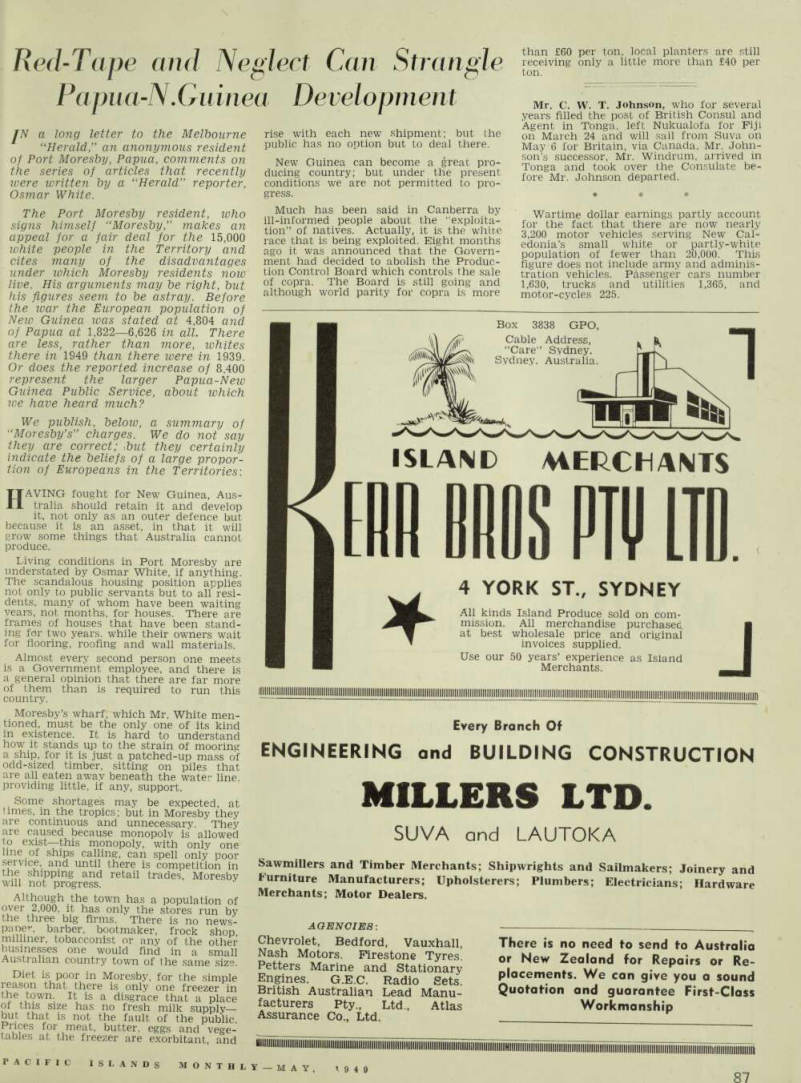
Papua-N.Guinea Development
I” a long letter to the Melbourne “Herald,” an anonymous resident of Port Moresby, Papua, comments on the series of articles that recently were written by a “Herald” reporter , Osmar White.
The Port Moresby resident, who signs himself “Moresby,” makes an appeal for a fair deal for the 15,000 lohite people in the Territory and cites many of the disadvantages under which Moresby residents noiv live. His arguments may be right, but his figures seem to be astray. Before the war the European population of New Guinea was stated at 4,804 and of Papua at 1,822—6,626 in all. There are less, rather than more, whites there in 1949 than there were in 1939.
Or does the reported increase of 8,400 represent the larger Papua-New Guinea Public Service, about which ice have heard much?
We publish, below, a summary of
“Moresby’s” charges. We do not say they are correct; but they certainly indicate the beliefs of a large propor tion of Europeans in the Territories : HAVING fought for New Guinea, Aus tralia should retain it and develop it, not only as an outer defence but because it is an asset, in that it will grow some things that Australia cannot produce.
Living conditions in Port Moresby are understated by Osmar White, if anything.
The scandalous housing position applies not only to public servants but to all resi dents, many of whom have been waiting vears, not months, for houses. There are frames of houses that have been stand ing for two years, while their owners wait for flooring, roofing and wall materials.
Almost every second person one meets is a Government employee, and there is a general opinion that there are far more of them than is required to run this country.
Moresby’s wharf, which Mr. White men tioned, must be the only one of its kind in existence. It is hard to understand how it stands up to the strain of mooring a ship, for it is just a patched-up mass of odd-sized timber, sitting on piles that are all eaten away beneath the wate** line, providing little, if any, support.
Some shortages may be expected, at times, in the tropics; but in Moresby they are continuous and unnecessary. They are caused because monopoly is allowed to exist —this monopoly, with only one line of ships calling, can spell only poor service, and until there is competition in the shipping and retail trades, Moresby will not progress.
Although the town has a population of over 2,000, it has only the stores run by the three big firms. There is no news paner, barber, bootmaker, frock shop milliner, tobacconist or any of the other businesses one would find in a small Australian country town of the same size.
Diet is poor in Moresby, for the simple reason that there is only one freezer in the tctwn. It is a disgrace that a place of this size has no fresh milk supply— but that is not the fault of the public Prices for meat, butter, eggs and vege tables at the freezer are exorbitant, and
rise with each new shipment; but (he public has no option but to deal there.
New Guinea can become a great pro ducing country; but under the present conditions we are not permitted to pro gress.
Much has been said in Canberra by ill-informed people about the “exploita tion” of natives. Actually, it is the white race that is being exploited. Eight months ago it was announced that the Govern ment had decided to abolish the Produc tion Control Board which controls the sale of copra. The Board is still going and although world parity for copra is more
than £6O per ton, local planters are still receiving only a little more than £4O per ton.
Mr. C. W. T. Johnson, who for several years filled the post of British Consul and Agent in Tonga, left Nukualofa for Fiji on March 24 and will sail from Suva on May 6 for Britain, via Canada. Mr. John son’s successor, Mr. Windrum, arrived in Tonga and took over the Consulate be fore Mr. Johnson departed, * * * Wartime dollar earnings partly account for the fact that there are now nearly 3,200 motor vehicles serving New Cal edonia’s small white or partly-white population of fewer than 20,000. This figure does not include army and adminis tration vehicles. Passenger cars number 1,630, trucks and utilities 1,365, and motor-cycles 225.