In Dispute
p. 75 · Read in the full issue
Tongan Chiefly Title
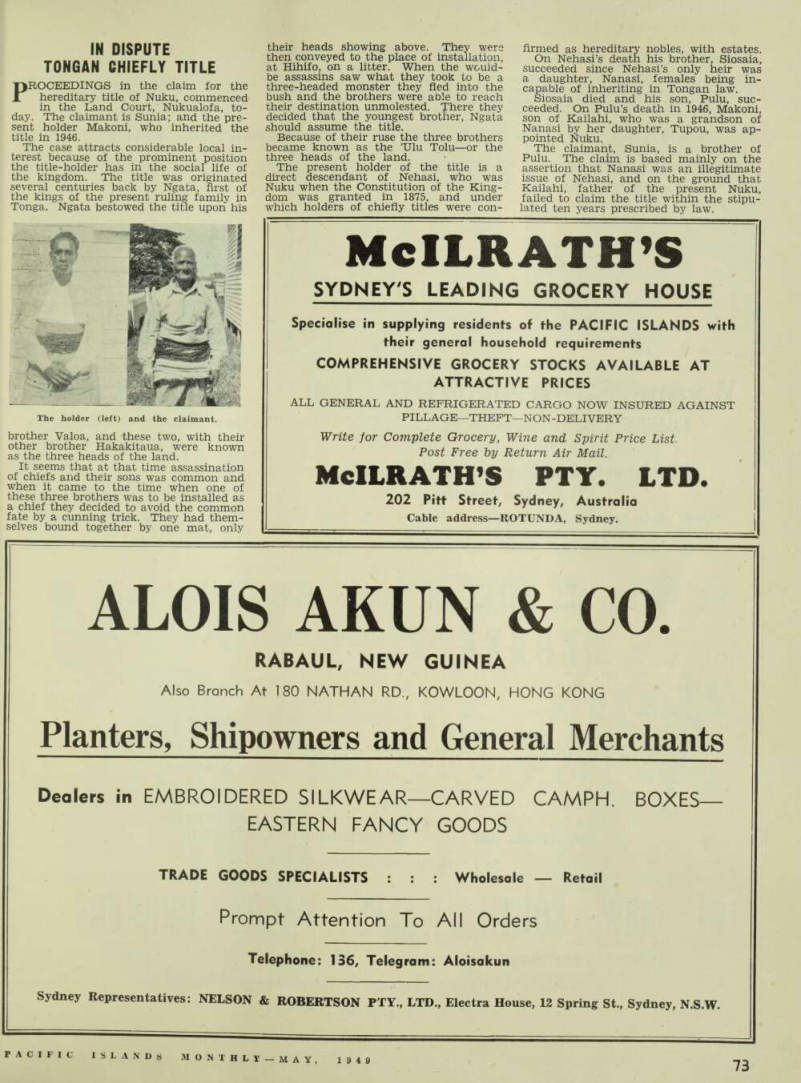
PROCEEDINGS in the claim for the hereditary title of Nuku, commenced in the Land Court, Nukualofa, to day. The claimant is Sunia; and the pre sent holder Makoni, who inherited the title in 1946.
The case attracts considerable local in terest because of the prominent position the title-holder has in the social life of the kingdom. The title was originated several centuries back by Ngata, first of the kings of the present ruling family in Tonga. Ngata bestowed the title upon his
their heads showing above. They were then conveyed to the place of installation, at Hihifo, on a litter. When the would be assassins saw what they took to be a three-headed monster they fled into the bush and the brothers were able to reach their destination unmolested. There they decided that the youngest brother, Ngata should assume the title.
Because of their ruse the three brothers became known as the ’Ulu Tolu —or the three heads of the land.
The present holder of the title is a direct descendant of Nehasi, who was Nuku when the Constitution of the King dom was granted in 1875, and under which holders of chiefly titles were con
firmed as hereditary nobles, with estates.
On Nehasi’s death his brother, Siosaia, succeeded since Nehasi’s only heir was a daughter, Nanasi, females being in capable of inheriting in Tongan law.
Siosaia died and his son, Pulu, suc ceeded. On Pulu’s death in 1946, Makoni, son of Kailahi, who was a grandson of Nanasi by her daughter, Tupou, was ap pointed Nuku.
The claimant, Sunia, is a brother of Pulu. The claim is based mainly on the assertion that Nanasi was an illegitimate issue of Nehasi, and on the ground that Kailahi, father of the present Nuku, failed to claim the title within the stipu lated ten years prescribed by law.
The holder (left) and the claimant. brother Valoa, and these two, with their other brother Hakakitaua, were known as the three heads of the land.
It seems that at that time assassination of chiefs and their sons was common and when it came to the time when one of these three brothers was to be installed as a chief they decided to avoid the common fate by a cunning trick. They had them selves bound together by one mat, only