Planners May Overlook Import
p. 56 · Read in the full issue
Education Progress In New
Guinea
Planners May Overlook Import ance of Economic Development
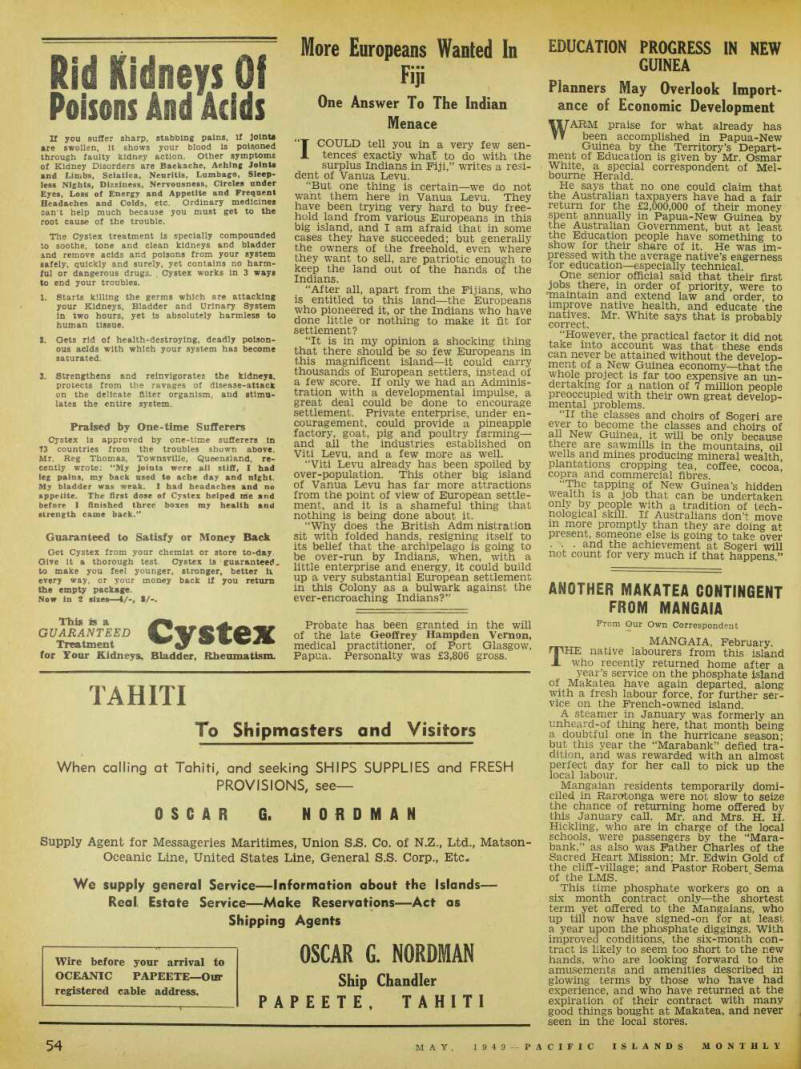
WARM praise for what already has been accomplished in Papua-New Guinea by the Territory’s Depart ment of Education is given by Mr. Osmar White, a special correspondent of Mel bourne Herald.
He says that no one could claim that the Australian taxpayers have had a fair return for the £2,000,000 of their money spent annually in Papua-New Guinea by the Australian Government, but at least the Education people have something to show for their share of it. He was im pressed with the average native’s eagerness for education—especially technical.
One senior official said that their first jobs there, in order of priority, were to 'maintain and extend law and order, to improve native health, and educate the natives. Mr. White says that is probably correct.
“However, the practical factor it did not take into account was that these ends can never be attained without the develop ment of a New Guinea economy—that the whole project is far too expensive an un dertaking for a nation of 7 million people preoccupied with their own great develop mental problems.
“If the classes and choirs of Sogeri are ever to become the classes and choirs of a h New Guinea, it will be only because there are sawmills in the mountains, oil wells and mines producing mineral wealth, plantations cropping tea, coffee, cocoa, copra and commercial fibres.
“The tapping of New Guinea’s hidden wealth is a job that can be undertaken only by people with a tradition of tech nological skill. If Australians move in more promptly than they are doing a* present, someone else is going to take over . . . and the achievement at Sogeri will not count for very much if that happens ”