Tropicalities
p. 50 · Read in the full issue
MALARIA cures come, and malaria cures go: Quinine, plasmaquin, atebrin, paludrine—tropic dwellers know them all.
Each was supposed to have advantages over its immediate predecessor. Palu drine was the latest development, hailed, as atebrin was before it, as a drug that would get the wog “right out of your sys tem.”
Nov/, the British medical profession seems to be having second thoughts about paludrine. It is reported that results from the use of it have not been as satisfactory in India and Africa as they are in New Guinea, and early hopes that it would prove the solution to all the problems in the treatment of malaria are being reconsidered. In some respects paludrine is stated to be inferior to atebrin.
The technical name for paludrine is Proguanil, and, discussing the experiences of over three years of its use, a leading article in the British Medical Journal concludes that “it is doubtful whether the ideal drug either for the prophylaxis or radical cure of malaria has yet been discovered.”
Well—here’s still hoping. In the mean time, it appears that those hide-bound conservatives—the quinine addicts—might be doing as well as the rest of us who will try anything new—MAC. * * *
Ravuama Vunivalu, Ba (Auck
land), the first Fijian Morris Hed strom Scholar, who is now doing post-graduate work at Cambridge, rocked the university with a report to an inter viewer from a students’ newspaper, said Dr. J. W. Davidson, lecturer in Colonial Affairs, who recently passed through Nadi Airport.
The interviewer started inauspiciously by asking: “I understand that your grand father had well, certain cannibalistic propensities?”
“Good heavens,” replied Ravuama; don t tell me someone’s missing from my floor!”
The interview went no further. * « * Lieut. -colonel elliott-smith. formerly well known as a Resident Magistrate in Papua during Sir Hubert Murray’s regime, is now settled near Mildura, Victoria, where he is fruit farming and likes the life and conditions in that progressive area.
He commanded a particularly smart battalion of the Papuan Infantry during the war, and those who were present will recollect how, at a big parade for General Blarney at Torokina, he and his native soldiers completely “stole the show.”
Old-Timers in Papua will recall his ability, during his term as Resident Magistrate, to verbally flay native evil doers, whilst fully preserving the dignity of the Court. In appearance and manner he was a kind of local “Sanders of the River.”
This Territory of Papua-New Guinea can ill spare these experienced officers of the old Papuan Regiment—especially in these times of native dissatisfaction and bewilderment, brought about by existing conditions.—Special Correspondent. * * * MR. C. F. CORBETT, of Suva—pre sumably misquoted by the “New Zealand Herald,” Auckland is alleged to have said that a meat-ration ing system would be impossible in Fiji because “many Fijians who, for religious or other reasons, did not eat meat, would probably sell their ration coupons and create a black market.”
The Fijian reaction to this is vitriolic— black marketing in Fiji being almost ex clusively an Asiatic preserve. The mis take probably rises from the' overseas ob servation that anybody in Fiji may be called a Fijian with impunity—S.
H* $ A hard-bitten resident of Suva was asked to make a donation to some Fiji- Indian institution.
“Certainly,” he replied, “I will give £5O to the Indian Returned Soldiers Associa tion, and another £2O to the Indian Nurses- Association.”
They are still thinking it out. ❖ ❖ ❖ pLAGUES of giant snails apparently are not new. According to the following extract from the “Crown Colonist” they had an attack in Ceylon 40 years ago. The correct term, in Ceylon, however, is “pest of snails.”
Otherwise there appears little differ
mice between that visitation and the one that is the aftermath of war in some of the Pacific Islands: A PEST of snails in Ceylon of about 40 years ago is recalled by a writer to “The Manchester Guardian.” Gigantic snails, he writes, appeared south of Colombo and proceeded to devour vegetation of all kinds and pollute the water of the wells. “In an incredibly short time the roads, the trunks of trees, the walls of houses, and the gardens were covered with these monsters.”
Their shells were later found to be seven to nine inches in length, and they weighed two pounds and more. On in quiry it was found that the snail was Ac hatma fulica, a species from Mauritius. A single specimen had been brought to Cey lon by a traveller and had multiplied, its offspring developing in Ceylon far beyond the usual size.
WE have had several letters about the Marquis de Rays millstone (see PIM of February and March).
It appears that it was brought in from Port Breton by Harbour Master Webb at the request of the Administrator, the late Sir Ramsay McNicoll, following a visit to Rabaul and Port Breton of Mademoiselle J. H. Niau. Mdme. Niau was the daughter of one of the Port Breton settlers; she later wrote a book about the venture called “Phantom Paradise.”
After the eruption of 1937, the old stone was lying around the Rabaul fore shore. The tidal wave than preceded the eruption demolished the PWD building, which was then built very close to the shore, and when a very modern establish ment was built to replace it (see photo graph, March PIM) in the record time of four weeks, the old stone was brought along to give it a finishing touch. The stone way temporarily mounted slant wise but was later mounted upright, and in this position survived the Japanese occupation and the Allied blitz.
The Japanese inscription which has caused a certain amount of conjecture (it was suggested that it might be some Jap war-winning slogan) means “This is where the mosquito-larvae-eating-fish (Gambusia) are kept” or, in other words, the “Malaria-control unit.”
When the Australian army re-occupied the area in 1945, they set up their dry canteen on the site of the PWD building —only a concrete floor and the strong room remained. When the Australian Army, in its turn, moved out, the premises were taken over by the Com monwealth Bank who were glad to make use of the strong-room.
The original bronze plate which was affixed to the stone shortly before the outbreak of World War II disappeared during the occunation —apparently taken by some Jap soldier. It has been suggested that, one of these days when Rabaul is in a more reconstructed state, Wun derlich, who supplied the original plate may make another, with some mention of the stone’s survival.
We think that this is an excellent idea and worthy of consideration by some public body in Rabaul.
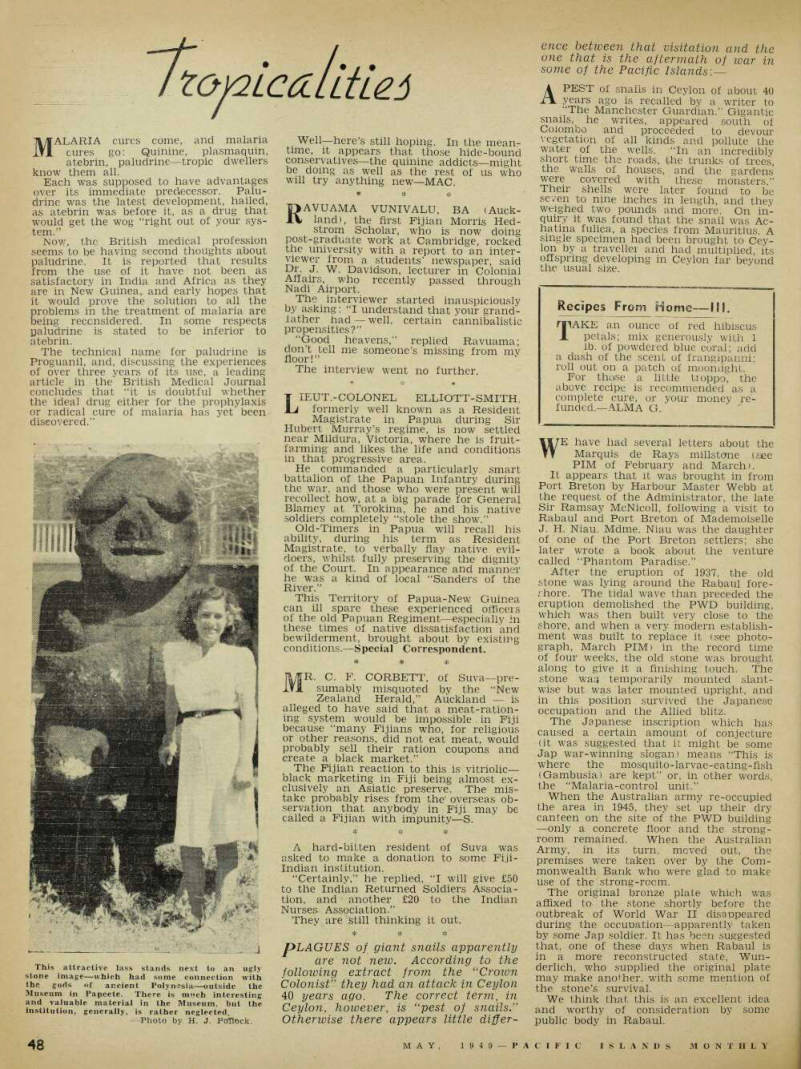
This attractive lass stands next to an ugly stone image—which had some connection with the gods of ancient Polynesia—outside the Museum in Papeete. There is much interesting and valuable material in the Museum, but the institution, generally, is rather neglected. —Photo by H. J. PoTlock.