Tabiteuea
pp. 48-49 · Read in the full issue
We Visit
By Brett Milder
rpHE Gilbertese atoll of Tabiteuea is L first sighted as a string of tree-tops along the horizon, soon marked by breakers, for the trees are only visible about 10 miles, and reefs extend out half this distance to the westward. Being 30 miles long, this is the largest atoll in the Gilberts, but the string of islets which form it cannot add up to more than 15 square miles. This dry land is a flat bank of coral debris, up to 10 feet high, and with no real soil. Considering the mean annual rainfall is 30 inches, the number of coconut and other trees that do grow upon it is surprising.
On closing the coastline we find that the compass bearings refuse to fit to gether, as the plan of the island was made in a hurry in 1841, by the American Ex ploring Expedition under Commodore Wilkes. The anchorage is found in 7 fathoms at the edge of the western reefs, but instead of being one mile off the shore, as shown by the chart, the island is a good four miles away.
Setting out from the ship in the launch, the island is still just a line on the hori zon, and after running over and between the coral patches for half an hour, the launch grounds on the shallows and it is necessary to take to wading. It is about a mile through the shallow water and over the tidal flats to the actual beach head —that is the penalty for not arriving at high water, when the launch can get right up to the landing.
At the landing we find the Government Station, with the flagpole guarded by an ancient cannon, and dominated by the huge walls of the old gaol, which would have done credit to the convict ruins of Port Arthur, Tasmania.
The village of Utiroa stretches along the tidy coastal road to the southward, where I found the famous canoe, “Teraia n-Tabiteuea,” hidden under a low shelter of thatch, and therefore, very difficult to photograph. It is one of the few survi vors in the Gilberts of the old-time canoes for inter-island voyages, but it is no longer regarded as seaworthy, owing to the work of the borers. This island flagship is 66 feet long, and just over 6 feet high, be ing built up of imported planks with the keel, stem and stern, and outrigger made of the local but (in the Gilberts) rare tree named Calophyllum. The name oi
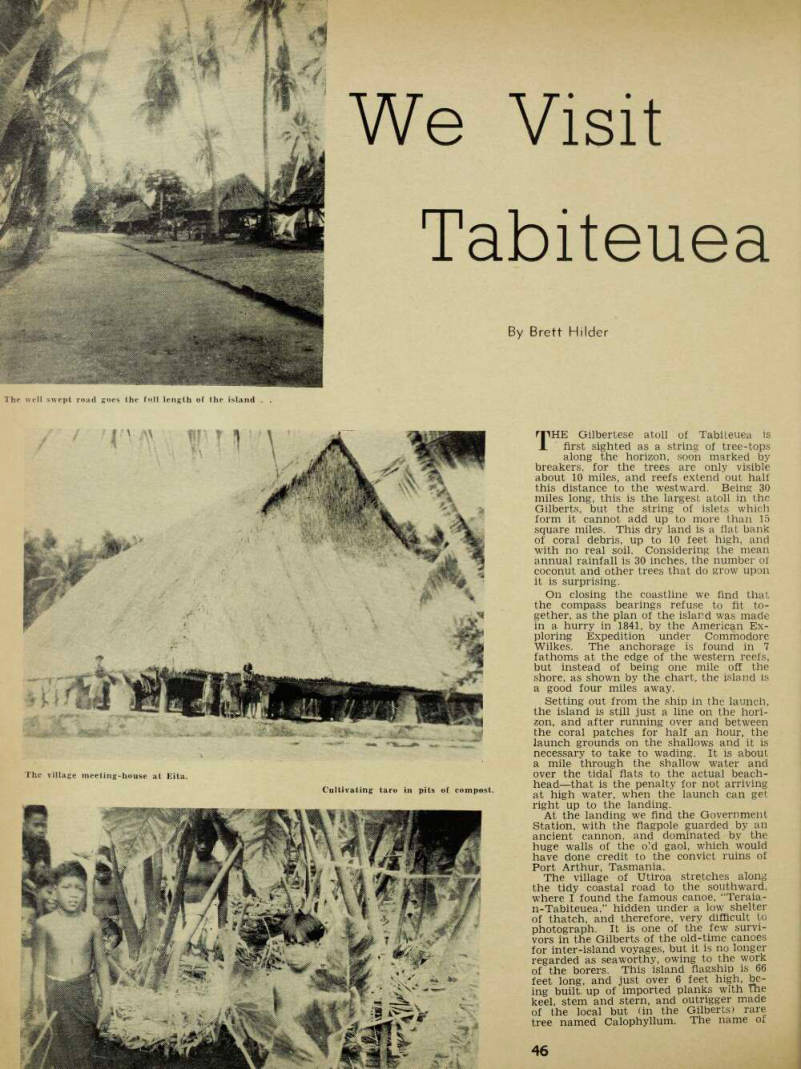
The well swept road goes the full length of the island . .
The village meeting-house at Eita.
Cultivating taro in pits of compost.
the vessel means the “sighting of Tabi teuea”—a good landfall after a long, deep sea voyage.
The other canoes used by the natives are small craft for fishing, and these may be seen many miles from land. Fishing is also done by men just swimming along the reefs, with lines or spears and a small float. There is a special guild of shark fishermen, who are said to catch some of the sharks with a rope noose when they are sleeping. Certainly fish is the main food of the islanders, after the coconut, and everything that comes out of the sea has a fair wind to the cooking pot.
I have seen pieces of baby whale, or “blackfish” being eaten, and besides the sharks, clamshells and octopus there is an occasional Greenback turtle.
The only trouble with the fish is that the local ones are toxic, and if eaten more than two or three times a week, are liable to produce the usual signs of fish poisoning. The deep-sea fish, and the mi gratory types like Tuna, are free from this trouble, which is so widespread in the Pacific.
It is quite true that the main food of the Gilbertese is the coconut, and I have often seen them eating part of the husk, that soft part of a green nut near the milk holes. The shortage of water on the atolls makes the value of the coconut milk greater than usual, so that most nuts are taken and eaten in their green state.
NEXT to the coconut is taro, called “ba-bai” with accent on the second syllable. This plant takes more work to cultivate than all the other household chores put together, for besides being slow-growing, it requires water and soil to grow in, and that, on an atoll, is like asking a Sydney publican for bottled beer to take home. The ba-bai is grown in pits about six feet deep, which, there on the atoll, is nearly down to sea level, and the muddy, brackish water which colled s in the pits is protected by the shade of the trees, generally remaining about a foot deep.
The taro plants are carefully nurtured in artificial soil, made from compost of the dead leaves and vegetation of the whole island, the rotting pulp of fallen coconut palms, and perhaps some sand, ashes and other more secret ingredients.
This compost is banked around the stalks of the plants, and held in place by wreathes of leaves forming a coffer-dam One result of this laborious work is that the island is kept tidy and clean, for every leaf that falls is gathered up in small baskets for the ba-bai pits. The only gap in the total soil economy is the loss of human nitrogenous was e, for that goes out to sea, probably to lessen the dangers of earth-borne worms and dis eases.
The fruit of the Pandanus in the Gil berts is more edible than other island varieties, and is chewed raw or cooked into a thick, sweet jam which is laid out in the sun to dry in sheets. It helps to colour the flat diet.
During the lean years of drought the natives are forced onto still more primi tive foods like berries and a type of fig, and small tubers, about an inch long, which grow just below the surface. In the more civilised islands like Tarawa, the Government issues rations of European food, but during our November visits to Tabiteuea there were not even any staple foods for sale in the trade-store. Before the Group was brought under control the problem of overpopulation was eased by tribal wars and the practice of infanti cide, and some very forcible invasions and migrations must have taken place. natives are Micronesians like the rest of the Gilbertese, and if their individual variations are any criterion, their racial mixing must have
been still proceeding until recent times.
The men look like Japanese, Mongols or Thibetans, while the women vary between Tamils. Malays, Filipinos, and Balinese— partly depending upon their hair-do and their types of clothing. At home on their island the women wear grass skirts, and the men loin-cloths, both sexes generally wearing shorts or pants of some sort un derneath, while a married woman will generally cover her bosom with any spare piece of cloth when met by a European.
Before the war there had been British, Chinese and Japanese trading in the Group, American, French and London missionaries, and various stray seamen wandering through the islands, including Germans from the Marshalls, so that some of the Caucasian, Aryan and Mongolian racial strains may not be very remote in their origin. 11HE legend about a red-bearded man, castaway on Beru about 1568, seems to have influenced a number of natives who show very tawny strains in their otherwise straight black hair. The natives vary in skin colouring through all the browns from ochre to mahogany, but there is an undercoat of yellow, with the sun-tan on top, and a further layer of black due to the lack of fresh water and soap. The women are particularly averse to cleanliness, and I think that if the women of Tabiteuea were carefully scraped down there would be enough black soil to fill all the ba-bai pits. All the natives are well-built, and appear physically fit without showing any signs of fatness or even plumpness. The men are more hir sute than the average Asiatic, but show no body-hair.
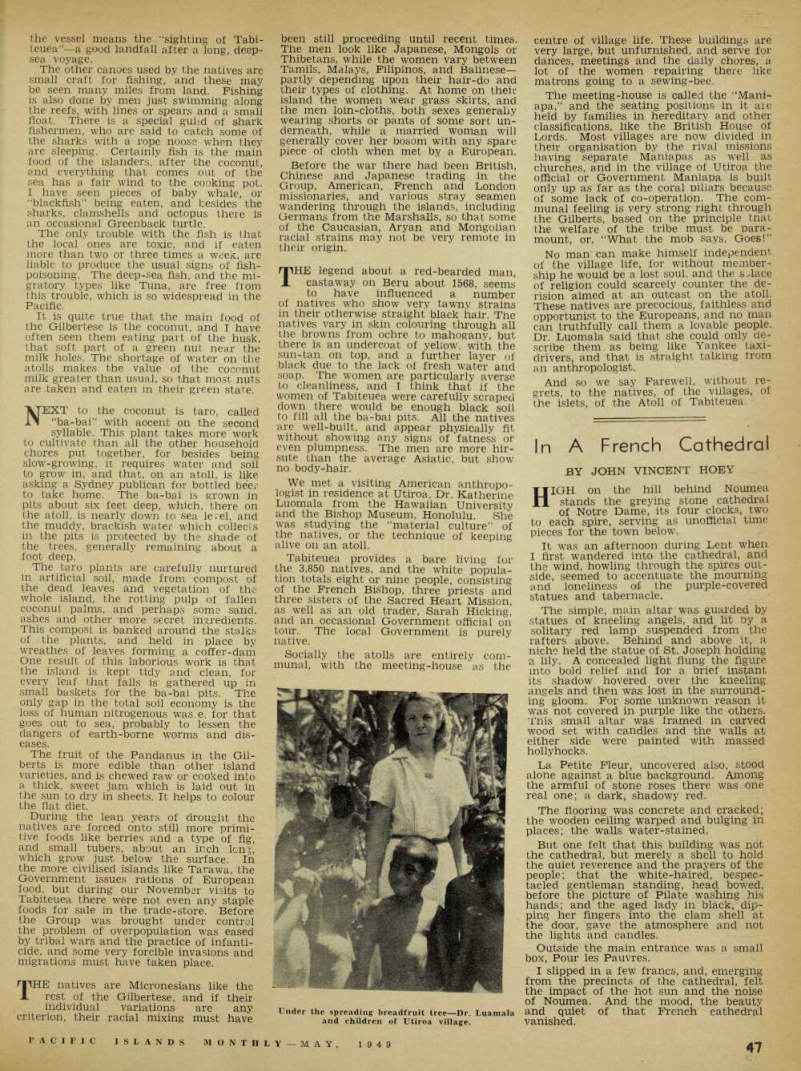
We met a visiting American anthropo logist in residence at Utiroa, Dr. Katherine Luomala from the Hawaiian University and the Bishop Museum, Honolulu. She was studying the “material culture” of the natives, or the technique of keeping alive on an atoll.
Tabiteuea provides a bare living for the 3,850 natives, and the white popula tion totals eight or nine people, consisting of the French Bishop, three priests and three sisters of the Sacred Heart Mission, as well as an old trader, Sarah Kicking, and an occasional Government official on tour. The local Government is purely native.
Socially the atolls are entirely com munal, with the meeting-house as the
centre of village life. These buildings are very large, but unfurnished, and serve for dances, meetings and the daily chores, a lot of the women repairing there like matrons going to a sewing-bee.
The meeting-house is called the “Mani apa,” and the seating positions in it aie held by families in hereditary and other classifications, like the British House of Lords. Most villages are now divided in their organisation by the rival missions having separate Maniapas as well as churches, and in the village of Utiroa the official or Government Maniapa is built only up as far as the coral pillars because of some lack of co-operation. The com munal feeling is very strong right through the Gilberts, based on the principle tnat the welfare of the tribe must be para mount, or, “What the mob says, Goes!”
No man can make himself independent of the village life, for without member ship he would be a lost soul, and the solace of religion could scarcely counter the de rision aimed at an outcast on the atoll.
These natives are precocious, faithless and opportunist to the Europeans, and no man can truthfully call them a lovable people.
Dr. Luomala said that she could only de scribe them as being like Yankee taxi drivers, and that is straight talking from an anthropologist.
And so we say Farewell, without re grets, to the natives, of the villages, of the islets, of the Atoll of Tabiteuea.
Under the spreading breadfruit tree—Dr. Luamala and children of Utiroa village.