How a War Club Became
p. 47 · Read in the full issue
an Emblem of Peace
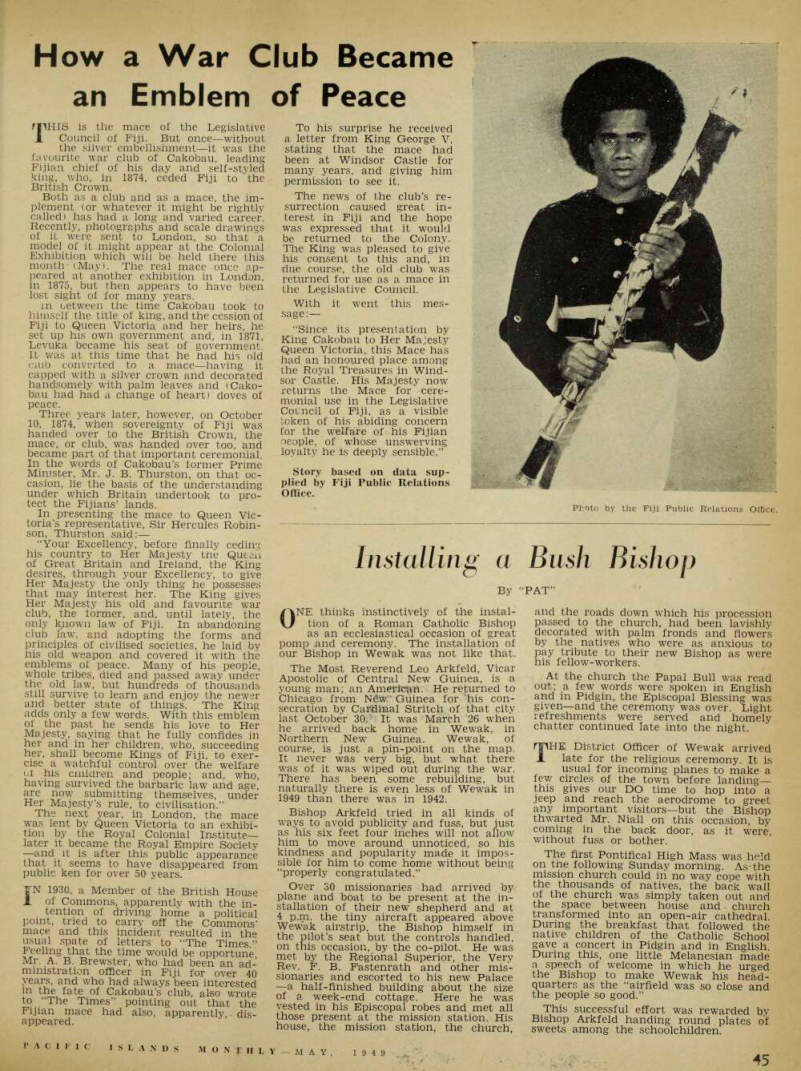
riIHIS is the mace of the Legislative 1 Council of Fiji. But once—without the silver embellishment —it was the favourite war club of Cakobau, leading Fijian chief of his day and self-styled king, who, in 1874, ceded Fiji to the British Crown.
Both as a club and as a mace, the im plement (or whatever it might be rightly called) has had a long and varied career.
Recently, photographs and scale drawings of it were sent to London, so that a model of it might appear at the Colonial Exhibition which will be held there this month (May). The real mace once ap peared at another exhibition in London, in 1875, but then appears to have been lost sight of for many years. in between the time Cakobau took to himself the title of king, and the cession oi Fiji to Queen Victoria and her heirs, he set up his own government and, in 1871, Levuka became his seat of government.
It was at this time that he had his old emb converted to a mace—having it capped with a silver crown and decorated handsomely with palm leaves and (Cako bau had had a change of heart) doves of peace.
Three years later, however, on October 10, 1874, when sovereignty of Fiji was handed over to the British Crown, the mace, or club, was handed over too, and became part of that important ceremonial.
In the words of Cakobau’s former Prime Minister, Mr. J. B. Thurston, on that oc casion, lie the basis of the understanding under which Britain undertook to pro tect the Fijians’ lands.
In presenting the mace to Queen Vic toria’s representative, Sir Hercules Robin son, Thurston said:— “Your Excellency, before finally ceding his country to Her Majesty the Queen of Great Britain and Ireland, the King desires, through your Excellency, to give Her Majesty the only thing he possesses that may interest her. The King gives Her Majesty his old and favourite war club, the iormer, and, until lately, the only known law of Fiji. In abandoning club law, and adopting the forms and principles of civilised societies, he laid by his old weapon and covered it with the emblems of peace. Many of his people, whole tribes, died and passed away under the old law, but hundreds of thousands still survive to learn and enjoy the newer and better state of things. ‘ The King adds only a few words. With this emblem of the past he sends his love to Her Majesty, saying that he fully confides in her and in her children, who, succeeding her, shall become Kings of Fiji, to exer cise a watchful control over the welfare of his cmidren and people; and, who, having survived the barbaric law and age, are now submitting themselves, under Her Majesty’s rule, to civilisation.”
The next year, in London, the mace was lent by Queen Victoria to an exhibi tion by the Royal Colonial Institute— later it became the Royal Empire Society —and it is after this public appearance that it seems to have disappeared from public ken for over 50 years.
IN 1930, a Member of the British House of Commons, apparently with the in tention of driving home a political point, tried to carry off the Commons’ mace and this incident resulted in the usual spate of letters to “The Times.”
Feeling that the time would be opportune Mr. A. B. Brewster, who had been an ad ministration officer in Fiji for over 40 years, and who had always been interested in the fate of Cakobau’s club, also wrote to “The Times” pointing out that the Fijian mace had also, apparently, dis appeared.
To his surprise he received a letter from King George V, stating that the mace had been at Windsor Castle for many years, and giving him permission to see it.
The news of the club’s re surrection caused great in terest in Fiji and the hope was expressed that it would be returned to the Colony.
The King was pleased to give his consent to this and, in due course, the old club was returned for use as a mace in the Legislative Council.
With it went this mes sage:— “Since its presentation by King Cakobau to Her Majesty Queen Victoria, this Mace has had an honoured place among the Royal Treasures in Wind sor Castle. His Majesty now returns the Mace for cere monial use in the Legislative Council of Fiji, as a visible token of his abiding concern for the welfare of his Fijian oeople, of whose unswerving loyalty he is deeply sensible.”
Story based on data sup plied by Fiji Public Relations Office.
Photo by the Fiji Public Relations Office.