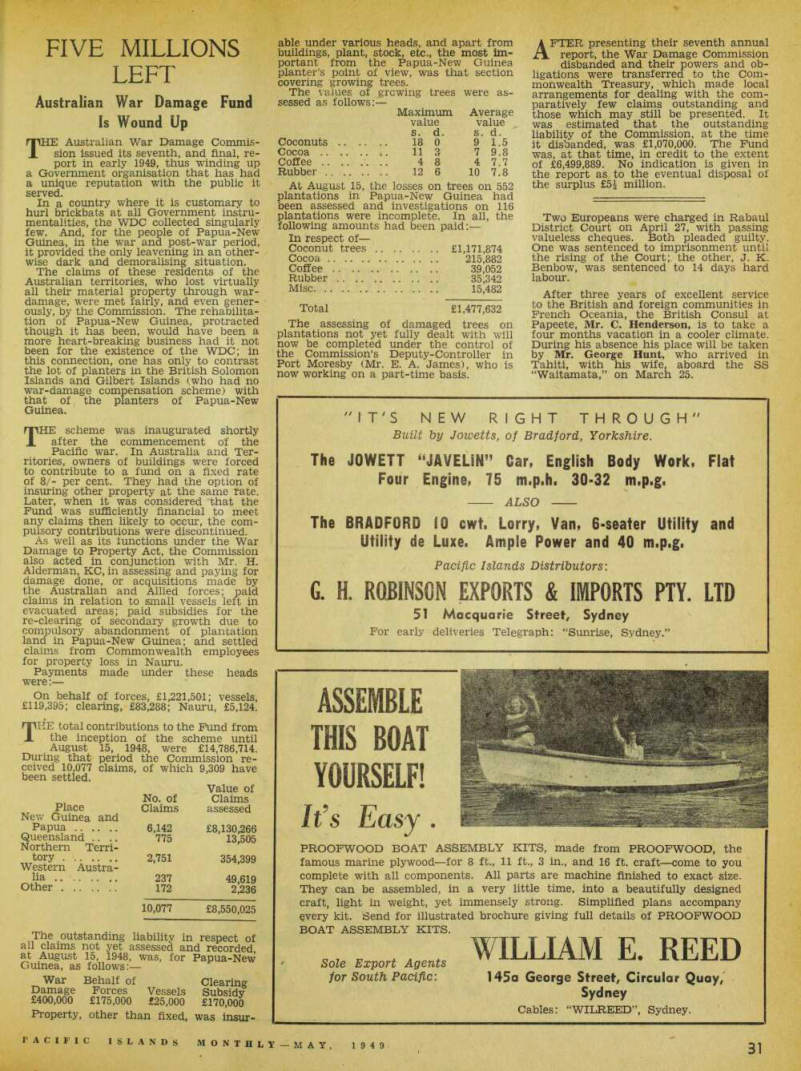
Five Millions
p. 33 · Read in the full issue
Left
Australian War Damage Fund Is Wound Up
THE Australian War Damage Commis sion issued its seventh, and final, re port in early 1949, thus winding up a Government organisation that has had a unique reputation with the public it served.
In a country where it is customary to hurl brickbats at all Government instru mentalities, the WDC collected singularly few. And, for the people of Papua-New Guinea, in the war and post-war period, it provided the only leavening in an other wise dark and demoralising situation.
The claims of these residents of the Australian territories, who lost virtually all their material property through war damage, were met fairly, and even gener ously, by the Commission. The rehabilita tion of Papua-New Guinea, protracted though it has been, would have been a more heart-breaking business had it not been for the existence of the WDC; in this connection, one has only to contrast the lot of planters in the British Solomon Islands and Gilbert Islands (who had no war-damage compensation scheme) with that of the planters of Papua-New Guinea.
THE scheme was inaugurated shortly after the commencement of the Pacific war. In Australia and Ter ritories, owners of buildings were forced to contribute to a fund on a fixed rate of 8/- per cent. They had the option of insuring other property at the same rate.
Later, when it was considered that the Fund was sufficiently financial to meet any claims then likely to occur, the com pulsory contributions were discontinued.
As well as its functions under the War Damage to Property Act, the Commission also acted in conjunction with Mr. H.
Alderman, KC, in assessing and paying for damage done, or acquisitions made by the Australian and Allied forces; paid claims in relation to small vessels left in evacuated areas; paid subsidies for the re-clearing of secondary growth due to compulsory abandonment of plantation land in Papua-New Guinea; and settled claims from Commonwealth employees for property loss in Nauru.
Payments made under these heads were:— On behalf of forces, £1,221,501; vessels, £119,395; clearing, £83,288; Nauru, £5,124.
THE total contributions to the Fund from the inception of the scheme until August 15, 1948, were £14,786,714.
During that period the Commission re ceived 10,077 claims, of which 9,309 have been settled.
The outstanding liability in respect of all claims not yet assessed and recorded at August 15, 1948, was, for Papua-New Guinea, as follows: War Behalf of Clearing Damage Forces Vessels Subsidy £400,000 £175,000 £25,000 £170,000 Property, other than fixed, was insur
able under various heads, and apart from buildings, plant, stock, etc., the most im portant from the Papua-New Guinea planter's point of view, was that section covering growing trees.
The values of growing trees were as sessed as follows:
At August 15, the losses on trees on 552 plantations in Papua-New Guinea had been assessed and investigations on 116 plantations were incomplete. In all, the following amounts had been paid:—
The assessing of damaged trees on plantations not yet fully dealt with will now be completed under the control of the Commission's Deputy-Controller in Port Moresby (Mr, E. A. James), who is now working on a part-time basis.
AFTER presenting their seventh annual report, the War Damage Commission disbanded and their powers and ob ligations were transferred to the Com monwealth Treasury, which made local arrangements for dealing with the com paratively few claims outstanding and those which may still be presented. It was estimated that the outstanding liability of the Commission, at the time it disbanded, was £1,070,000. The Fund was, at that time, in credit to the extent of £6,499,889. No indication is given in the report as to the eventual disposal of the surplus £si million.
Two Europeans were charged in Rabaul District Court on April 27, with passing valueless cheques. Both pleaded guilty.
One was sentenced to imprisonment until the rising of the Court; the other, J. K.
Benbow, was sentenced to 14 days hard labour.
After three years of excellent service to the British and foreign communities in French Oceania, the British Consul at Papeete, Mr. C. Henderson, is to take a four months vacation in a cooler climate.
During his absence his place will be taken by Mr. George Hunt, who arrived in Tahiti, with his wife, aboard the SS “Waitamata,” on March 25.
Maximum Average value value s. d. s. d.
Coconuts 18 0 9 1.5 Cocoa 11 3 7 9.8 Coffee 48 47.7 Rubber 12 6 10 7.8
In respect of — Coconut trees .. ..
Cocoa Coffee Rubber Misc .. .. £1,171,874 ... 215.882 .. .. 39,052 Total £1,477,632
Place New Guinea and No. of Value of Claims Claims assessed Papua 6.142 £8,130,266 Queensland ..
Northern Terri- 775 13,505 tory Western Austra- 2,751 354,399 lia 237 49,619 Other 172 10,077 2,236 £8,550,025