Tng Copra
p. 11 · Read in the full issue
Still Under Canberra Control
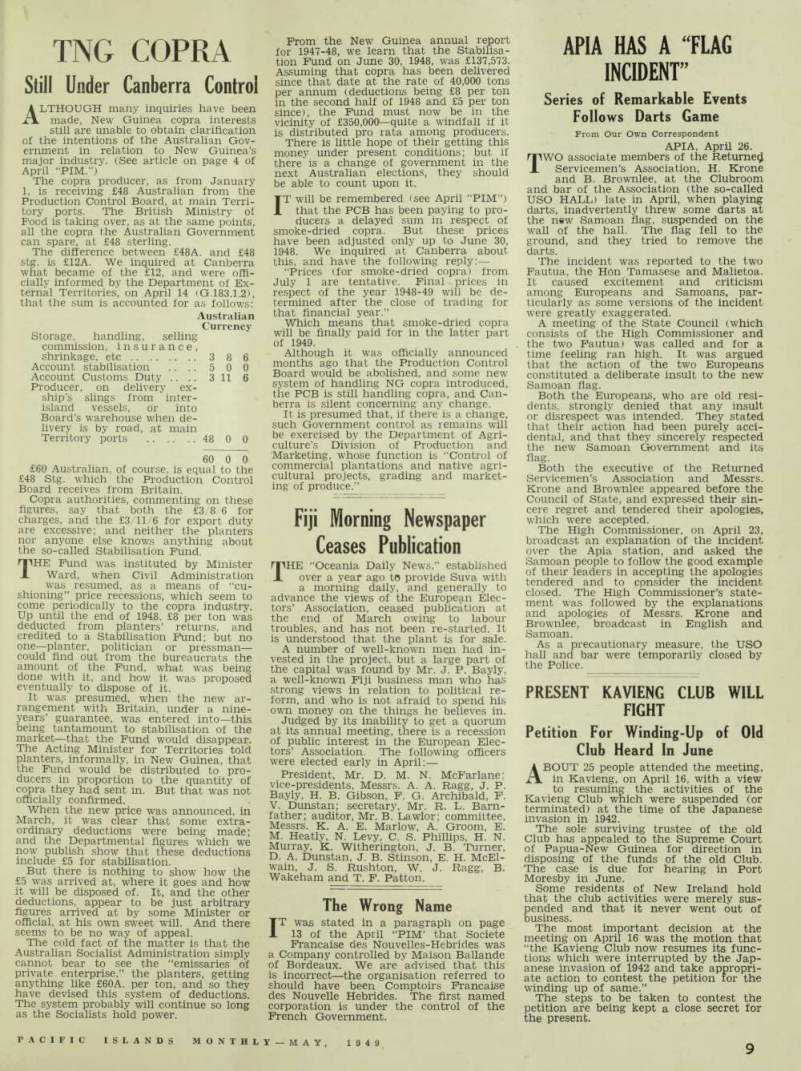
ALTHOUGH many inquiries have been made, New Guinea copra interests still are unable to obtain clarification of the intentions of the Australian Gov ernment in relation to New Guinea’s major industry. (See article on page 4 of April “PIM.”) The copra producer, as from January 1, is receiving £4B Australian from the Production Control Board, at main Terri tory ports. The British Ministry of Food is taking over, as at the same points, all the copra the Australian Government can spare, at £4B sterling.
The difference between £4BA. and £4B stg. is £I2A, We inquired at Canberra what became of the £l2, and were offi cially informed by the Department of Ex ternal Territories, on April 14 (G. 183.1.2), that the sum is accounted for as follows: Australian Currency Storage, handling, selling commission, insurance, shrinkage, etc 3 8 6 Account stabilisation ... 500 Account Customs Duty 311 6 Producer, on delivery ex ship’s slings from inter island vessels, or into Board’s warehouse when de livery is by road, at main Territory ports 48 0 0 60 0 0 £6O Australian, of course, is equal to the £4B Stg. which the Production Control Board receives from Britain.
Copra authorities, commenting on these figures, say that both the £3/8/6 for charges, and the £3/11/6 for export duty are excessive; and neither the planters nor anyone else knows anything about the so-called Stabilisation Fund.
THE Fund was instituted by Minister Ward, when Civil Administration was resumed, as a means of “cu shioning” price recessions, which seem to come periodically to the copra industry.
Up until the end of 1948. £8 per ton was deducted from planters’ returns, and credited to a Stabilisation Fund; but no one—planter, politician or pressman— could find out from the bureaucrats the amount of the Fund, what was being done with it, and how it was proposed eventually to dispose of it.
It was presumed, when the new ar rangement with Britain, under a nine years’ guarantee, was entered into—this being tantamount to stabilisation of the market—that the Fund would disappear.
The Acting Minister for Territories told planters, informally, in New Guinea, that the Fund would be distributed to pro ducers in proportion to the quantity of copra they had sent in. But that was not officially confirmed.
When the new price was announced, in March, it was clear that some extra ordinary deductions were being made; and the Departmental figures which we now publish show that these deductions include £5 for stabilisation.
But there is nothing to show how the £5 was arrived at, where it goes and how it will be disposed of. It, and the other deductions, appear to be just arbitrary figures arrived at by some Minister or official, at his own sweet will. And there seems to be no way of appeal.
The cold fact of the matter is that the Australian Socialist Administration simply cannot bear to see the “emissaries of private enterprise,” the planters, getting anything like £6OA. per ton, and so they have devised this system of deductions.
The system probably will continue so long as the Socialists hold power.
Prom the New Guinea annual report for 1947-48, we learn that the Stabilisa tion Fund on June 30, 1948, was £137,573.
Assuming that copra has been delivered since that date at the rate of 40,000 tons per annum (deductions being £8 per ton in the second half of 1948 and £5 per ton since), the Fund must now be in the vicinity of £3so,ooo—quite a windfall if it is distributed pro rata among producers.
There is little hope of their getting this money under present conditions; but if there is a change of government in the next Australian elections, they should be able to count upon it.
IT will be remembered (see April “PIM”) that the PCB has been paying to pro ducers a delayed sum in respect of smoke-dried copra. But these prices have been adjusted only up to June 30, 1948. We inquired at Canberra about this, and have the following reply:— “Prices (for smoke-dried copra) from July 1 are tentative. Final prices in respect of the year 1948-49 will be de termined after the close of trading for that financial year.”
Which means that smoke-dried copra will be finally paid for in the latter part of 1949.
Although it was officially announced months ago that the Production Control Board would be abolished, and some new system of handling NG copra introduced, the PCB is still handling copra, and Can berra is silent concerning any change.
It is presumed that, if there is a change, such Government control as remains will be exercised by the Department of Agri culture’s Division of Production and Marketing, whose function is “Control of commercial plantations and native agri cultural projects, grading and market ing of produce.”