Tropicalities
p. 45 · Read in the full issue
“ A TTACKED by a crocodile” or “Dis- A appeared with a crocodile into the depths of the muddy Sepik” would make no headlines up here. But this recent accident startled even veterans on the Sepik:— Two marys had left by canoe for their daily trip up the river, just a few miles, to get the “kina” (shrimps) for the next meal. When they arrived at their usual fishing ground they dived down to the “floor” of the Sepik. One of them then came up with a scream—she had stood on a crocodile! The other one smiled at her for letting herself be scared by an old submerged log. Then she dived down again to prove her contention.
Soon there ensued a turmoil in the Sepik. The unbelieving one was fighting off a crocodile. The crocodile won and went off with its prey.
As soon as the other mary had re covered her breath and the control of her muscles, she raced back to the village.
Immediately canoes hurried to the scene of the attack in search of the crocodile.
They found it but succeeded only in wounding the beast. Next day they re turned and this time the crocodile was mortally wounded. Next morning some one saw an object floating down the Sepik, almost as big as a small pinnace.
It was the dead crocodile.
They brought it to the village, cut it open and found the mary in the beast’s stomach. She was still intact, except for an arm torn off and her head mutilated.
The crocodile obviously had swallowed her head first.
Had the villagers been quicker they might have saved her and now be able
to boast of having a black Jonah.
Pat.
EARLY this year, there arrived in Fiji two slices of Princess Elizabeth’s wedding cake.
One slice was received by the Girl Guide Commissioner, and was promi nently displayed in one of the leading shops in Suva and then was raffled, thus raising £lB for the Mayor of London’s Appeal for Children.
The winner, a Suva woman, divided her slice among her friends, including her old Indian cook (whose proud boasts spread throughout the neighbourhood) and she sent the remainder, about the size of her thumb, to her daughter, at a school in New Zealand. The girls at the schopl were thrilled to receive the cake, which was divided among sixteen of them; and it was further subdivided, to be put under pillows and slept on.
One fragment eventually found its way to a girl in Australia.
The other slice was received by the wife of the High Commissioner for the Western Pacific. She divided the slice into five. Each portion was wrapped in cellophane, and tied with silver ribbon, and the five were distributed among the Commissioner’s five territories—namely, the Gilbert and Ellice Islands: the Solomon Islands; Tonga; the Anglo- French Condominium of the New Heb rides: and Pitcairn Island.
At Tonga, one of the few remaining monarchies of the world, the little bit of cake was presented to Queen Salote, who was delighted to receive it.
At Guadalcanal, in the Solomons, the cake was insoected with lively interest by the members of the United States forces stationed there. Suggestions put
forward by American officers, and mem bers of the British community, resulted in the cake being raffled to provide com forts for the leper settlement —this de cision being known locally as the “Anglo- American Agreement”! * * * MRS. LILLIAN MILLAR, who was well known in New Guinea —from Wewak to Rabaul, and particularly in Morobe —has developed new talents since she has been living permanently in Australia.
Some time ago she broadcast over the ABC network and told listeners of some of her pioneering experiences in New Guinea when Morobe goldfield first found
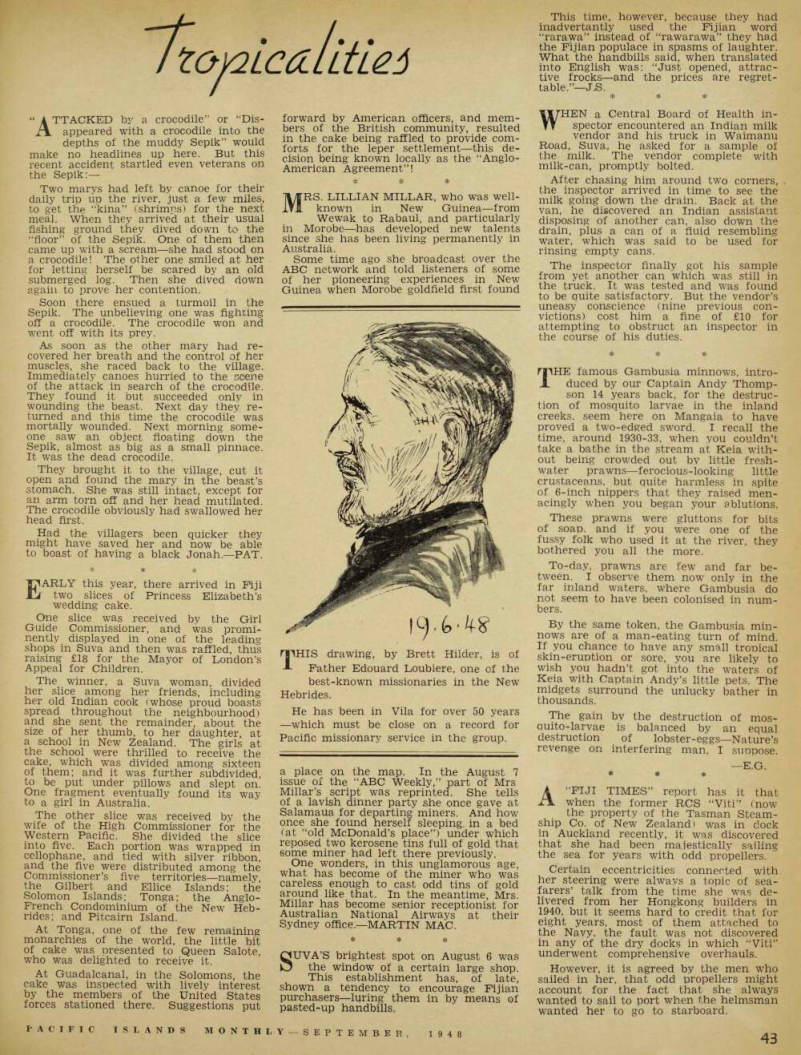
THIS drawing, by Brett Hilder, is of Father Edouard Loubiere, one of the best-known missionaries in the New Hebrides.
He has been in Vila for over 50 years —which must be close on a record for Pacific missionary service in the group.
a place on the map. In the August 7 issue of the “ABC Weekly,” part of Mrs Millar’s script was reprinted. She tells of a lavish dinner party she once gave at Salamaua for departing miners. And how once she found herself sleeping in a bed (at “old McDonald’s place”) under which reposed two kerosene tins full of gold that some miner had left there previously.
One wonders, in this unglamorous age, what has become of the miner who was careless enough to cast odd tins of gold around like that. In the meantime, Mrs.
Millar has become senior receptionist for Australian National Airways at their Sydney office.—MAßTlN MAC. * * * SUVA’S brightest spot on August 6 was the window of a certain large shop.
This establishment has, of late, shown a tendency to encourage Fijian purchasers—luring them in by means of pasted-up handbills.
This time, however, because they had inadvertantly used the Fijian word “rarawa” instead of “rawarawa” they had the Fijian populace in spasms of laughter.
What the handbills said, when translated into English was: “Just opened, attrac tive frocks—and the prices are regret
table.
J.S.
WHEN a Central Board of Health in spector encountered an Indian milk vendor and his truck in Waimanu Road, Suva, he asked for a sample of the milk. The vendor complete with milk-can, promptly bolted.
After chasing him around two corners, the inspector arrived in time to see the milk going down the drain. Back at the van, he discovered an Indian assistant disposing of another can, also down the drain, plus a can of a fluid resembling water, which was said to be used for rinsing empty cans.
The inspector finally got his sample from yet another can which was still in the truck. It was tested and was found to be quite satisfactory. But the vendor’s uneasy conscience (nine previous con victions) cost him a fine of £lO for attempting to obstruct an inspector in the course of his duties. * ♦ ♦ THE famous Gambusia minnows, intro duced by our Captain Andy Thomp son 14 years back, for the destruc tion of mosquito larvae in the inland creeks, seem here on Mangaia to have proved a two-edged sword. I recall the time, around 1930-33, when you couldn’t take a bathe in the stream at Keia with out being crowded out bv little fresh water prawns—ferocious-looking little crustaceans, but quite harmless in spite of 6-inch nippers that they raised men acingly when you began your ablutions.
These prawns were gluttons for bits of soap, and if you were one of the fussy folk who used it at the river, they bothered you all the more.
To-day, prawns are few and far be tween. I observe them now only in the far inland waters, where Gambusia do not seem to have been colonised in num bers.
By the same token, the Gambusia min nows are of a man-eating turn of mind.
If you chance to have any small tronical skin-eruption or sore, you are likely to wish you hadn’t got into the waters of Keia with Captain Andy’s little pets. The midgets surround the unlucky bather in thousands.
The gain by the destruction of mos quito-larvae is balanced by an equal destruction of lobster-eggs—Nature’s revenge on interfering man, I suppose.
E.G.
A “FIJI TIMES” report has it that when the former RCS “Viti” (now the property of the Tasman Steam ship Co. of New Zealand) was in dock in Auckland recently, it was discovered that she had been majestically sailing the sea for years with odd propellers.
Certain eccentricities connected with her steering were always a topic of sea farers’ talk from the time she was de livered from her Hongkong builders in 1940. but it seems hard to credit that for eight years, most of them attached to the Navy, the fault was not discovered in any of the dry docks in which “Viti” underwent comprehensive overhauls.
However, it is agreed by the men who sailed in her, that odd propellers might account for the fact that she always wanted to sail to port when the helmsman wanted her to go to starboard.