Fiji's first Governor dealt with Fiji's
p. 44 · Read in the full issue
last cannibal
By R. C. Macpherson
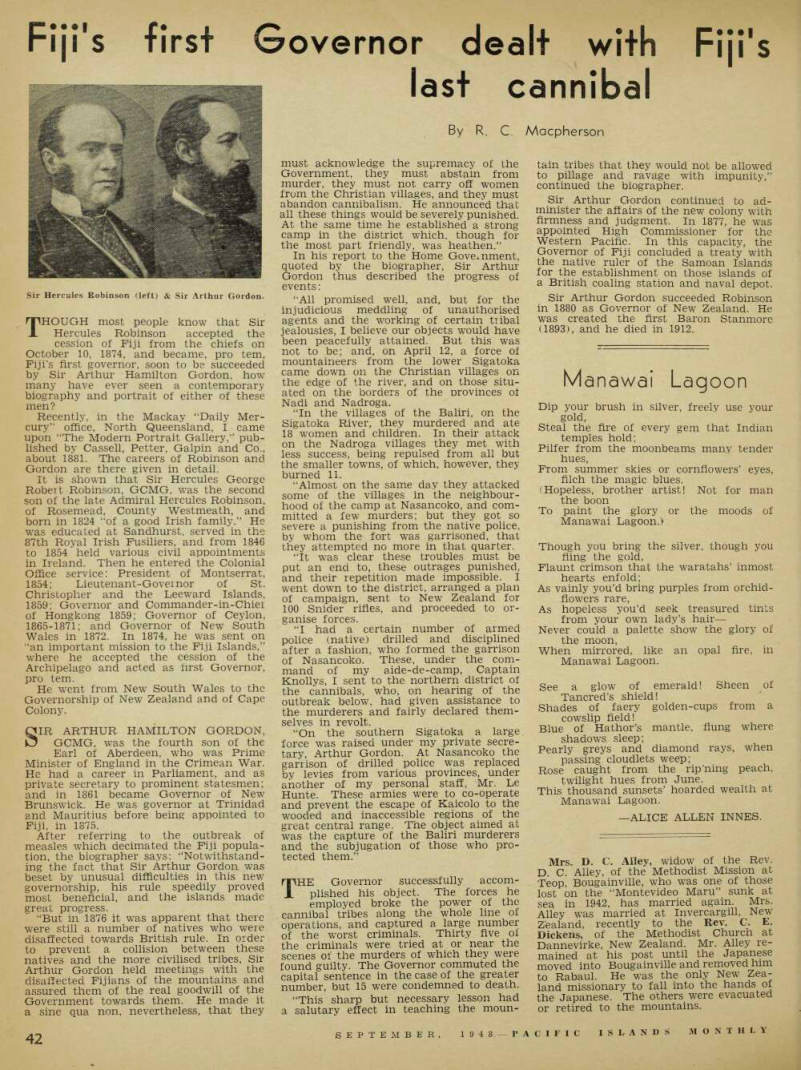
T HOUGH most people know that Sir Hercules Robinson accepted the cession of Fiji from the chiefs on October 10, 1874, and became, pro tern, Fiji's first governor, soon to be succeeded by Sir Arthur Hamilton Gordon, how many have ever seen a contemporary biography and portrait of either of these men?
Recently, in the Mackay “Daily Mer cury” office, North Queensland, I came upon “The Modern Portrait Gallery,” pub lished by Cassell, Fetter, Galpin and Co., about 1881. The careers of Robinson and Gordon are there given in detail.
It is shown that Sir Hercules George Robert Robinson, GCMG, was the second son of the late Admiral Hercules Robinson, of Rosemead, County Westmeath, and born in 1824 “of a good Irish family.” He was educated at Sandhurst, served in the 87th Royal Irish Fusiliers, and from 1846 to 1854 held various civil appointments in Ireland. Then he entered the Colonial Office service: President of Montserrat, 1854; Lieutenant-Governor of St.
Christopher and the Leeward Islands, 1859; Governor and Commander-in-Chiet of Hongkong 1859; Governor of Ceylon, 1865-1871; and Governor of New South Wales in 1872. In 1874, he was sent on “an important mission to the Fiji Islands,” where he accepted the cession of the Archipelago and acted as first Governor, pro tern.
He went from New South Wales to the Governorship of New Zealand and of Cape Colony.
Sir Arthur Hamilton Gordon,
GCMG, was the fourth son of the Earl of Aberdeen, who was Prime Minister of England in the Crimean War.
He had a career in Parliament, and as private secretary to prominent statesmen; and in 1861 became Governor of New Brunswick. He was governor at Trinidad and Mauritius before being appointed to Fiji, in 1875.
After referring to the outbreak of measles which decimated the Fiji popula tion, the biographer says: “Notwithstand ing the fact that Sir Arthur Gordon was beset by unusual difficulties in this new governorship, his rule speedily proved most beneficial, and the islands made great progress.
“But in 1876 it was apparent that there were still a number of natives who were disaffected towards British rule. In order to prevent a collision between these natives and the more civilised tribes, Sir Arthur Gordon held meetings with the disaffected Fijians of the mountains and assured them of the real goodwill of the Government towards them. He made it a sine qua non, nevertheless, that they
must acknowledge the supremacy of the Government, they must abstain from murder, they must not carry off women from the Christian villages, and they must abandon cannibalism. He announced that all these things would be severely punished.
At the same time he established a strong camp in the district which, though for the most part friendly, was heathen.”
In his report to the Home Government, quoted by the biographer, Sir Arthur Gordon thus described the progress of events; “All promised well, and, but for the injudicious meddling of unauthorised agents and the working of certain tribal jealousies, I believe our objects would have been peacefully attained. But this was not to be; and, on April 12, a force of mountaineers from the lower Sigatoka came down on the Christian villages on the edge of the river, and on those situ ated on the borders of the provinces of Nadi and Nadroga. ‘Tn the villages of the Baliri, on the Sigatoka River, they murdered and ate 18 women and children. In their attack on the Nadroga villages they met with less success, being repulsed from all but the smaller towns, of which, however, they burned 11.
“Almost on the same day they attacked some of the villages in the neighbour hood of the camp at Nasancoko, and com mitted a few murders: but they got so severe a punishing from the native police, by whom the fort was garrisoned, that they attempted no more in that quarter.
“It was clear these troubles must be put an end to, these outrages punished, and their repetition made impossible. I went down to the district, arranged a plan of campaign, sent to New Zealand for 100 Snider rifles, and proceeded to or ganise forces.
“I had a certain number of armed police (native) drilled and disciplined after a fashion, who formed the garrison of Nasancoko. These, under the com mand of my aide-de-camp, Captain Knollys, I sent to the northern district of the cannibals, who, on hearing of the outbreak below, had given assistance to the murderers and fairly declared them selves in revolt.
“On the southern Sigatoka a large force was raised under my private secre tary, Arthur Gordon. At Nasancoko the garrison of drilled police was replaced by levies from various provinces, under another of my personal staff, Mr. Le Hunte. These armies were to co-operate and prevent the escape of Kaicolo to the wooded and inaccessible regions of the great central range. The object aimed at was the capture of the Baliri murderers and the subjugation of those who pro tected them.”
THE Governor successfully accom plished his object. The forces he employed broke the power of the cannibal tribes along the whole line of operations, and captured a large number of the worst criminals. Thirty five of the criminals were tried at or near the scenes of the murders of which they were found guilty. The Governor commuted the capital sentence in the case of the greater number, but 15 were condemned to death.
“This sharp but necessary lesson had a salutary effect in teaching the moun
tain tribes that they would not be allowed to pillage and ravage with impunity,” continued the biographer.
Sir Arthur Gordon continued to ad minister the affairs of the new colony with firmness and judgment. In 1877, he was appointed High Commissioner for the Western Pacific. In this capacity, the Governor of Fiji concluded a treaty with the native ruler of the Samoan Islands for the establishment on those islands of a British coaling station and naval depot.
Sir Arthur Gordon succeeded Robinson in 1880 as Governor of New Zealand. He was created the first Baron Stanmore (1893), and he died in 1912.
Sir Hercules Robinson (left) & Sir Arthur Gordon.