Immigration Minister Presents Some Forgotten History
pp. 29-30 · Read in the full issue
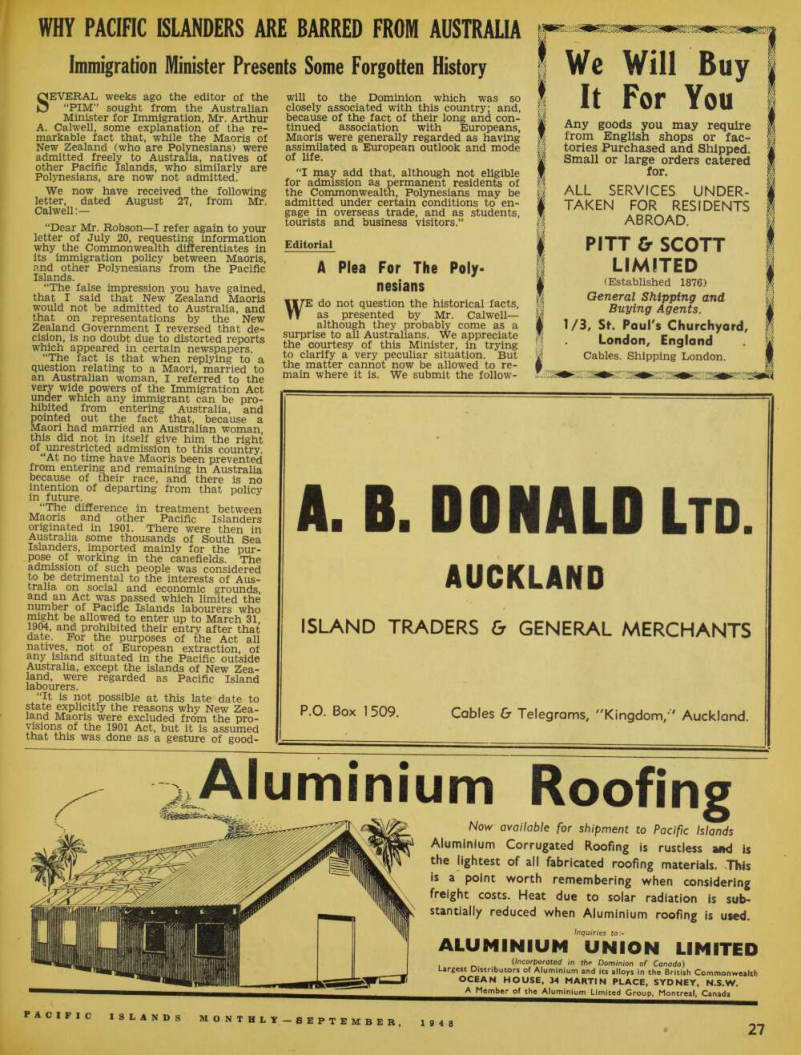

WHY PACIFIC ISLANDERS ARE BARRED FROM AUSTRALIA Immigration Minister Presents Some Forgotten History
SEVERAL weeks ago the editor of the “PIM” sought from the Australian Minister for Immigration, Mr. Arthur A. Calwell, some explanation of the re markable fact that, while the Maoris of New Zealand (who are Polynesians) were admitted freely to Australia, natives of other Pacific Islands, who similarly are Polynesians, are now not admitted.
We now have received the following letter, dated August 27, from Mr.
Calwell: — “Dear Mr. Robson —I refer again to your letter of July 20, requesting information why the Commonwealth differentiates in its immigration policy between Maoris, and other Polynesians from the Pacific Islands.
“The false impression you have gained, that I said that New Zealand Maoris would not be admitted to Australia, and that on representations by the New Zealand Government I reversed that de cision, is no doubt due to distorted reports which appeared in certain newspapers.
“The fact is that when replying to a question relating to a Maori, married to an Australian woman, I referred to the very wide powers of the Immigration Act under which any immigrant can be pro hibited from entering Australia, and pointed out the fact that, because a Maori had married an Australian woman, this did not in itself give him the right of unrestricted admission to this country.
“At no time have Maoris been prevented from entering and remaining in Australia because of their race, and there is no intention of departing from that policy in future.
“The difference in treatment between Maoris and other Pacific Islanders originated in 1901. There were then in Australia some thousands of South Sea Islanders, imported mainly for the pur pose of working in the canefields. The admission of such people was considered to be detrimental to the interests of Aus tralia on social and economic grounds, and an Act was passed which limited the number of Pacific Islands labourers who might be allowed to enter up to March 31 1904, and prohibited their entry after that date. For the purposes of the Act all natives, not of European extraction, of any island situated in the Pacific outside Australia, except the islands of New Zea land, were regarded as Pacific Island labourers.
“It is not possible at this late date to state explicitly the reasons why New Zea land Maoris were excluded from the pro visions of the 1901 Act, but it is assumed that this was done as a gesture of good
will to the Dominion which was so closely associated with this country; and, because of the fact of their long and con tinued association with Europeans, Maoris were generally regarded as having assimilated a European outlook and mode of life.
“I may add that, although not eligible for admission as permanent residents of the Commonwealth, Polynesians may be admitted under certain conditions to en gage in overseas trade, and as students, tourists and business visitors.”
Editorial
A Plea For The Poly
nesians
11TE do not question the historical facts, ff as presented by Mr. Calwell— although they probably come as a surprise to all Australians. We appreciate the courtesy of this Minister, in trying to clarify a very peculiar situation. But the matter cannot now be allowed to re main where it is. We submit the follow
ing points, for consideration by the Aus tralian authorities:— The circumstances which led to the banning of Pacific Islanders from Aus tralia, more than 40 years ago, have long ceased to exist, and those considerations cannot now apply to the formulation of Australian immigration policy.
Although no differentiation was made,
the provisions of the 1901 Act clearly were intended to apply to Melanesians—the dark-skinned, woolly-headed people of New Guinea, Solomons, etc., and not to the brown-skinned Polynesians, who are of a different and higher racial type.
For at least three decades, the Islands people from Polynesia, including the Maoris, have been free to enter and
settle in Australia; and very many of them, especially half-Polynesians, have settled there. Like the Maoris in New Zealand they have been good and law-abiding citizens, and have lived in harmony with Europeans.
Why does this Australian Minister of Immigration suddenly, without any ex planation or apparent cause, now evoke the powers of a 1901 Act that has been long dead and forgotten? What have our good friends the Polynesians done to be treated in this harsh fashion by offi cials at Canberra who apparently know nothing of the racial distinctions be tween Pacific Islanders?
Every intelligent man in Australia and New Zealand recognises that there is need for a White Australia Policy. Any one can read the lesson presented by the spectacle of one thousand millions of people in overcrowded Southeastern Asia, staring hungrily across the narrow seas at the rich empty lands of Australia and Oceania, where there are only nine millions of people. We must keep the Asiatics out of Australasia, or perish.
But there is no comparison between Asiatics and Pacific Islanders, and especi ally Polynesians. They represent no menace in the spheres of economics or industrialism, and they have not got the overwhelming and terrifying fecundity of the Asiatic.
The issue is not vital. It does not matter very much to the Polynesians, except perhaps on sentimental grounds, whether they are excluded from Australia or n0t—99.9 per cent, of them much prefer to live in thier own beautiful and fertile islands. But the maintenance of this ban places upon the Polynesian a stigma that is wholly undeserved, and is most unfair.
The 1901 Act should be amended and Polynesians put on the same basis, in terms of immigration as the Maoris.