‘John Williams Vi’ Due In November
p. 13 · Read in the full issue
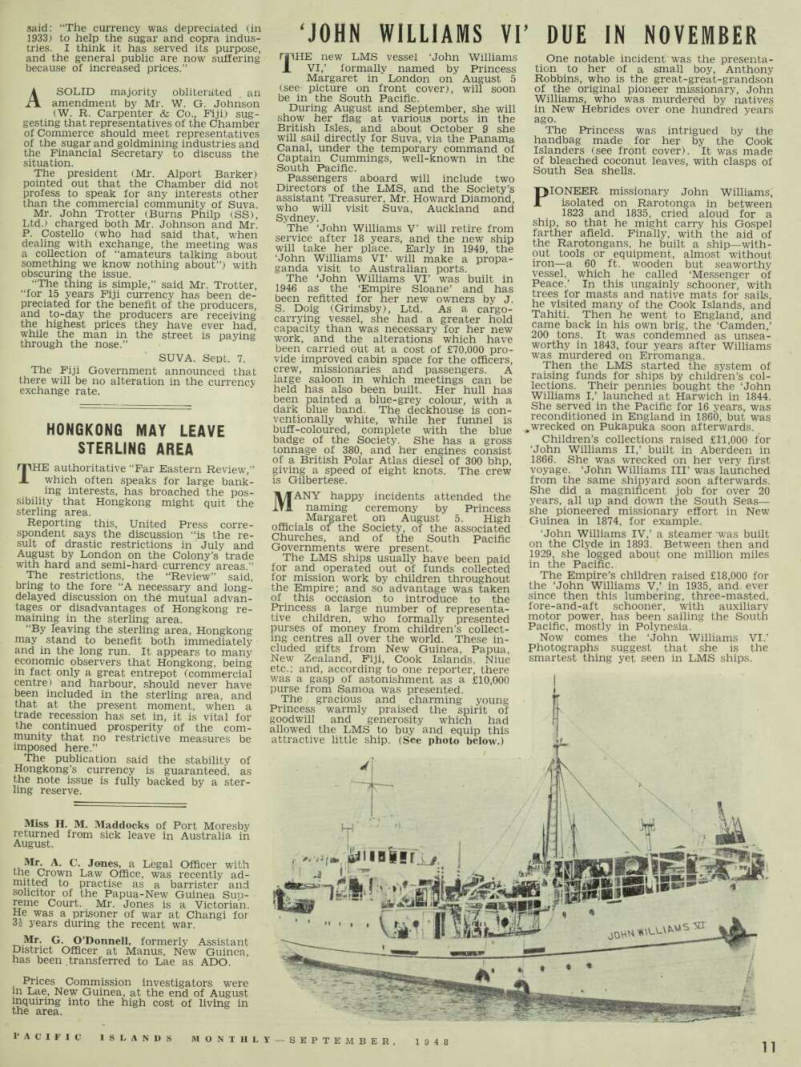
THE new LMS vessel ‘John Williams Vl,’ formally named by Princess Margaret in London on August 5 (see picture on front cover), will soon be in the South Pacific.
During August and September, she will show her flag at various ports in the British Isles, and about October 9 she will sail directly for Suva, via the Panama Canal, under the temporary command of Captain Cummings, well-known in the South Pacific.
Passengers aboard will include two Directors of the LMS, and the Society’s assistant Treasurer, Mr. Howard Diamond, who will visit Suva, Auckland and Sydney.
The ‘John Williams V’ will retire from service after 18 years, and the new ship will take her place. Early in 1949, the ‘John Williams Vl’ will make a propa ganda visit to Australian ports.
The ‘John Williams Vl’ was built in 1946 as the ‘Empire Sloane’ and has been refitted for her new owners by J.
S. Doig (Grimsby), Ltd. As a cargo carrying vessel, she had a greater hold capacity than was necessary for her new work, and the alterations which have been carried out at a cost of £70,000 pro vide improved cabin space for the officers, crew, missionaries and passengers. A large saloon in which meetings can be held has also been built. Her hull has been painted a blue-grey colour, with a dark blue band. The deckhouse is con ventionally white, while her funnel is buff-coloured, complete with the blue badge of the Society. She has a gross tonnage of 380, and her engines consist of a British Polar Atlas diesel of 300 bhp, giving a speed of eight knots. The crew is Gilbertese.
MANY happy incidents attended the naming ceremony by Princess Margaret on August 5. High officials of the Society, of the associated Churches, and of the South Pacific Governments were present.
The LMS ships usually have been paid for and operated out of funds collected for mission work by children throughout the Empire; and so advantage was taken of this occasion to introduce to the Princess a large number of representa tive children, who formally presented purses of money from children’s collect ing centres all over the world. These in cluded gifts from New Guinea, Papua, New Zealand, Fiji, Cook Islands, Niue etc.; and, according to one reporter, there v/as a gasp of astonishment as a £lO,OOO purse from Samoa was presented.
The gracious and charming young Princess warmly praised the spirit of goodwill and generosity which had allowed the LMS to buy and equip this attractive little ship. (See photo below.)
One notable incident was the presenta tion to her of a small boy, Anthony Robbins, who is the great-great-grandson of the original pioneer missionary, John Williams, who was murdered by natives in New Hebrides over one hundred years ago.
The Princess was intrigued by the handbag made for her by the Cook Islanders (see front cover). It was made of bleached coconut leaves, with clasps of South Sea shells.
PIONEER missionary John Williams, isolated on Rarotonga in between 1823 and 1835, cried aloud for a ship, so that he might carry his Gospel farther afield. Finally, with the aid of the Rarotongans, he built a ship—with put tools or equipment, almost without iron—a 60 ft. wooden but seaworthy vessel, which he called ‘Messenger of Peace.’ In this ungainly schooner, with trees for masts and native mats for sails, he visited many of the Cook Islands, and Tahiti. Then he went to England, and came back in his own brig, the ‘Camden,’ 200 tons. It was condemned as unsea worthy in 1843, four years after Williams was murdered on Erromanga.
Then the LMS started the system of raising funds for ships by children’s col lections. Their pennies bought the ‘John Williams I,’ launched at Harwich in 1844.
She served in the Pacific for 16 years, was reconditioned in England in 1860, but was wrecked on Pukapuka soon afterwards.
Children’s collections raised £ll,OOO for ‘John Williams ll,’ built in Aberdeen in 1866. She was wrecked on her very first voyage. ‘John Williams lII’ was launched from the same shipyard soon afterwards.
She did a magnificent job for over 20 years, all up and down the South Seas— she pioneered missionary effort in New Guinea in 1874, for example. ‘John Williams IV,’ a steamer was built on the Clyde in 1893. Between then and 1929, she logged about one million miles in the Pacific.
The Empire’s children raised £lB,OOO for the ‘John Williams V,’ in 1935, and ever since then this lumbering, three-masted, fore-and-aft schooner, with auxiliary motor power, has been sailing the South Pacific, mostly in Polynesia.
Now comes the ‘John Williams Vl.’ photographs suggest that she is the smartest thing yet seen in LMS ships.