Jhite neontef SI bna?d
p. 61 · Read in the full issue
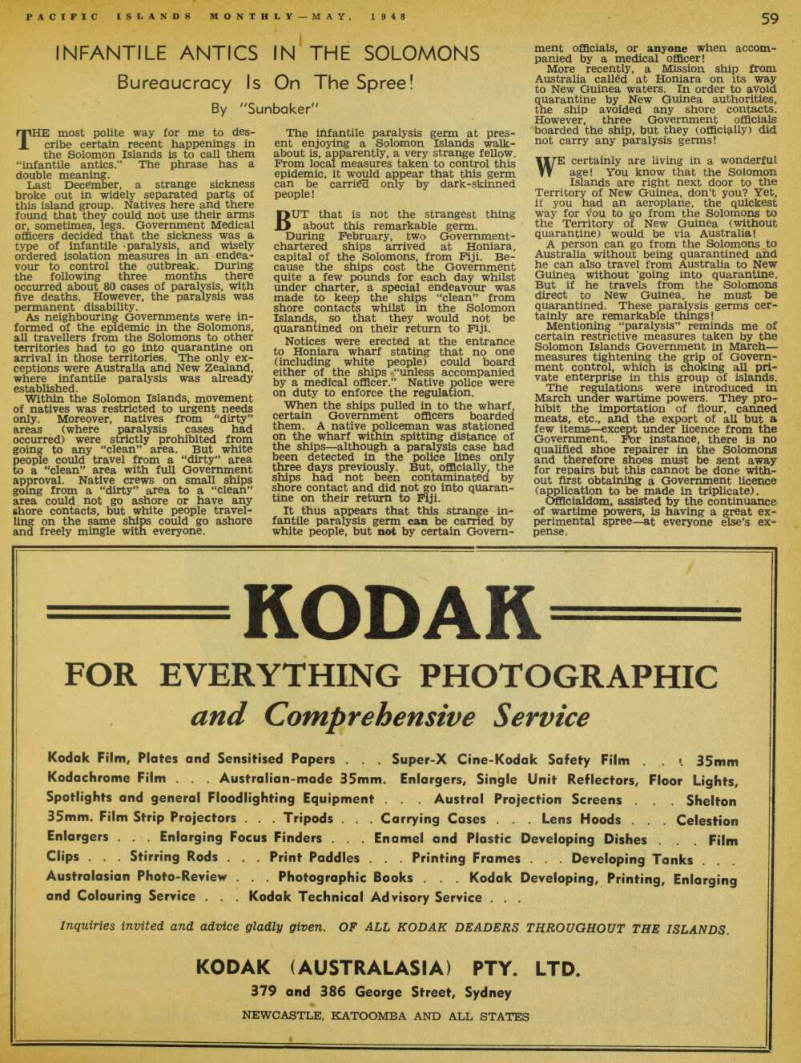
Infantile Antics In The Solomons
Bureaucracy Is On The Spree!
By "Sunbaker"
THE most polite way for me to describe certain recent happenings in the Solomon Islands is to call them “infantile antics.” The phrase has a double meaning.
Last December, a strange sickness broke out in widely separated parts of this island group. Natives here and there found that they could not use their arms or, sometimes, legs. Government Medical officers decided that the sickness was a type of infantile ‘paralysis, and wisely ordered isolation measures in an endeavour to control the outbreak. During the following three months there occurred about 80 cases of paralysis, with five deaths. However, the paralysis was permanent disability.
As neighbouring Governments were informed of the epidemic in the Solomons, all travellers from the Solomons to other territories had to go into quarantine on arrival in those territories. The only exceptions were Australia and New Zealand, where infantile paralysis was already established.
Within the Solomon Islands, movement of natives was restricted to urgent needs only. Moreover, natives from “dirty” areas (where paralysis cases had occurred) were strictly prohibited from going to any “clean” area. But white people could travel from a “dirty” area to a “clean” area with full Government approval. Native crews on small ships going from a “dirty” area to a “clean” area could not go ashore or have any shore contacts, but white people travelling on the same ships could go ashore and freely mingle with everyone.
The infantile paralysis germ at present enjoying a Solomon Islands walkabout is, apparently, a very strange fellow.
From local measures taken to control this epidemic, it would appear that this germ can be carried only by dark-skinned people!
OUT that is not the strangest thing
X 3 about this remarkable germ.
During February, two Governmentchartered ships arrived at Honiara, capital of the Solomons, from Fiji. Because the ships cost the Government quite a few pounds for each day whilst under charter, a special endeavour was made to keep the ships “clean” from shore contacts whilst in the Solomon Islands, so that they would not be quarantined on their return to Fiji. wpt-p prppf-Pri at thp Pntr«npp to Honllra wharf statffig thlt no one
Jhite neontef SI bna?d
ehher of thp shtos arcomnanted
bvamedicaf officer ” NaUverSlicewere
duTv to enfOTcl 'the rSaffin
n ei T rce „ * When the ships pulled m to the wharf, certain Government officers boarded them. A native policeman was stationed pu the wharf within spitting distance of the ships—alUiough a paralysis case had been detected in the police lines only three days previously. But, officially, the smps had not been contaminated by shore contact and did not go into quarantine on their return to Fiji.
It thus appears that this strange infantile paralysis germ can be carried by white people, but not by certain Govern-
meat officials, or anyone when accom panied by a medical officer!
More recently, a Mission ship from Australia called at Honiara on its way to New Guinea waters. In order to avoid quarantine by New Guinea authorities, the ship avoided any shore contacts.
However, three Government officials boarded the ship, but they (officially) did not carry any paralysis germs! 11TE certainly are living in a wonderful ▼f age! You know that the Solomon Islands are right next door to the Territory of New Guinea, don’t you? Yet, if you had an aeroplane, the quickest way for you to go from the Solomons to the Territory of New Guinea (without quarantine) would be via Australia!
A person can go from the Solomons to Australia without being quarantined and he can also travel from Australia to New Guinea without ‘going into quarantine.
But if he travels from the Solomons direct to New Guinea, he must be quarantined. These paralysis germs cer tainly are remarkable things!
Mentioning “paralysis” reminds me of certain restrictive measures taken by the Solomon Islands Government in March— measures tightening the grip of Govern ment control, which is choking all pri vate enterprise in this group of islands.
The regulations were introduced in March under wartime powers. They pro hibit the importation of flour, canned meats, etc., and the export of all but a few items—except under licence from the Government. For instance, there is no qualified shoe repairer in the Solomons and therefore shoes must be sent away for repairs but this cannot be done with out first obtaining a Government licence (application to be made in triplicate).
Officialdom, assisted by the continuance of wartime powers, is having a great ex perimental spree—at everyone else’s ex pense.