Self-Government
p. 28 · Read in the full issue
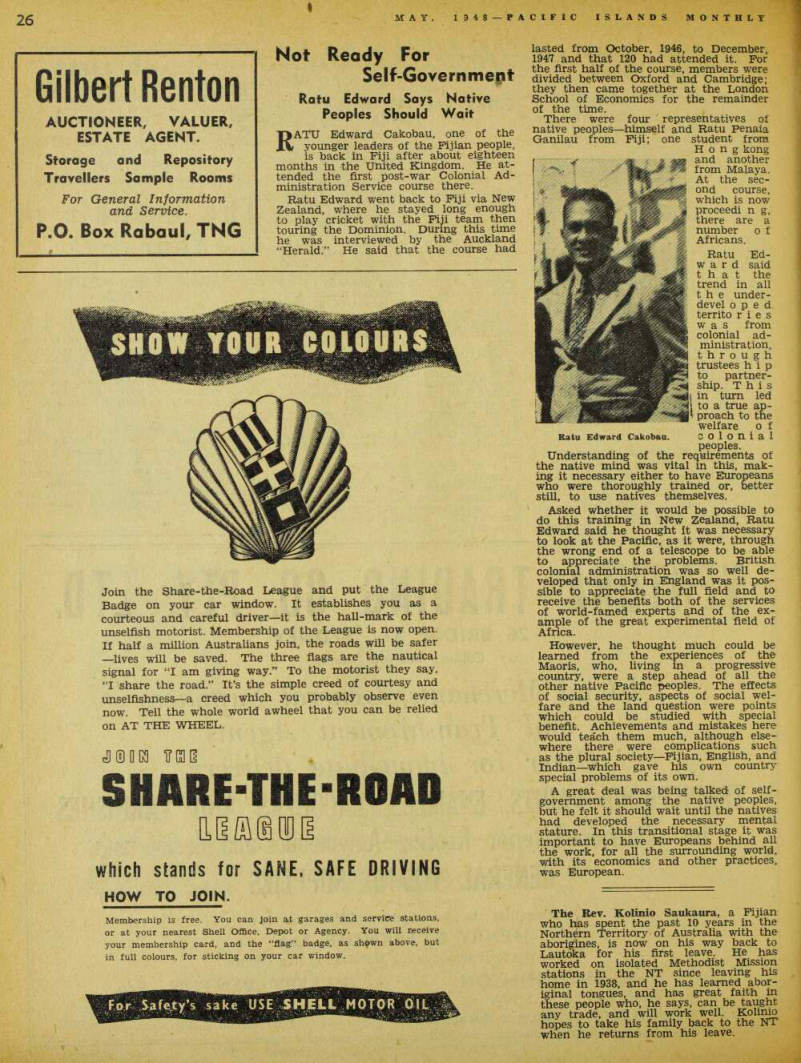
Not Ready For Self-Government Ratu Edward Says Native Peoples Should Wait
RATU Edward Cakobau, one of the younger leaders of the Fijian people, is back in Fiji after about eighteen months in the United Kingdom. He at tended the first post-war Colonial Ad ministration Service course there.
Ratu Edward went back to Fiji via New Zealand, where he stayed long enough to play cricket with the Fiji team then touring the Dominion. During this time he was interviewed by the Auckland “Herald.” He said that the course had
lasted from October, 1946, to December, 1947 and that 120 had attended it. For the first half of the course, members were divided between Oxford and Cambridge; they then came together at the London School of Economics for the remainder of the time.
There were four representatives of native peoples—himself and Ratu penaia Ganilau from Fiji; one student from
Hong kong and another from Malaya.
At the sec ond course, which is now proceedi n g, there are a number o f Africans.
Ratu Ed w a r d said that the trend in all the under devel oped territories was from colonial ad ministration, through trustees hip to partner ship. This in turn led to a true ap proach to the welfare o f colonial peoples.
Understanding of the requirements of the native mind was vital in this, mak ing it necessary either to have Europeans who were thoroughly trained or, better still, to use natives themselves.
Asked whether it would be possible to do this training in New Zealand, Ratu Edward said he thought it was necessary to look at the Pacific, as it were, through the wrong end of a telescope to be able to appreciate the problems. British colonial administration was so well de veloped that only in England was it pos sible to appreciate the full field and to receive the benefits both of the services of world-famed experts and of the ex ample of the great experimental field of Africa.
However, he thought much could be learned from the experiences of the Maoris, who, living in a progressive country, were a step ahead of all the other native Pacific peoples. The effects of social security, aspects of social wel fare and the land question were points which could be studied with special benefit. Achievements and mistakes here would teach them much, although else where there were complications such as the plural society—Fijian, English, and Indian —which gave his own country special problems of its own, A great deal was being talked of self government among the native peoples, but he felt it should wait until the natives had developed the necessary mental stature. In this transitional stage it was important to have Europeans behind all the work, for all the surrounding world, with its economics and other practices, was European.
The Rev. Kolinio Saukaura, a Fijian who has spent the past 10 years in the Northern Territory of Australia with the aborigines, is now on his way back to Lautoka for his first leave. He has worked on isolated Methodist Mission stations in the NT since leaving his home in 1938, and he has learned abor iginal tongues, and has great faith in these people who, he says, can be taught any trade, and will work well. Kolinio hopes to take his family back to the NT when he returns from his leave.
Ratu Edward Cakobau.