In Sydney
p. 10 · Read in the full issue
To Co-Ordinate Administration In
South Pacific
Six-Nations Commission Opens Sessions In Sydney
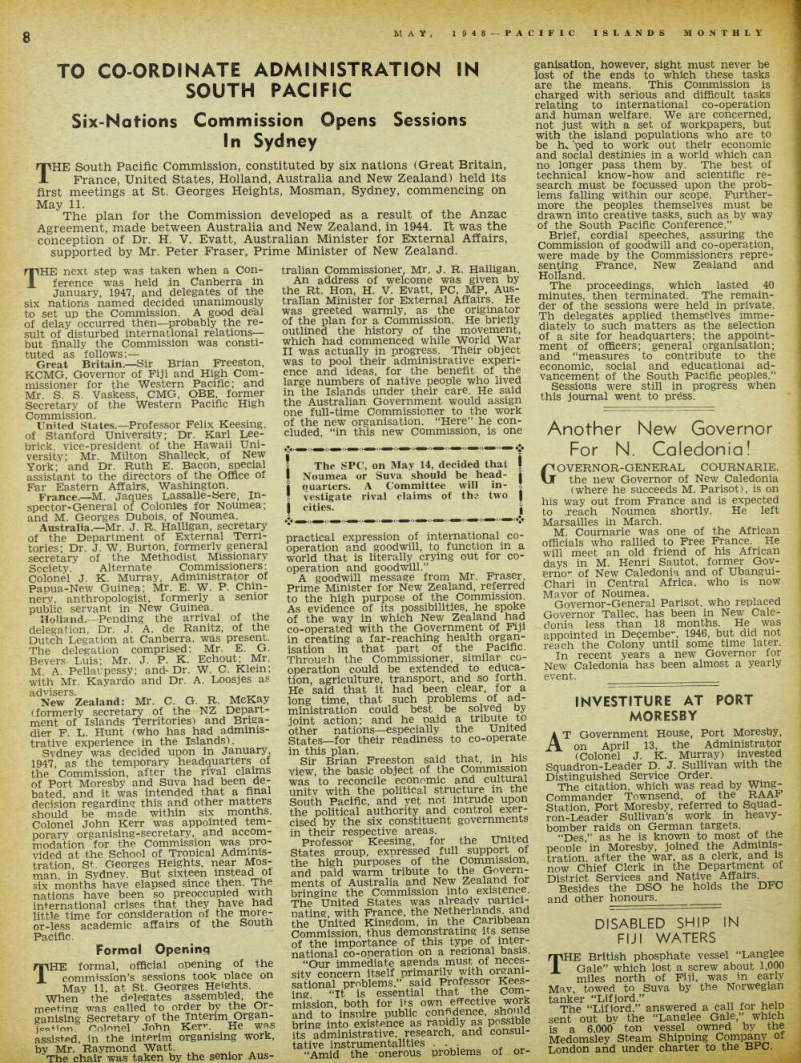
THE South Pacific Commission, constituted by six nations (Great Britain, France, United States, Holland, Australia and New Zealand) held its first meetings at St. Georges Heights, Mosman, Sydney, commencing on May 11.
The plan for the Commission developed as a result of the Anzac Agreement, made between Australia and New Zealand, in 1944. It was the conception of Dr. H. V. Evatt, Australian Minister for External Affairs, supported by Mr. Peter Fraser, Prime Minister of New Zealand.
THE next step was taken when a Con ference was held in Canberra in January, 1947, and delegates of the six nations named decided unanimously to set up the Commission. A good deal of delay occurred then—probably the re sult of disturbed international relations— but finally the Commission was consti tuted as follows: Great Britain.—Sir Brian Freeston, KCMG, Governor of Fiji and High Com missioner for the Western Pacific; and Mr. S. S. Vaskess, CMG, QBE, former Secretary of the Western Pacific High Commission.
United States.—Professor Felix Keesing, of Stanford University; Dr. Karl Lee brick. vice-president of the Hawaii Uni versity; Mr. Milton Shalleck, of New York; and Dr. Ruth E. Bacon, special assistant to the directors of the Office of Far Eastern Affairs, Washington.
France.— M. Jaques Lassalle-Sere, In spector-General of Colonies for Noumea; and M. Georges Dubois, of Noumea.
Australia.— Mr. J. R. Halligan, secretary of the Department of External Terri tories; Dr. J. W. Burton, formerly general secretary of the Methodist Missionary Society. Alternate Commissioners: Colonel J. K. Murray, Administrator of Papua-New Guinea; Mr. E. W. P. Chin nefv, anthropologist, formerly a senior public servant in New Guinea.
Holland.—Pending the arrival of the delegation, Dr. J. A. de Ranitz, of the Dutch Legation at Canberra, was present.
The delegation comprised: Mr. E. G.
Severs Luis; Mr. J. P. K. Echout; Mr.
M. A. Pellarpessy; and* Dr. W. C. Klein; with Mr. Kayardo and Dr. A. Loosjes as advisers.
New Zealand: Mr. C. G. R. McKay (formerly secretary of the NZ Depart ment of Islands Territories) and Briga dier F. L. Hunt (who has had adminis trative experience in the Islands).
Sydney was decided upon in January, 1947, as the temporary headquarters, of the Commission, after the rival claims of Port Moresby and Suva had been de bated, and it was intended that a final decision regarding this and other matters should be made within six months.
Colonel John Kerr was appointed tem porary organising-secretary, and accom modation for the Commission was pro vided at the School of Tropical Adminis tration, St. Georges Heights, near Mos man in Sydney. But sixteen instead of six months have elapsed since then. The nations have been so preoccupied with international crises that they have had little time for consideration of the more or-less academic affairs of the South Pacific.
Formal Opersinq
THE formal, official opening of the commission’s sessions took place on May 11. at St. Georges Heights.
When the delegates assembled, the meeting was called to order by the Or ganising Secretary of the interim Organ fppHon colonel' John He was assisted, in the interim organising work, by Mr. Raymond Watt.
The chair was taken by the senior Aus
tralian Commissioner, Mr. J. R. Halligan.
An address of welcome was given by the Rt. Hon, H. V. Evatt, PC, MP, Aus tralian Minister for External Affairs. He was greeted warmly, as the originator of the plan for a Commission. He briefly outlined the history of the movement, which had commenced while World War II was actually in progress. Their object was to pool their administrative experi ence and ideas, for the benefit of the large numbers of native people who lived in the Islands under their care. He said the Australian Government would assign one full-time Commissioner to the work of the new organisation. “Here” he con cluded, “in this new Commission, is one
The SPC, on May 14, decided that Noumea or Suva should be head quarters. A Committee will in vestigate rival claims of tha two cities.
practical expression of internatiqnal co operation and goodwill, to function in a world that is literally crying out for co operation and goodwill.”
A goodwill message from Mr. Fraser, Prime Minister for New Zealand, referred to the high purpose of the Commission.
As evidence of its possibilities, he spoke of the way in which New Zealand had co-operated with the Government of Fiji in creating a far-reaching health organ isation in that part of the Pacific.
Through the Commissioner, similar co operation could be extended to educa tion, agriculture, transport, and so forth.
He said that it had been clear, for a long time, that such problems of ad ministration could best be solved by joint action; and he paid a tribute to other nations —esoecially the United States —for their readiness to co-operate in this plan. ...
Sir Brian Freeston said that, in his view, the basic object of the Commission was to reconcile economic and cultural unity with the political structure in the South Pacific, and yet not intrude upon the political authority and control exer cised bv the six constituent governments in their resoective areas.
Professor Keesing, for the United States group, exnressed full support of the high purposes of the Commission, and paid warm tribute to the Govern ments of Australia and New Zealand for bringing the Commission into existence.
The United States was already partici nating, with France, the Netherlands and the United Kingdom, in the Caribbean Commission, thus demonstrating its sense of the importance of this type of inter national co-operation on a regional basis.
“Our immediate agenda must of neces sity concern itself primarily with orgam sational problems." said Professor Kees ing “It is essential that the com mission, both for its own effective work and to inspire public confidence, should bring into existence as rapidly as possible its administrative, research, and consul tative instrumentalities ...
“Amid the onerous problems of or
ganisatlon, however, sight must never be lost of the ends to which these tasks are the means. This Commission is charged with serious and difficult tasks relating to international co-operation and human welfare. We are concerned, not just with a set of workpapers, but with the island populations who are to be hv 'ped to work out their economic and social destinies in a world which can no longer pass them by. The best of technical know-how and scientific re search must be focussed upon the prob lems falling within our scope. Further more the peoples themselves must be drawn into creative tasks, such as by way of the South Pacific Conference.”
Brief, cordial speeches, assuring the Commission of goodwill and co-operation, were made by the Commissioners repre senting France, New Zealand and Holland.
The proceedings, which lasted 40 minutes, then terminated. The remain der of the sessions were held in private.
Th delegates applied themselves imme diately to such matters as the selection of a site for headquarters; the appoint ment of officers; general organisation; and “measures to contribute to the economic, social and educational ad vancement of the South Pacific peoples.”
Sessions were still in progress when this journal went to press.