Inaugurated
pp. 7-8 · Read in the full issue
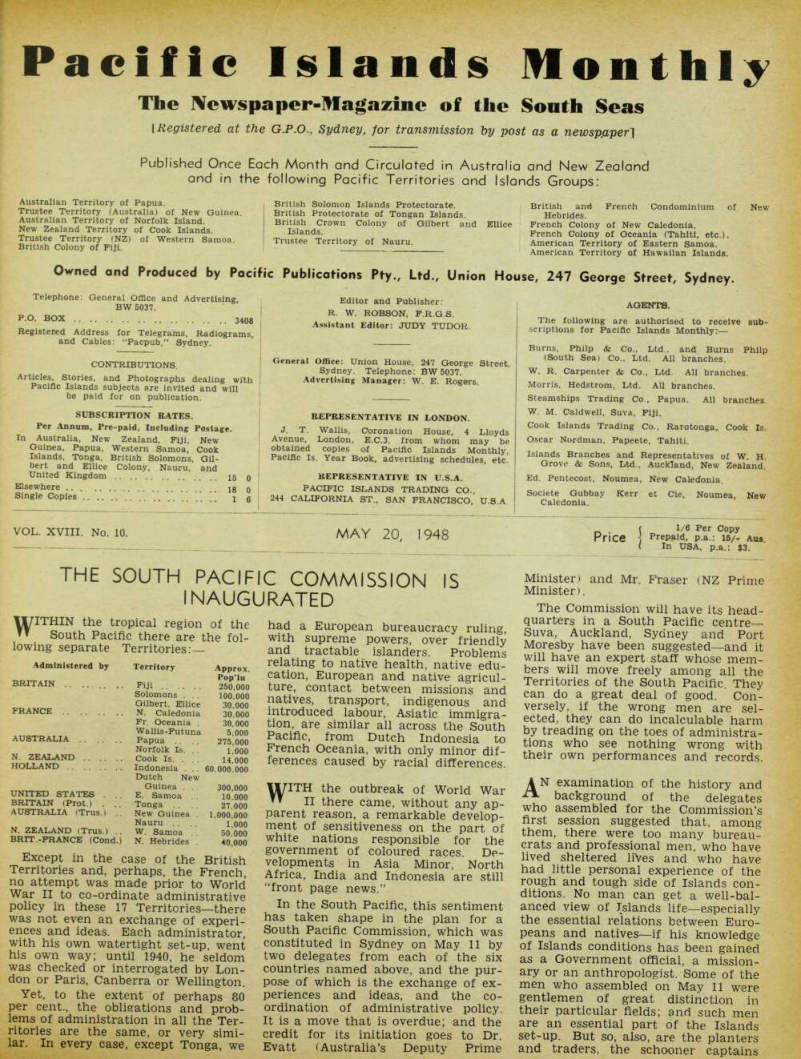
The South Pacific Commission Is
WITHIN the tropical region of the "" South Pacific there are the fol lowing separate Territories;— Administered by Territory Approx.
Pop’iu
Britain Fiji 250,000
Solomons . . . 100,000 Gilbert, Ellice 30,000 FRANCE N. Caledonia 30,000 Fr. Oceania , 30,000 Wallis-Putuna 5,000 AUSTRALIA Papua . . . . 275,000 Norfolk Is. . . 1.000 N. ZEALAND Cook Is. . . . 14,000 HOLLAND Indonesia . . . eo.ooo'ooo Dutch New Guinea . . . 300,000 UNITED STATES ... E. Samoa . . 10,000 BRITAIN (Prot.) . .. Tonga . . . . 27,000 AUSTRALIA (Trus.) . . New Guinea . 1.000,000 Nauru .. .. 1,000 N. ZEALAND (Trus.) . . W. Samoa . . 50,000 BRIT.-PRANCE (Cond.) N. Hebrides . 40,000 Except in the case of the British Territories and, perhaps, the French, no attempt was made prior to World War II to co-ordinate administrative policy in these 17 Territories—there was not even an exchange of experi ences and ideas. Each administrator, with his own watertight set-up, went his own way; until 1940, he seldom was checked or interrogated by Lon don or Paris, Canberra or Wellington.
Yet, to the extent of perhaps 80 per cent., the obligations and prob lems of administration in all the Ter ritories are the same, or very simi lar. In every case, except Tonga, we
had a European bureaucracy ruling, with supreme powers, over friendly and tractable islanders. Problems relating to native health, native edu cation, European and native agricul ture, contact between missions and natives, transport, indigenous and introduced labour, Asiatic immigra tion, are similar all across the South Pacific, from Dutch Indonesia to French Oceania, with only minor dif ferences caused by racial differences.
WITH the outbreak of World War ” II there came, without any ap parent reason, a remarkable develop ment of sensitiveness on the part of white nations responsible for the government of coloured races. De velopments in Asia Minor, North Africa, India and Indonesia are still “front page news.”
In the South Pacific, this sentiment has taken shape in the plan for a South Pacific Commission, which was constituted in Sydney on May 11 by two delegates from each of the six countries named above, and the pur pose of which is the exchange of ex periences and ideas, and the co ordination of administrative policy.
It is a move that is overdue; and the credit for its initiation goes to Dr.
Evatt (Australia’s Deputy Prime
Minister) and Mr. Fraser (NZ Prime Minister).
The Commission will have its head quarters in a South Pacific centre— Suva, Auckland, Sydney and Port Moresby have been suggested—and it will have an expert staff whose mem bers will move freely among all the Territories of the South Pacific. They can do a great deal of good. Con versely, if the wrong men are sel ected, they can do incalculable harm by treading on the toes of administra tions who see nothing wrong with their own performances and records.
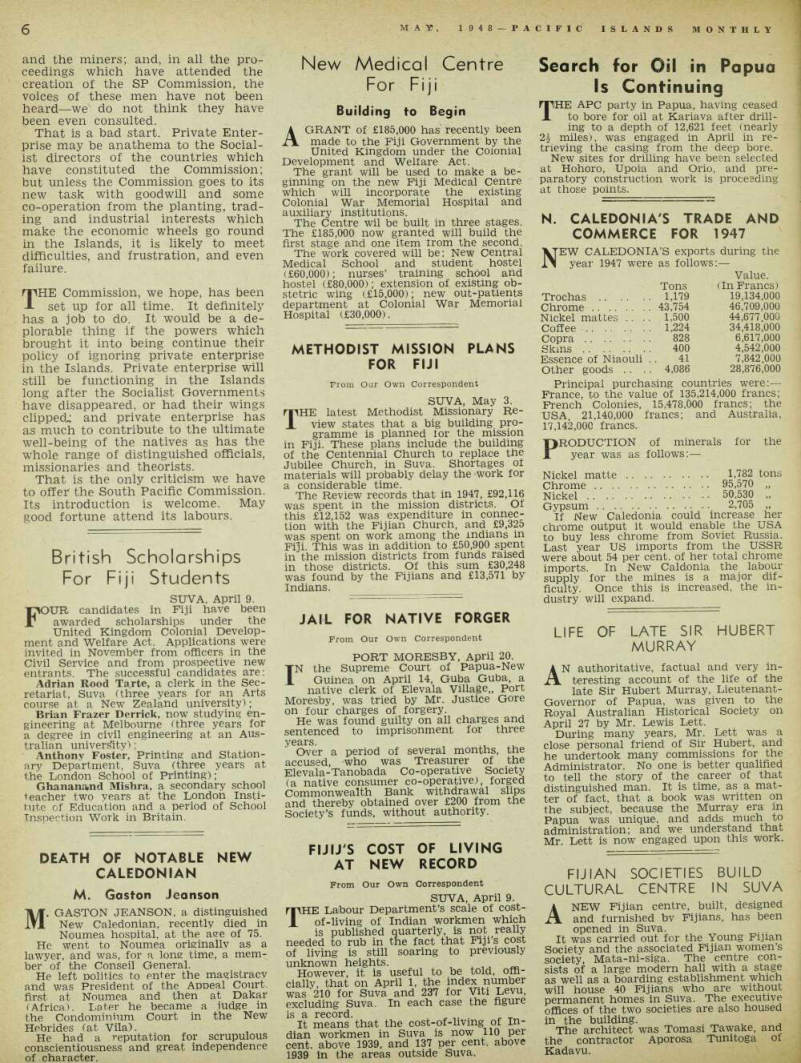
AN examination of the history and background of the delegates who assembled for the Commission’s first session suggested that, among them, there were too many bureau crats and professional men, who have lived sheltered liVes and who have had little personal experience of the rough and tough side of Islands con ditions. No man can get a well-bal anced view of Islands life—especially the essential relations between Euro peans and natives—if his knowledge of Islands conditions has been gained as a Government official, a mission ary or an anthropologist. Some of the men who assembled on May 11 were gentlemen of great distinction in their particular fields; and such men are an essential part of the Islands set-up. But so, also, are the planters and traders, the schooner captains
and the miners; and, in all the pro ceedings which have attended the creation of the SP Commission, the voices of these men have not been heard—we do not think they have been even consulted.
That is a bad start. Private Enter prise may be anathema to the Social ist directors of the countries which have constituted the Commission; but unless the Commission goes to its new task with goodwill and some co-operation from the planting, trad ing and industrial interests which make the economic wheels go round in the Islands, it is likely to meet difficulties, and frustration, and even failure.
THE Commission, we hope, has been set up for all time. It definitely has a job to do. It would be a de plorable thing if the powers which brought it into being continue their policy of ignoring private enterprise in the Islands. Private enterprise will still be functioning in the Islands long after the Socialist Governments have disappeared, or had their wings and private enterprise has as much to contribute to the ultimate well-being of the natives as has the whole range of distinguished officials, missionaries and theorists.
That is the only criticism we have to offer the South Pacific Commission.
Its introduction is welcome. May good fortune attend its labours.