Lament From
p. 48 · Read in the full issue
Levuka
A Visitor Writes of the Changes She Sees in the Town After
25 Years
ALL my life I have wanted to “sit and think or maybe just sit”; and here we are, in the one spot on earth, where one may stagnate into a mollusc. I penned a little ditty once for you “Time is no object in all South Seas!” Well, here that is more than right.
Maybe I’m just built cussed-like!
Having at last got what I wanted in leisure, I am finding it has, like sin, a penalty. I can sit and think—or not— in this lovely old town of Levuka, but actually I’m sitting cussing because I can’t snake the whole darn caboose up!
I want to make sweeping reforms! (How the locals would hate me if they knew!) This place has given me the peace I craved; but it has also given my pride of race a great set-back. You see, I knew this place when I was a girl.
Then I had a charming old uncle who lived in his attractive waterfront home playing with his stamp collection between local “eats and drinks.” Then Levuka lay at the cross roads of the South Seas world, and between the harbour, full of ships, and the cargo “in” and the local exports “out,” Levuka was a busy, thriv ing and vital little spot.
Its fine “Ovalau Club,” complete with reading room and library, its local “Planters Club” and general male ren dezvous, and its local orchestra, were things to boast about. The Club is still good; likewise the Bowling Club.
Well, even if there was once a copra slump; and even if the seat of Adminis tration is now in Suva; and even (again) if there was a war surely the whole place can get a move on and tidy up?
There is a general air of inertia every where, Many of the once well-built bungalows are now untenanted and fall ing to pieces. But surely the sagging posts, roofs, and gates of the tenanted nomes could be repaired and made tidy, and the leprous - looking unpainted houses, stores and pub, painted. One may blame the lack of paint and beyond that, the lack of shipping but the fault is very much lack of local pride.
But what strikes me most of all here in Levuka is: What is to be the future of the immense number of part-European young people and children?
There are fine schools and good board ing hostels here and the children live,
as far as eating and dressing go, at a good standard. But what of the future?
How will they all live?
The present easily made money, earn ings left from the Yank era, and the high price of copra can’t last for ever. This stagnant prosperity, gets me! The local labour shortage is so acute that prospec tive development is hamstrung.
There is a local pineapple cannery due to commence canning this month and pineapples grown here are unique. Mr, A. G. McCown, just back from America, has spent years and a large amount of money, to bring this fine project into being.
As I write he is facing great difficulties.
There is a 10/- a month rise demanded by unskilled native labour, stacked against the rigid regulations of the Fiji Prices Control Commissioner, and the competition of cheaply produced “foreign” products. But during the war, this fac tory produced 5,000 cases of canned pine apple working through November, Dec ember and January. The overseas de mand was growing and the industry pro mised a sound local development. One could easily visualise this as successful as the Hawaiian pineapple industry with pineapple gardens covering miles of foot hills of Ovalau, which now are matted with weeds and shrubs ever-shrinking garden areas. Even in my memory I knew them as acres of fine native and European food gardens.
But now there is a universal food shortage in once bounteous Levuka.
Mi*, and Mrs. T. Low, of Rotuma Island, Fiji, left the island in December for Fiji en route to Pago Pago, American Samoa. Mr. Low has been appointed branch manager of Burns Philp and Co. (SS) Ltd., at Pago Pago, after nine years’ service with the company on Rotuma.
Mrs. Low, who is well -known to “PIM” readers for her bright sketches and stories, which appear under the pen name of “Amel,” says that they feel a great sadness at leaving the island which they know so well and will always re member, in spite of its faults. But at the same time they are looking forward to their plunge into things American at Pago. “PIM” readers will be looking for ward to Amel’s impressions of life under the Stars and Stripes.
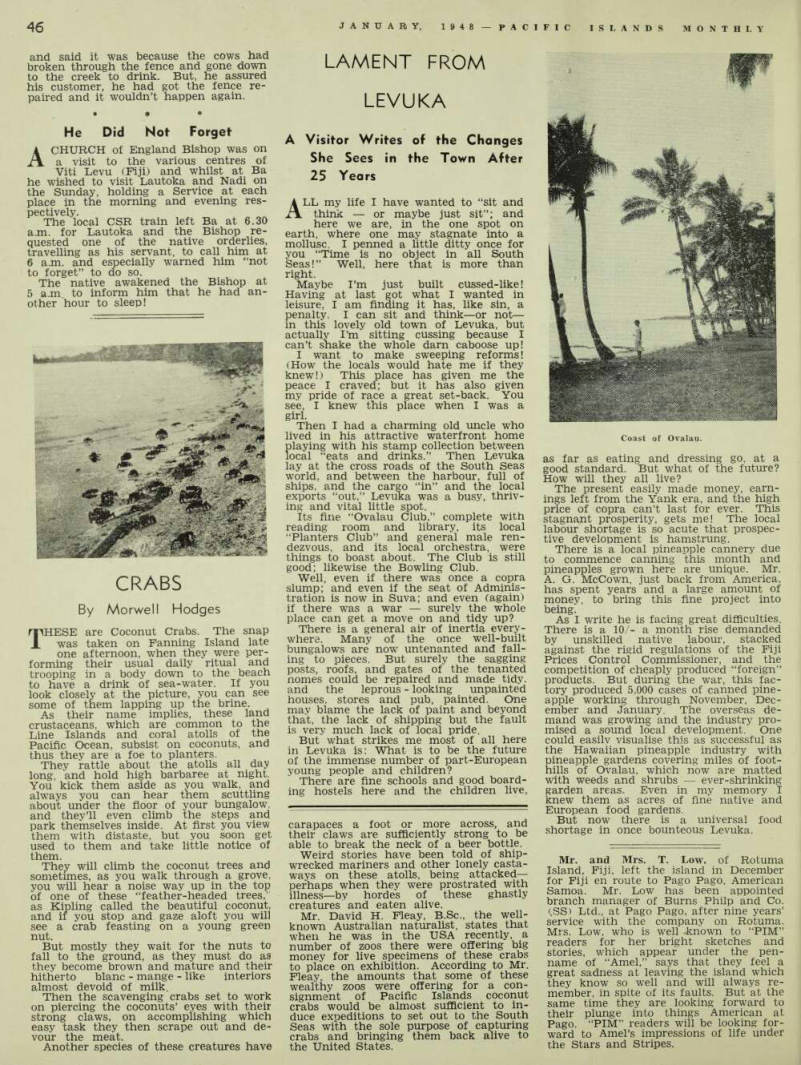
Coast of Ovalau.