Slow and Wearisome Process
pp. 36-38 · Read in the full issue
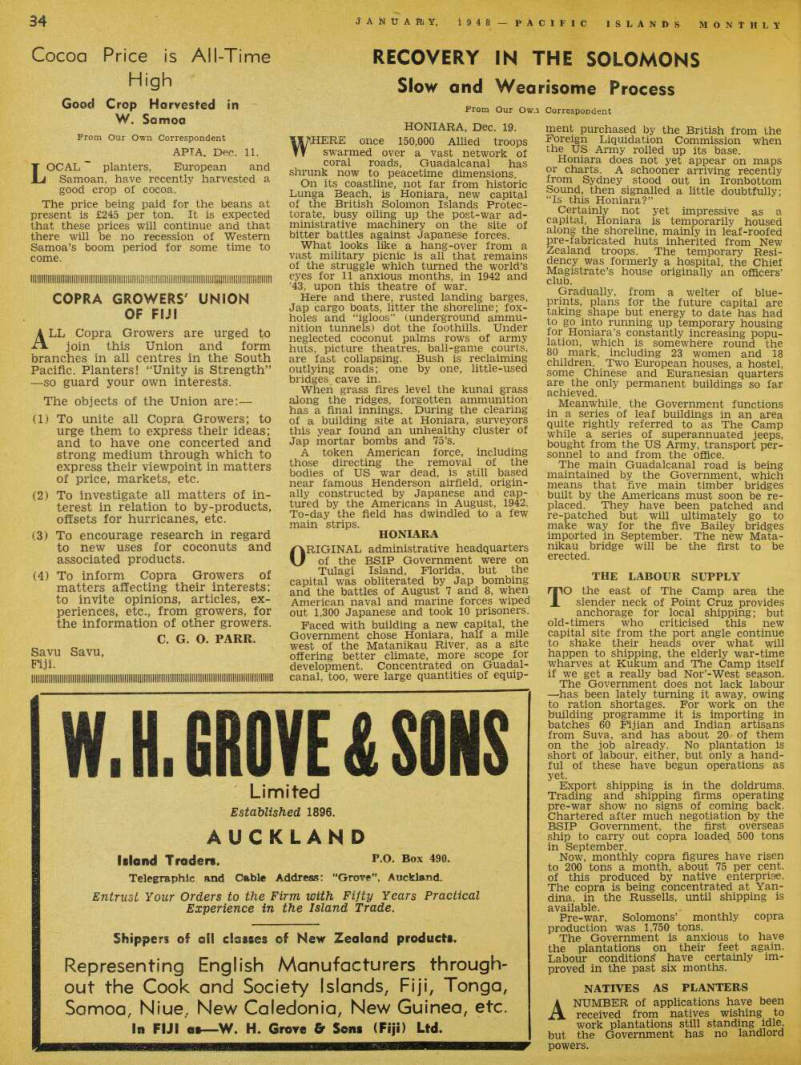

Recovery In The Solomons
From Our Owj Correspondent
Honiara, Dec. 19.
WHERE once 150,000 Allied troops swarmed over a vast network of coral roads, Guadalcanal has shrunk now to peacetime dimensions.
On its coastline, not far from historic Lunga Beach, is Honiara, new capital of the British Solomon Islands Protec torate, busy oiling up the post-war ad ministrative machinery on the site of bitter battles against Japanese forces.
What looks like a hang-over from a vast military picnic is all that remains of the struggle which turned the world’s eyes for 11 anxious months, in 1942 and '43, upon this theatre of war.
Here and there, rusted landing barges, Jap cargo boats, litter the shoreline; fox holes and “igloos” (underground ammu nition tunnels) dot the foothills. Under neglected coconut palms rows of army huts, picture theatres, ball-game courts, are fast collapsing. Bush is reclaiming outlying roads; one by one, little-used bridges cave in.
When grass fires level the kunai grass along the ridges, forgotten ammunition has a final innings. During the clearing of a building site at Honiara, surveyors this year found an unhealthy cluster of Jap mortar bombs and 75’s.
A token American force, including those directing the removal of the bodies of US war dead, is still based near famous Henderson airfield, origin ally constructed by Japanese and cap tured by the Americans in August, 1942.
To-day the field has dwindled to a few main strips.
Honiara
ORIGINAL administrative headquarters
of the BSIP Government were on Tulagi Island, Florida, but the capital was obliterated by Jap bombing and the battles of August 7 and 8, when American naval and marine forces wiped out 1,300 Japanese and took 10 prisoners.
Faced with building a new capital, the Government chose Honiara, half a mile west of the Matanikau River, as a site offering better climate, more scope for development. Concentrated on Guadal canal, too, were large quantities of equip
ment purchased by the British from the Foreign Liquidation Commission when the US Army rolled up its base.
Honiara does not yet appear on maps or charts. A schooner arriving recently from Sydney stood out in Ironbottom Sound, then signalled a little doubtfully; “Is this Honiara?”
Certainly not yet impressive as a capital, Honiara is temnorarily housed along the shoreline, mainly in leaf-roofed pre-fabricated huts inherited from New Zealand troops. The temporary Resi dency was formerly a hospital, the Chief Magistrate’s house originally an officers’ club.
Gradually, from a welter of blue prints, plans for the future capital are taking shape but energy to date has had to go into running up temporary housing for Honiara’s constantly increasing popu lation, which is somewhere round the 80 mark, including 23 women and 18 children. Two European houses, a hostel, some Chinese and Euranesian quarters are the only permanent buildings so far achieved.
Meanwhile, the Government functions in a series of leaf buildings in an area quite rightly referred to as The Camp while a series of superannuated jeeps, bought from the US Army, transport per sonnel to and from the office.
The main Guadalcanal road is being maintained by the Government, which means that five main timber bridges built by the Americans must soon be re placed. They have been patched and re-patched but will ultimately go to make way for the five Bailey bridges imported in September, The new Mata nikau bridge will be the first to be erected.
The Labour Supply
TO the east of The Camp area the slender neck of Point Cruz provides anchorage for local shipping; but old-timers who criticised this new capital site from the port angle continue to shake their heads over what will happen to shipping, the elderly war-time wharves at Kukum and The Camp itself if we get a really bad Nor’-West season.
The Government does not lack labour —has been lately turning it away, owing to ration shortages. For work on the building programme it is importing in batches 60 Fijian and Indian artisans from Suva, and has about 20 of them on the job already. No plantation is short of labour, either, but only a hand ful of these have begun operations as yet.
Export shipping is in the doldrums.
Trading and shipping firms operating pre-war show no signs of coming back.
Chartered after much negotiation by the BSIP Government, the first overseas ship to carry out copra loaded 500 tons in September.
Now, monthly copra figures have risen to 200 tons a month, about 75 per cent, of this produced by native enterprise.
The copra is being concentrated at Yan dina. in the Russells, until shipping is available Pre-war, Solomons’ monthly copra production was 1,750 tons.
The Government is anxious to have the plantations on their feet again, Labour have certainly im proved in the past six months.
Natives As Planters
A NUMBER of applications have been received from natives wishing to work plantations still standing idle, but the Government has no landlord powers.
The first such scheme is under way on well-known Berande plantation, where a group of Tasimboko natives have entered into an agreement with the present lessee, Mr. J. C. Williamson, to work a portion of the Berande estate,
retaining two-thirds of the proceeds themselves.
At the moment, Honiara’s contact with the outside world is through Suva, and through occasional Trans-Oceanic flying boats for whose use a mooring buoy was laid down in a 4-fathom patch to the east of Point Cruz on December 8, Previously, Tulagi was the terminal point; but Point Cruz will be available, in suitable weather only.
The now Government-owned Kuri marau (Lever’s, pre-war) makes a trip to Suva roughly every eight weeks for mail and stores, but cargo space is a constant problem with so many people to supply, and the Government Trade Scheme only store in Honiara, apart from a few Chinese operating at higher prices to be kept in stocks.
Care Of Natives
rTH slender revenue coming in, working on a Grant-in-Aid from Great Britain, the Government is pushing ahead an ambitious rehabilita tion programme.
An expanded scheme for medical assis tance to natives throughout the Group is well under way, from the temporary Central Government hospital at Mata nikau its buildings and equipment bought from the US authorities. This supplies medicines, etc., to district Gov ernment hospitals, which are supervised by a medical officer with a trained native staff.
An educational programme promoting schools in village centres is under way,
Agricultural officers are fostering village agriculture. Loyal government by native councils working under the super vision of district officers is being incul cated in various areas.
“Marching Rule”
BIGGEST post-war headache for the Government has been the subversive movement known as “Marching Rule” (native way of saying “Marxian Law”); but this was decisively checked in August by the arrest of nearly 106 native ringleaders and followers.
On December 15 the trial of the 33 main leaders began in Honiara, at which more than 70 witnesses are giving evid ence, both for the prosecution and the defence.
At present, things are quiet. The Marching Rule movement appears to have been generally relinquished on Guadalcanal, except in one or two areas.
And it is regarded as significant that since the Government arrests, one or two places regarded previously as a March ing Rule hotbed have turned their ener gies to native production.