Sir W. Mcnicoll
p. 15 · Read in the full issue
Death in Sydney: Aged 70
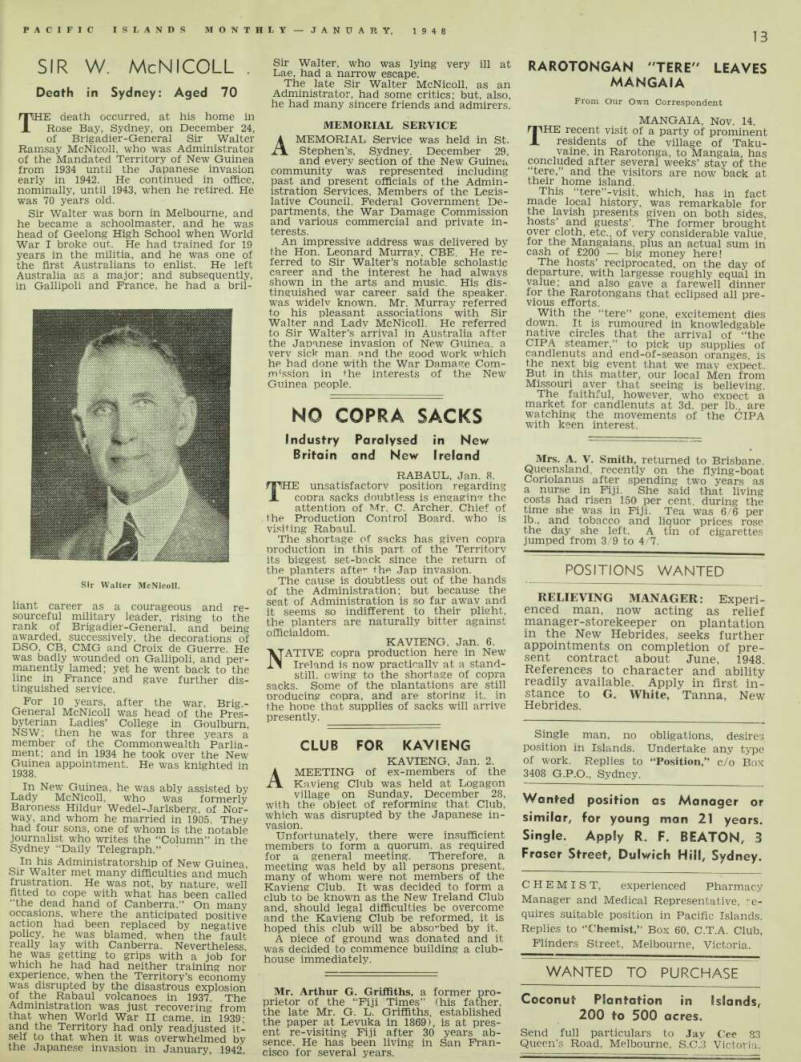
rE death occurred, at his home in Rose Bay, Sydney, on December 24, of Brigadier-General Sir Walter Ramsay McNicoll, who was Administrator of the Mandated Territory of New Guinea from 1934 until the Japanese invasion early in 1942. He continued in office, nominally, until 1943, when he retired. He was 70 years old.
Sir Walter was born in Melbourne, and he became a schoolmaster, and he was head of Geelong High School when World War I broke out. He had trained for 19 years in the militia, and he was one of the first Australians to enlist. He left Australia as a major; and subsequently, in Gallipoli and France, he had a bril-
liant career as a courageous and re sourceful military leader, rising to the rank of Brigadier-General, and being awarded, successively, the decorations of DSO, CB, CMG and Croix de Guerre. He was badly wounded on Gallipoli, and per manently lamed; yet he went back to the line in France and gave further dis tinguished service.
For 10 years, after the war, Brig.- General McNicoll was head of the Pres byterian Ladies’ College in Goulburn, NSW; then he was for three years a member of the Commonwealth Parlia ment; and in 1934 he took over the New Guinea appointment. He was knighted in 1938.
In New Guinea, he was ably assisted by Lady McNicoll, who was formerly Baroness Hildur Wedel-Jarlsberg, of Nor way, and whom he married in 1905. They had four sons, one of whom is the notable journalist who writes the “Column” in the Sydney “Daily Telegraph.”
In his Administratorship of New Guinea, Sir Walter met many difficulties and much frustration. He was not, by nature, well fitted to cope with what has been called “the dead hand of Canberra.” On many occasions, where the anticipated positive action had been replaced by negative policy, he was blamed, when the fault really lay with Canberra. Nevertheless, he was getting to grips with a job for which he had had neither training nor experience, when the Territory’s economy was disrupted by the disastrous explosion of the Rabaul volcanoes in 1937. The Administration was just recovering from that when World War II came, in 1939and the Territory had only readjusted it self to that when it was overwhelmed by the Japanese invasion in January, 1942.
Sir Walter, who was lying very ill at Lae, had a narrow escape.
The late Sir Walter McNicoll, as an Administrator, had some critics; but, also, he had many sincere friends and admirers.
Memorial Service
A MEMORIAL Service was held in St.
Stephen’s, Sydney. December 29, and every section of the New Guinea community was represented including past and present officials of the Admin istration Services, Members of the Legis lative Council, Federal Government De partments, the War Damage Commission and various commercial and private in terests.
An impressive address was delivered by the Hon. Leonard Murray. CBE. He re ferred to Sir Walter’s notable scholastic career and the interest he had always shown in the arts and music. His dis tinguished war career said the speaker, was widelv known. Mr. Murray referred to his pleasant associations with Sir Walter and Ladv McNicoll. He referred to Sir Walter’s arrival in Australia after the Japanese invasion of New Guinea, a very sick man. and the good work which he had done with the War Damage Com mission in the interests of the New Guinea people.
Sir Walter McNicoll.