Micronesia
p. 50 · Read in the full issue
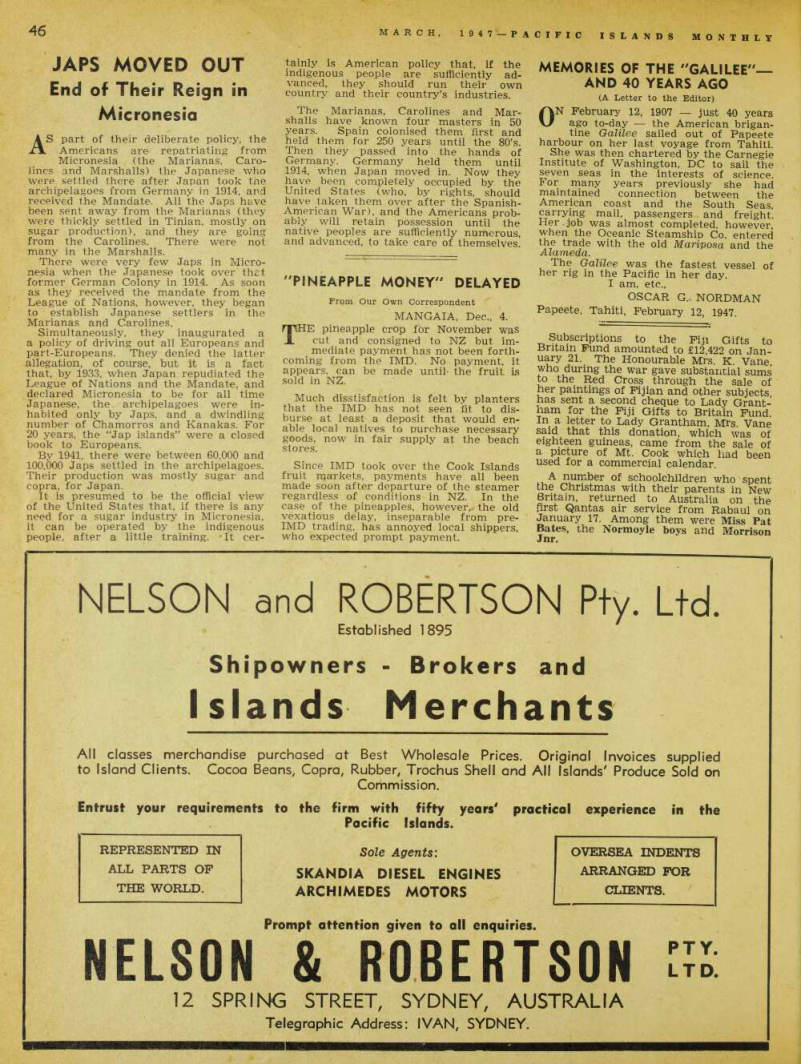
Japs Moved Out
End of Their Reign in Micronesia
AS part of their deliberate policy, the Americans are repatriating from Micronesia (the Marianas. Caro lines and Marshalls) the Japanese who were settled there after Japan took the archipelagoes from Germany in 1914, and received the Mandate. All the Japs have been sent away from the Marianas (they were thickly settled in Tinian, mostly on sugar production), and they are going from the Carolines. There were not many in the Marshalls.
There were very few Japs in Micro nesia when the Japanese took over that former German Colony in 1914. As soon as they received the mandate from the League of Nations, however, they began to establish Japanese settlers in the Marianas and Carolines.
Simultaneously, they inaugurated a a policy of driving out all Europeans and part-Europeans. They denied the latter allegation, of course, but it is a fact that, by 1933, when Japan repudiated the League of Nations and the Mandate, and declared Micronesia to be for all time Japanese, the archipelagoes were in habited only by Japs, and a dwindling number of Chamorros and Kanakas. For 20 years, the “Jap islands” were a closed book to Europeans.
By 1941, there were between 60,000 and 100,000 Japs settled in the archipelagoes.
Their production was mostly sugar and copra, for Japan.
It is presumed to be the official view of the United States that, if there is any need for a sugar industry in Micronesia, it can be operated by the indigenous people, after a little training. *lt cer
tainly is American policy that, if the indigenous people are sufficiently ad vanced, they should run their own country and their country’s industries.
The Marianas, Carolines and Mar shalls have known four masters in 50 years. Spain colonised them first and held them for 250 years until the 80’s.
Then they passed into the hands of Germany. Germany held them until 1914, when Japan moved in. Now they have been completely occupied by the United States (who, by rights, should have taken them over after the Spanish- American War), and the Americans prob ably will retain possession until the native peoples are sufficiently numerous, and advanced, to take care of themselves.