Fiji's Candle-Nut Oil
p. 32 · Read in the full issue
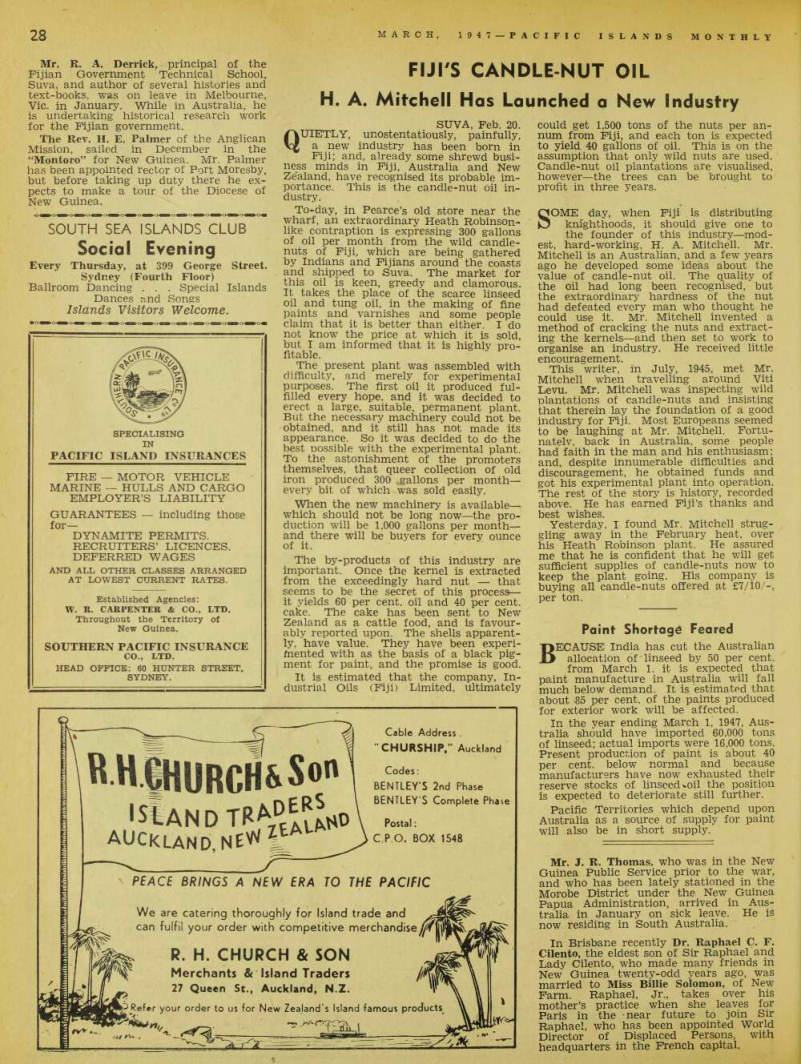
H. A. Mitchell Has Launched a New Industry
Suva, Feb. 20.
QUIETLY, unostentatiously, painfully,
a new industry has been born in Fiji; and, already some shrewd busi ness minds in Fiji, Australia and New Zealand, have recognised its probable im portance. This is the candle-nut oil in dustry.
To-day, in Pearce’s old store near the wharf, an extraordinary Heath Robinson like contraption is expressing 300 gallons of oil per month from the wild candle nuts of Fiji, which are being gathered by Indians and Fijians around the coasts and shipped to Suva. The market for this oil is keen, greedy and clamorous.
It takes the place of the scarce linseed oil and tung oil, in the making of fine paints and varnishes and some people claim that it is better than either. I do not know the price at which it is sold, but I am informed that it is highly pro fitable.
The present plant was assembled with difficulty, and merely for experimental purposes. The first oil it produced ful filled every hope, and it was decided to erect a large, suitable, permanent plant.
But the necessary machinery could not be obtained, and it still has not made its appearance. So it was decided to do the best nossible with the experimental plant.
To the astonishment of the promoters themselves, that queer collection of old iron produced 300 gallons per month— every bit of which was sold easily.
When the new machinery is available— which should not be long now—the pro duction will be 1,000 gallons per month— and there will be buyers for every ounce of it.
The by-products of this industry are important. Once the kernel is extracted from the exceedingly hard nut that seems to be the secret of this process— it yields 60 per cent, oil and 40 per cent, cake. The cake has been sent to New Zealand as a cattle food, and is favour ably reported upon. The shells apparent ly, have value. They have been experi mented with as the basis of a black pig ment for paint, and the promise is good.
It is estimated that the company, In dustrial Oils (Fiji) Limited, ultimately
could get 1,500 tons of the nuts per an num from Fiji, and each ton is expected to yield 40 gallons of oil. This is on the assumption that only wild nuts are used.
Candle-nut oil plantations are visualised, however —the trees can be brought to profit in three years.
SOME day, when Fiji is distributing knighthoods, it should give one to the founder of this industry—mod est, hard-working, H. A. Mitchell. Mr.
Mitchell is an Australian, and a few years ago he developed some ideas about the value of candle-nut oil. The quality of the oil had long been recognised, but the extraordinary hardness of the nut had defeated every man who thought he could use it. Mr. Mitchell invented a method of cracking the nuts and extract ing the kernels—and then set to work to organise an industry. He received little encouragement.
This writer, in July, 1945, met Mr.
Mitchell when travelling around Viti Levu. Mr. Mitchell was inspecting wild plantations of candle-nuts and insisting that therein lay the foundation of a good industry for Fiji. Most Europeans seemed to be laughing at Mr. Mitchell. Fortu nately, back in Australia, some people had faith in the man and his enthusiasm: and, despite innumerable difficulties and discouragement, he obtained funds and got his experimental plant into operation.
The rest of the story is history, recorded above. He has earned Fiji’s thanks and best wishes.
Yesterday, I found Mr. Mitchell strug gling away in the February heat, over his Heath Robinson plant. He assured me that he is confident that he will get sufficient supplies of candle-nuts now to keep the plant going. His company is buying all candle-nuts offered at £7/10/-, per ton.
Paint Shortage Feared
BECAUSE India has cut the Australian allocation of 'linseed by 50 per cent, from March 1. it is expected that paint manufacture in Australia will fall much below demand. It is estimated that about 85 per cent, of the paints produced for exterior work will be affected.
In the year ending March 1, 1947, Aus tralia should have imported 60,000 tons of linseed; actual imports were 16,000 tons.
Present production of paint is about 40 per cent, below normal and because manufacturers have now exhausted their reserve stocks of linseed *oil the position is expected to deteriorate still further.
Pacific Territories which depend upon Australia as a source of supply for paint will also be in short supply.
Mr. J. R. Thomas, who was in the New Guinea Public Service prior to the war, and who has been lately stationed in the Morobe District under the New Guinea Papua Administration, arrived in Aus tralia in January on sick leave. He is now residing in South Australia.
In Brisbane recently Dr. Raphael C. F.
Cilento, the eldest son of Sir Raphael and Lady Cilento, who made many friends in New Guinea twenty-odd years ago, was married to Miss Billie Solomon, of New Farm. Raphael, Jr., takes over his mother’s practice when she leaves for Paris in the near future to join Sir Raphael, who has been appointed World Director of Displaced Persons, with headquarters in the French capital.