Trials
p. 19 · Read in the full issue
Robaul War Criminal Trials Some Prisoners Could Solve Mys tery of Territorians' Disappear ance
Prom Our Own Correspondent
Rabaul, Feb. 11
r[E “Nellore” arrived in Rabaul re cently with some Jap legal advisers for the defence of Jap generals and high Jap officers imprisoned here. Tosh, who at one time was employed at Numa Numa plantation and was well-known throughout New Guinea, but who lately played a prominent part in the Japanese army hereabouts, will be amongst those who are tried.
The natives have told me something about his cruelties.
One of his playful habits was to have offending kanakas lined up two by two in front of their graves and then kill them by striking them on the base of the skull or the base of the spine. One boy whom I know well told me that the Japs stole his fowls and, by way of re taliation, he stole a case of meat. The Japs found out and for punishment strung him up to a tree head downwards for short periods.
One of these Jap prisoners was head of what might be called the Japanese Gestapo. I am convinced that he could tell us something of Albert Evensen. Bill Korn and quite a number of other Euro peans who disapneared here about Easter, 1945. I am afraid, however, that few Australians are interested in seeing jus tice meted out to these Japs.
Mrs. Stan McCosker, formerly of Mat ala Plantation, Rabaul, is at present living at Kelvin Grove, Brisbane. She is on the teaching staff of the Moreton Bay High School, Wynnum, and the Brisbane Girls Grammar School. In her spare time she is treasurer of the local NG Association. Mr. McCosker returned to his plantation early in 1946.
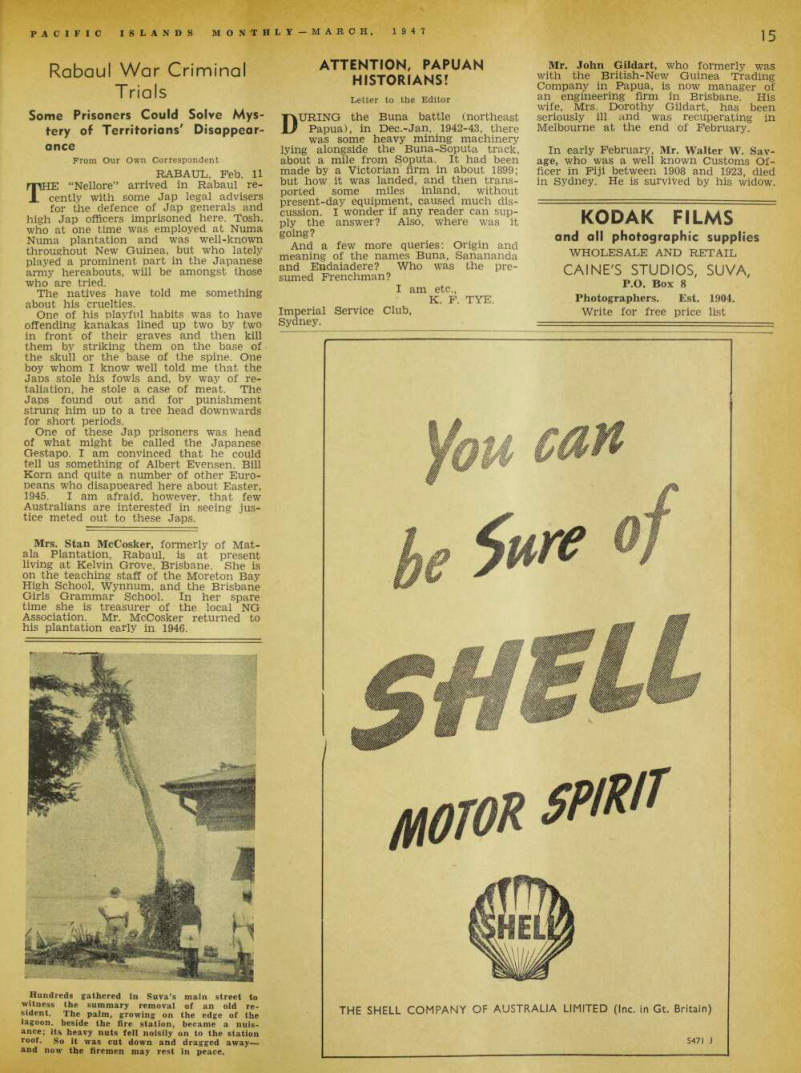
Hundreds gathered in Suva’s main street to witness the summary removal of an old re sident. The palm, growing on the edge of the lagoon, beside the fire station, became a nuis ance; its heavy nuts fell noisily on to the station roof. So it was cut down and dragged away— and now the firemen may rest in peace.