"Papa" Viggo Is
pp. 12-13 · Read in the full issue
Dead
Life Story of Famous South Seas Captain and Trader
From Our Own Correspondent
Rarotonga, Feb. 21
HIS many friends throughout the Paci fic, and further afield, will learn with regret of the passing of Captain Viggo Rasmussen on January 30 at his home in Penrhyn Island, where he leaves a widow and three young Euronesian sons.
He had been in failing health for a long period, necessitating his retirement from the post of Resident Agent of Pen rhyn in November 1945. During the greater part of 1946 he was cared for at the Rarotonga Hospital. Realising that his end was near, he obtained permission to return to his Penrhyn home to finish his days: and he sailed on the schooner “Tiare Taporo”’ in December. To the friends who gathered to bid him farewell, Captain Viggo said that he would not feel any regret if he passed away aboard the schooner which he had himself com manded for so many happy years.
“Papa” Viggo—as he was affectionately known to countless Europeans and natives in the ocean world in which he had wandered and lived for half a century
was one of the best-known Island char acters of our times. He has been men tioned in many South Sea books. With his short, rotund figure, the blue eyes of his far northern birthplace, and his genial, kindly nature, he was greatly liked by all who knew him.
CIAPTAIN VIGGO (few ever troubled to ' use his surname) was born in 1877 at Copenhagen, Denmark: and he became a naturalised British subject. He went to sea at an early age, sailing to Iceland as a boy in the fish trade. But he was destined to spend the greater part of his life in a much warmer clime.
While still in his teens he had his first glimpse of the South Seas, in the savage beauty of the Marquesas, from the deck of a Norwegian sailing ship.
He landed at Tahiti in 1896. and his romantic spirit was captivated by the glqmour of Islands life. He spent ten years in the Society Islands, sometimes ashore, sometimes afloat. During the pearling season, he worked with the pearlers in the Paumotus, surviving one of the violent hurricanes for which the Dangerous Isles are noted.
In Tahiti, the Captain met a girl from
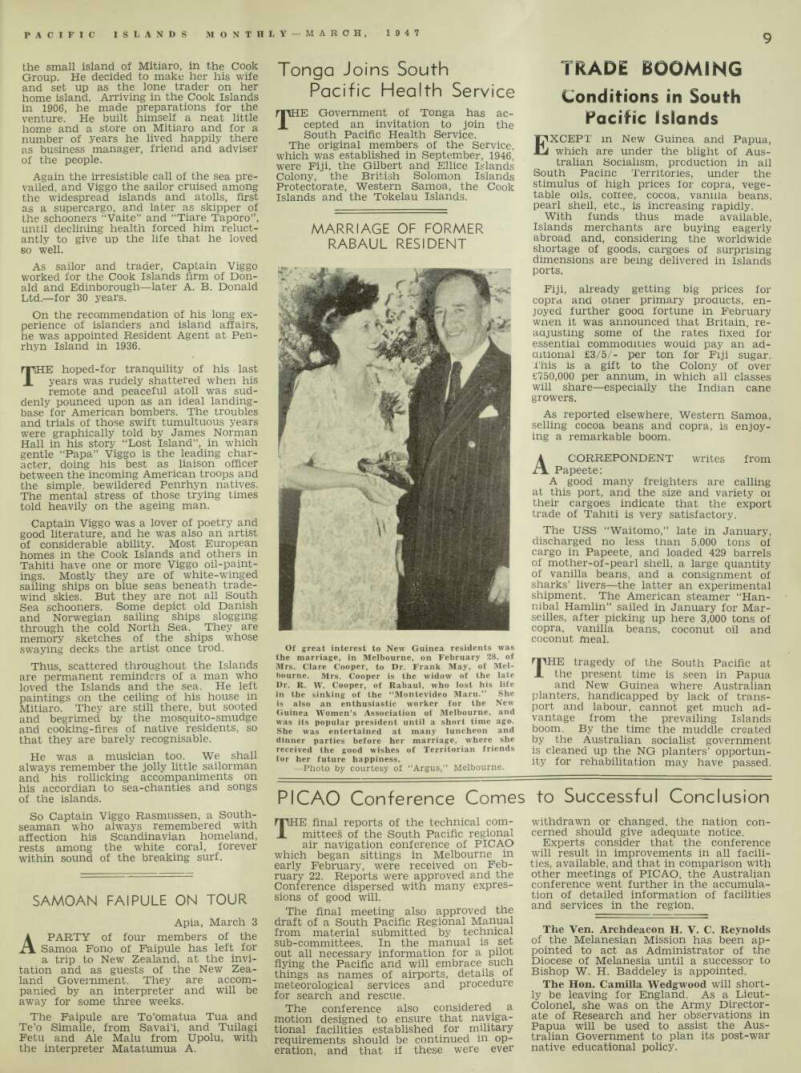
Capt. Viggo with his second wife and three sons outside his Penrhyn home.
the small island of Mitiaro, in the Cook Group. He decided to make her his wife and set up as the lone trader on her home island. Arriving in the Cook Islands in 1906, he made preparations for the venture. He built himself a neat little home and a store on Mitiaro and for a number of years he lived happily there as business manager, friend and adviser of the people.
Again the irresistible call of the sea pre vailed, and Viggo the sailor cruised among the widespread islands and atolls, first as a supercargo, and later as skipper of the schooners “Vaite” and “Tiare Taporo”, until declining health forced him reluct antly to give up the life that he loved so well.
As sailor and trader, Captain Viggo worked for the Cook Islands firm of Don ald and Edinborough—later A, B. Donald Ltd.—for 30 years.
On the recommendation of his long ex perience of islanders and island affairs, he was appointed Resident Agent at Pen rhyn Island in 1936. rE hoped-for tranquility of his last years was rudely shattered when his remote and peaceful atoll was sud denly pounced upon as an ideal landing base for American bombers. The troubles and trials of those swift tumultuous years were graphically told by James Norman Hall in his story “Lost Island”, in which gentle “Papa” Viggo is the leading char acter, doing his best as liaison officer between the incoming American troops and the simple, bewildered Penrhyn natives.
The mental stress of those trying times told heavily on the ageing man.
Captain Viggo was a lover of poetry and good literature, and he was also an artist of considerable ability. Most European homes in the Cook Islands and others in Tahiti have one or more Viggo oil-paint ings. Mostly they are of white-winged sailing ships on blue seas beneath trade wind skies. But they are not all South Sea schooners. Some depict old Danish and Norwegian sailing ships slogging through the cold North Sea. They are memory sketches of the ships whose swaying decks the artist once trod.
Thus, scattered throughout the Islands are permanent reminders of a man who loved the Islands and the sea. He left paintings on the ceiling of his house in Mitiaro. They are still there, but sooted and begrimed by the mosquito-smudge and cooking-fires of native residents, so that they are barely recognisable.
He was a musician too. We shall always remember the jolly little sailorman and his rollicking accompaniments on his accordian to sea-chanties and songs of the islands.
So Captain Viggo Rasmussen, a South seaman who always remembered with affection his Scandinavian homeland, rests among the white coral, forever within sound of the breaking surf.