and Self-Government
pp. 10-75 · Read in the full issue
Samoans’ Plea For Unity and Self-Government Europeans in Favour of a "Period of Transition"
mHE petition signed by 46 Samoan X chiefs and members of the Council, praying for self-government for a united Samoa (that is, that Western and Eastern Samoa be brought together as one nation) came before the Trusteeship Council of the United Nations in New York on March 10. So far as is known, it is still under consideration.
“It is difficult to guess what the out come may be/’ said an authority on Samoan affairs recently. “The Samoan Trusteeship Agreement, as between New Zealand and the Trusteeship Council, now has been accepted by the Council, and, legally, there seems nothing more to be done about it. The Mandate under which Western Samoa has been held for 25 years by New Zealand was a C Class Mandate, which means that the Samoan people actually have no official voice in the manner of how they are to be gov erned.
The Samoan people themselves do not take that view, however. In any event, they appear determined to press on with their demand for an ever-increasing measure of self-government.
We have received verbatim reports of important public meetings held in Apia, for discussion of matters relating to the future of Samoa, the transfer of control to the Trusteeship Council, and the Samoan people’s demand for the union of Western and Eastern Samoa and self government.
“Self-Government —Yes —But
How And When?”
A MEETING of European residents of Western Samoa held in Apia on De cember 17, was addressed by the Ad ministrator, Colonel F. W. Voelcker. The latter had had several discussions with the Samoans concerning the Agreement, and he deemed it wise, at that stage, to explain what had happened, what was now being done, and what was likely to happen.
His Honor presented a detailed, his torical sketch, covering events in Samoa
during the past 50 years, and the con trol of me country after World War I by New Zealand, subject to the League ox Nations. He carefully explained me provisions of the C Class Mandate; and ne claimed that New Zealand’s record in Samoa was good and creditable.
New Zealand, in drafting the Agree ment under which Samoa would be transferred from the League of Nations Mandate to the Trusteeship Council of the United Nations, had the assistance of Britain, United States, France and Australia. The Agreement reached him in Apia at the end of October; and it was submitted to a Fono of all Samoa on November 13, and was discussed in de tail by the Samoans. The Samoans re jected the Agreement on the ground that it was not essentially different from the Mandatory system, and took no cogni sance of the Samoans’ 25-years-old de mand for self-government. The Samoans men presented a petition for transmis sion to the Trusteeship Council. (See page 12 of December PIM.) His Honor took the Agreement, clause by clause, and argued that it represented “a tremendous advance” on the Mandate, and was worthy of acceptance by the Samoan people. He then similarly an alysed the Samoans’ petition. He sym pathised with their wish for union with Eastern Samoa but explained that that was outside his jurisdiction.
There was no fundamental difference between the Samoans’ wishes and the Agreement plan, he said. The United Nations agreed that the ultimate aim was self-government—the only difference between them was how and when. The Samoans apparently wanted self-govern ment at once; the Europeans argued that there must be a fairly long period of education and preparation—otherwise the condition of the Samoans would not im prove, but would deteriorate.
His Honor said that the petition had been sent forward for presentation to the Trusteeship Council in March, and the Samoans’ arguments and representa-
tions and arguments also would be pro perly presented.
Commenting later, the Hon Tatasese Tamasese said: “There is an idea that we cannot have self-government because we have no trained people. That might be true; but I would refer you to Tonga, where self-government was established before they had any qualified people, and so long as we have self-government we can employ anyone from any part of the world.”
A Period Of Transition
A MEETING of European residents of Samoa was held on February 3 to discuss the Trusteeship Agreement The Hon. A. G. Smyth, MLC, was chair man; and the attendance was about 120.
Mr. Smyth said they did not know what kind of self-government the Samoans wanted. In any event, Samoa should be placed permanently within the British Empire, either as a Crown Colony or as a dependency of New Zealand. “I do not think Samoa is yet ready to be an independent self-governing State,” said Mr. Smyth. “A democratic system of self-government is impossible until the Samoan social and political systems emerge from their present state and de velop into something more in accord with modern ideas.”
Mr. P. W. Glover, in an interesting and closely reasoned address, argued that the Samoans were not yet ready for self government; their present social and political organisation could not take care
(Continued on page 71)
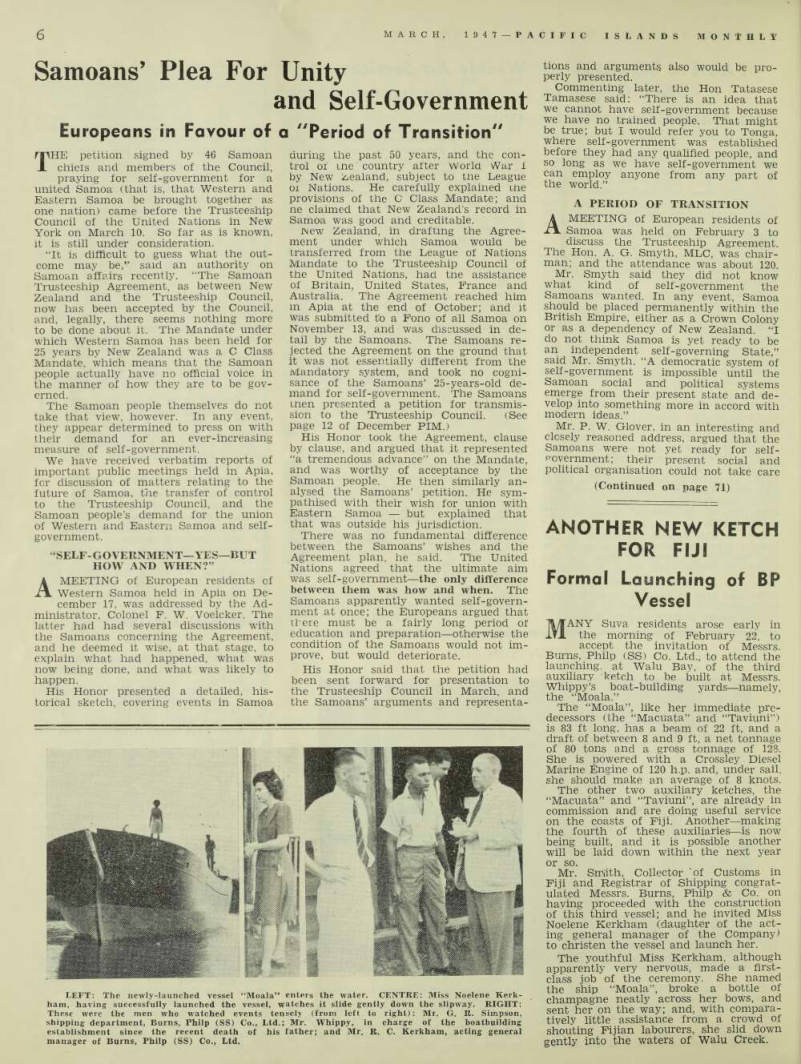
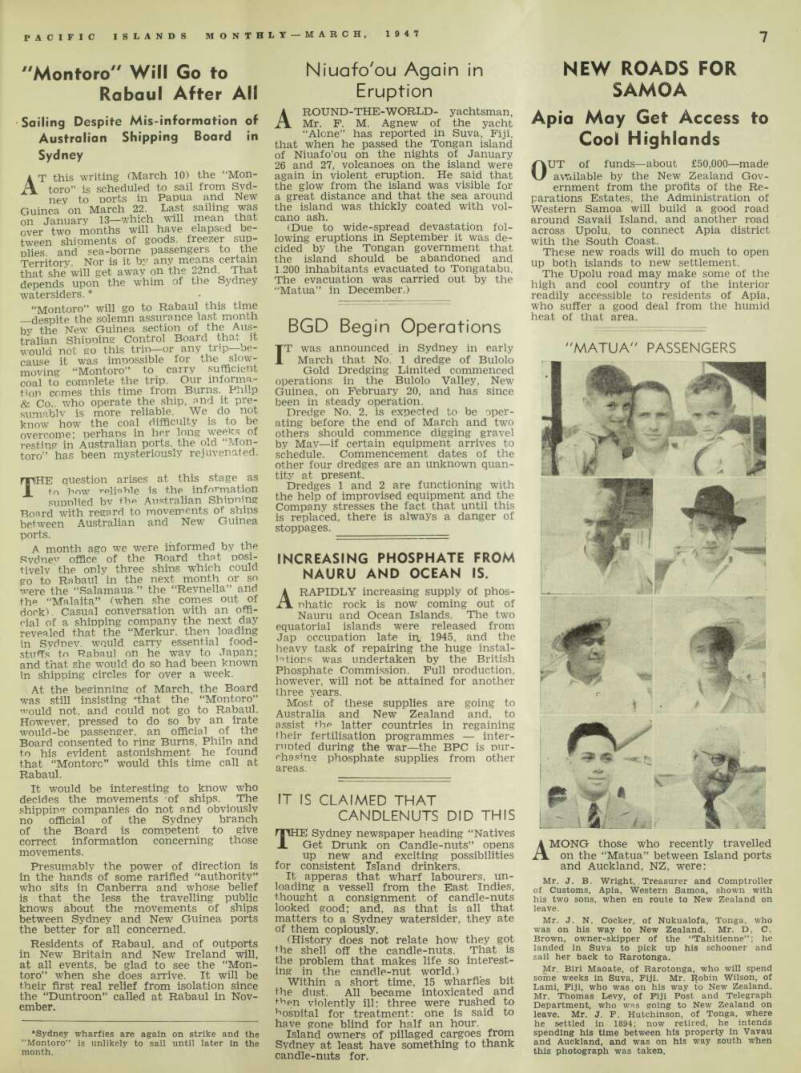
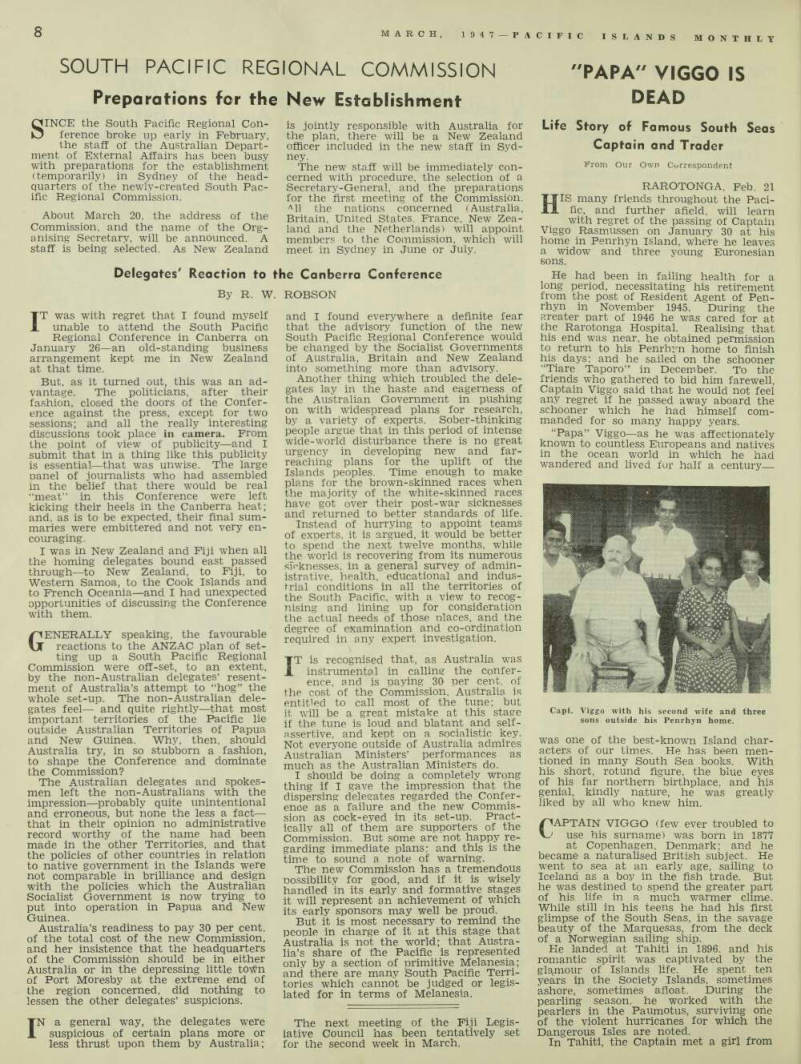
LEFT: The newly-launched vessel “Moala” enters the water. CENTRE: Miss Noelene Kerk ham, having successfully launched the vessel, watches it slide gently down the slipway. RIGHT; These were the men who watched events tensely (from left to right): Mr. G. R. Simpson, shipping department, Burns, Philp (SS) Co., Ltd.; Mr. Whippy, in charge of the boatbuilding establishment since the recent death of his father; and Mr. R. C. Kerkham, acting general manager of Burns, Philp (SS) Co., Ltd.
of their newly-acquired material knowl edge and modern conditions. “Theirs is a system of patriarchy modified by the early stages of feudalism. Is it any won der that their ideas on affairs of State, justice, finance, public service, general administration and so on are frequently at variance with those of Europeans?”
He urged that they should advise the Administrator that the plan of self-gov ernment for Samoa should be postponed for fifty years.
Hon. A. Stowers, MLC, said that if the Europeans would leave alone the 62,000 Samoans and the 5,000 Euronesians, they could look after themselves and manage their own affairs. When he was born in Samoa in 1883 Samoa was an indepen dent kingdom. The Europeans brought trouble into the country, and had kept trouble there ever since. He moved that they support the Samoan move for self government, and that the period of tran sition between present conditions a,nd self-government be considered by an elected committee representing the Euro peans, the Samoans and the Administra tion.
Mr. E. F. Paul pointed out that the Samoans did not ask for “immediate self government.” “I would not support the motion if it were for immediate self government. The time is not yet ripe; but I do believe that, in time, the Samoans will be capable and able to run their own affairs,” He argued in favour of “a period of transition,” when Sam oans would be given the chance to train themselves, with the assistance and sup port of New Zealand.
Mr. Glover said that, while he objected to immediate self-government, he did not object to self-government ultimately.
The motion was carried unanimously; and the following committee of 12 (pre sumably to represent the Europeans on the committee to discuss “the period of transition”) was elected; E. Annandale, Mrs. G. F. D. Betham, G. F. D. Betham, R. G. Bruce, R. H. Carruthers, F. Helg, J. Heig, Aleck Macdonald, H. W. Moors, Miss J. R. Nelson, E. F. Paul, R. Wetzell.
Philippines Example
ALL the indications are that the New Zealand Government, with the ap proval of the Trusteeship Council, will agree to a “period of transition,” during which the Samoans will be trained for virtual self-government.
Therefore, it would be to the advantage of all concerned to study the way in which the United States, having taken over the Philippines from Spain in 1898, gradually transferred governmental powers to the inexperienced hands of the Filipinos. There was a “transition period” between the passing of the Tydings- McDuffie Act of 1934 and the establish ment of almost complete independence in 1946. Many of the practical difficulties in the way of the Samoan plan are in dicated in the Philippines history.
Mr. “Biinny”Hammond, who has been acting as the representative of Guinea Airways Ltd., in New Guinea during the rehabilitation period, has now returned to Australia. The directors of Guinea Airways Ltd., have made no plans for the resumption of their air transportation services in New Guinea—it is presumed they are awaiting the result of the var ious air nationalsiation projects of the Commonwealth Government.