Proposed New Calendar
pp. 48-49 · Read in the full issue
World Move to Get Rid of Absurdities in Present Arrangement of Year
fTIHE World Calendar Association, Inc., X of 650 Fifth Avenue, New York, is organising a world-wide drive to have the New World Calendar brought into operation in 1950. It is a praise worthy plan to get rid of the wasteful, cumbersome and irritating Gregorian Calendar, now in operation throughout the world. To date, 14 nations have approved the World Calendar —Afghanistan, Brazil, Chili, China, Esthonia, Greece. Hungary, Mexico, Norway, Panama, Peru, Spain, Turkey, and Uru guay. The only really Western nation there is Norway.
The task of inducing the big nations to accept such a reform is enormous, but the Americans behind the movement believe jt can be accomplished. It is hoped to get the official approval of the United States in 1947. Canada probably
would follow USA. France and Russia probably would agree.
To bring the British nations into line, however, will not be easy—the British, in such matters, are the most stubborn and conservative people in the world.
Take, for example, the metric system.
Most of the great nations have followed the time and labour-saving device of cal culating in tens and hundreds—and en joyed incalculable benefits as a result. But not the British—they stick to their cum bersome pounds, shillings and pence, their feet, yards and miles, their ounces and pounds and tons. Even in the rule-of the-road,' tjie British refuse to co-operate with other nations. In British countries, traffic keeps to the left; but in practically every other country in the world, traffic keeps right. And so British motor cars cannot be sold outside the Empire with out considerable alteration; nor can American and French cars be sold in the Empire until the steering column is placed on the right side.
Other nations have accepted innumer able British institutions—the Greenwich system of time and navigation, for example. The British nations could reci procate by adopting the metric systems of record, the world rule-of-the-road, and the World Calendar.
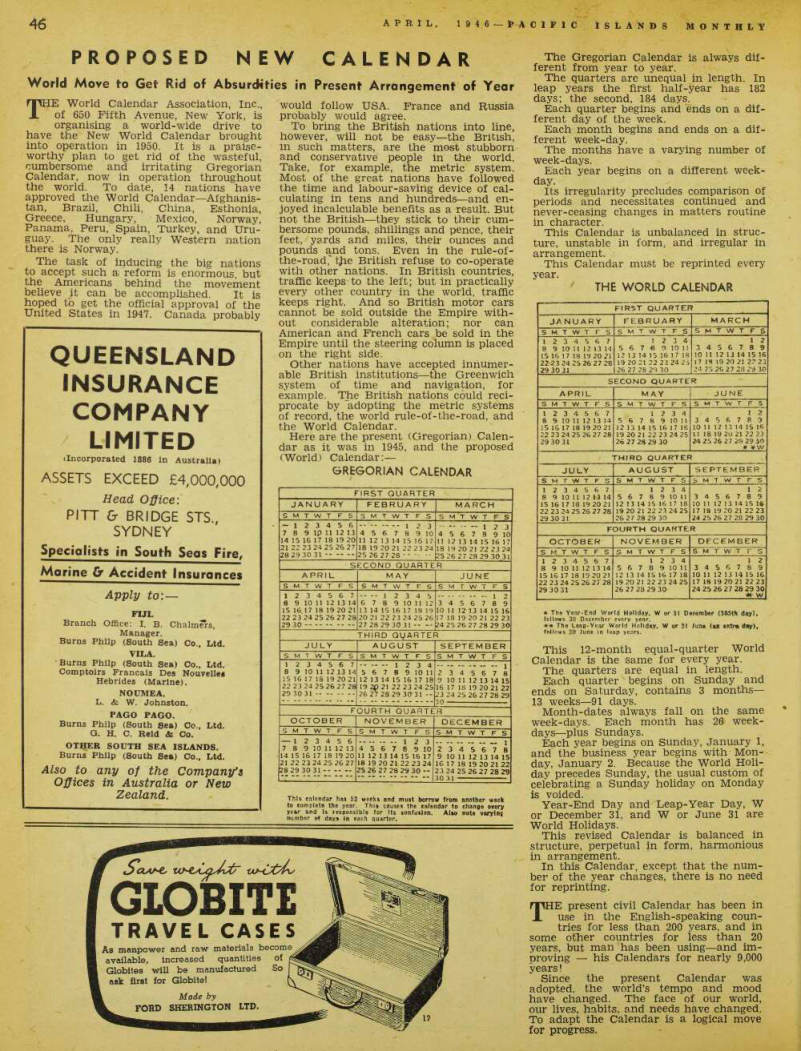
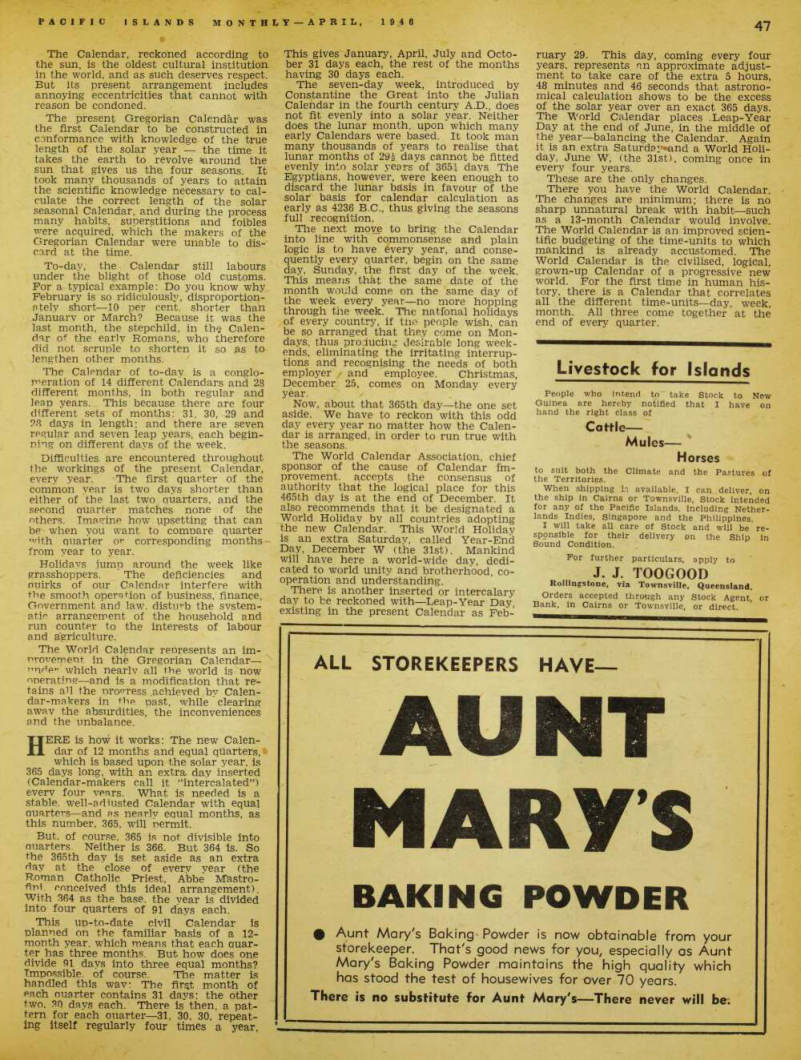
Here are the present (Gregorian) Calen dar as it was in 1945, and the proposed (World) Calendar:—
Gregorian Calendar
The Gregorian Calendar is always dif ferent from year to year.
The quarters are unequal in length. In leap years the first half-year has 182 days: the second, 184 days.
Each quarter begins and ends on a dif ferent day of the week.
Each month begins and ends on a dif ferent week-day.
The months have a varying number of week-days.
Each year begins on a different week day.
Its irregularity precludes comparison of periods and necessitates continued and never-ceasing changes in matters routine in character.
This Calendar is unbalanced in struc ture, unstable in form, and irregular in arrangement.
This Calendar must be reprinted every year.
The World Calendar
This 12-month equal-quarter World Calendar is the same for every year.
The quarters are equal in length.
Each quarter begins on Sunday and ends on Saturday, contains 3 months — 13 weeks —91 days.
Month-dates always fall on the same week-days. Each month has 26 week days—plus Sundays.
Each year begins on Sunday, January 1, and the business year begins with Mon day, January 2. Because the World Holi day precedes Sunday, the usual custom of celebrating a Sunday holiday on Monday is voided.
Year-End Day and Leap-Year Day, W or December 31, and W or June 31 are World Holidays.
This revised Calendar is balanced in structure, perpetual in form, harmonious in arrangement.
In this Calendar, except that the num ber of the year changes, there is no need for reprinting. fTTHE present civil Calendar has been in JL use in the English-speaking coun tries for less than 200 years, and in some other countries for less than 20 years, but man has been using—and im proving his Calendars for nearly 9,000 years !
Since the present Calendar was adopted, the world’s tempo and mood have changed. The face of our world, our lives, habits, and needs have changed.
To adapt the Calendar is a logical move for progress.
First Quarter
January
February
March
S M T W T F S S M T W T F S S M T W T F S - 1 2 3 4 5 6 7 8 9 IP 11 12 13 14 15 16 17 18 19 20 21 22 23 24 25 26 27 4 5 6 7 8 9 10 11 12 13 14 15 16 17 18 19 20 21 22 23 24 4 5 6 7 8 9 10 11 12 13 14 15 16 17 18 19 20 21 22 23 24 28 29 30 31 ** ** ** 25 26 27 28 25 26 27 28 29 30 31
Second Quarter
April
May
June
S M T W T F S S M T W T F S S M T W T F S 8 9 10 11 12 13 14 15 16.17 18 19 20 21 22 23 24 25 26 27 28 6 7 8 9 10 11 12 13 14 15 16 17 18 19 20 21 22 23 24 25 26 I 2 3 4 5 6 7 8 9 10 11 12 13 14 15 16 17 18 19 20 21 22 23 24 25 26 27 28 29 30
Third Quarter
July
August
September
S M T W T F S S M T W T F S S M T W T F S 1 2 3 4 5 6 7 8 9 10 11 12 13 14
Is 16 17 Is 19 2021
22 23 24 25 26 27 28| 29 30 31 -- -• -- -- 5 6 7 8 9 10 \ \ 12 13 14 15 16 17 18 19 2D 21 22 23 24 25 26 27 28 29 30 31 -- 2 3 4 5 6 7 8 9 10 11 12 13 14 15 16 17 18 19 20 21 22 23 24 25 26 27 28 29 30 F
Ourth Quarte
fl
October
November
December
S M T W T F S S M T W T F S S M T W T F S — 1 2 3 4 5 6 7 8 9 10 11 12 13 14 15 16 17 18 19 20 21 22 23 24 25 26 27 ~>q *)o in ■} i 4 5 6 7 8 9 10 11 12 13 14 15 16 17 18 19 20 21 22 23 24 25 26 27 28 29 30 — 2 3 4 5 6 7 8 9 10 11 12 13 14 15 16 17 18 19 20 21 22 23 24 25 26 27 28 29
To 42 Ju ** ”
This calendar has 52 to complete the year year and Is tespons number of days In e 1 weeks and must borro This causes the ealei Ible for Its confusion, ach Quarter. w from another week odar to change every Also note varylnt
First Quarter
January
February
March
S M T W T F S S M T W T F S S M T W T F S 1 2 3 4 5 6 7 8 9 10 11 12 13 14 IS 16 17 18 19 2021 22 23 24 2S 26 27 28 29 30 31 12 3 4 5 6 7 « 9 10 11 12 13 14 15 16 17 18 19 20 21 22 23 24 25 26 27 28 29 30 1 2 3 4 5 6 7 8 9 10 11 12 13 14 IS 16 17 19 19 20 21 22 23 24 25 26 27 28 29 30
Second Quarter
April
May
June
S M T W T F S S M T W T F S S M T W T F S 1 2 3 4 S 6 7 8 9 10 11 12 13 14 15 16 17 18 19 20 21 22 23 24 25 26 27 28 29 30 31 12 3 4 5 6 7 8 9 10 II 12 13 14 IS 16 17 18 19 20 21 22 23 24 25 26 27 28 29 30 1 2 3 4 5 6 7 8 9 10 11 12 13 14 IS 16 17 18 19 20 21 22 23 24 25 26 27 28 2930 » * W
Third Quarter
July
August
September
S M T W T F S S M T W T F S S M T W T F s 1 2 3 4 5 6 7 S 9 10 11 12 13 14 15 16 17 18 19 20 21 22 23 24 25 26 27 28 29 30 31 12 3 4 5 6 7 8 9 10 11 12 13 14 15 16 17 18 19 20 21 22 23 24 25 26 27 28 29 30 1 2 3 4 5 6 7 8 9 10 11 12 11 14 15 16 17 18 19 20 21 22 23 24 25 26 27 28 29 30
Fourth Quarter
October
November
December
S M T W T F S S M T W T F S S M T W T F S 1 2 3 4 5 6 7 8 9 10 11 12 13 14 15 16 17 18 19 20 21 22 23 24 25 26 27 28 29 30 31 12 3 4 5 6 7 8 9 10 11 12 13 14 IS 16 17 18 19 20 21 22 23 24 25 26 27 28 29 30 1 2 3 4 5 6 7 8 9 10 11 12 13 14 15 16 17 18 19 20 21 22 23 24 25 26 27 28 29 30 W * The Year-End World Holiday, W or 31 December (365th day). follows 30 December every year. ** The Leap-Year World Holiday. W or 31 June (an extra day), follows 3b June in leap years.
The Calendar, reckoned according to the sun, is the oldest cultural institution in the world, and as such deserves respect.
But its present arrangement includes annoying eccentricities that cannot with reason be condoned.
The present Gregorian Calendar was the first Calendar to be constructed in conformance with knowledge of the true length of the solar year the time it takes the earth to revolve Ground the sun that gives us the four seasons. It took many thousands of years to attain the scientific knowledge necessarv to cal culate the correct length of the solar seasonal Calendar, and during the process many habits, superstitions and foibles were acquired, which the makers of the Gregorian Calendar were unable to dis card at the time.
To-day, the Calendar still labours under the blight of those old customs.
For a typical example: Do you know why February is so ridiculously, disproportion ately short—lo per cent, shorter than January or March? Because it was the last month, the stepchild, in the Calen dar of the early Romans, who therefore did not scruple to shorten it so as to lengthen other months.
The Calendar of to-day is a conglo meration of 14 different Calendars and 28 different months, in both regular and leap years. This because there are four different sets of months: 31, 30, 29 and 28 days in length; and there are seven regular and seven leap years, each begin ning on different days of the week.
Difficulties are encountered throughout the workings of the present Calendar, every year. The first quarter of the common year is two days shorter than either of the last two quarters, and the second quarter matches none of the others. Imagine how upsetting that can be when you want to comnare quarter with quarter or corresponding months from year to year.
Holidays jump around the week like grasshoppers. The deficiencies and ouirks of our Calendar interfere with the smooth operation of business, finance, Government and law. disturb the system atic arrangement of the household and run counter to the interests of labour and agriculture.
The World Calendar reoresents an im provement in the Gregorian Calendar— unde** which nearly all th e world is now operating—and is a modification that re tains all the nrovress .achieved by Calen dar-makers in the past, while clearing away the absurdities, the inconveniences and the unbalance.
HERE is how it works: The new Calen dar of 12 months and equal quarters, which is based upon the solar year, is 365 days long, with an extra, day inserted (Calendar-makers call it “intercalated”) every four years. What is needed is a stable, well-adiusted Calendar with equal Quarters—and as nearly equal months, as this number, 365, will permit.
But. of course, 365 is not divisible into Quarters. Neither is 366. But 364 is. So the 365th day is set aside as an extra day at the close of every vear (the Roman Catholic Priest, Abbe Mastro firn. conceived this ideal arrangement).
With 364 as the base, the vear is divided into four quarters of 91 days each.
This up-to-date civil Calendar is planned on the familiar basis of a 12month year, which means that each Quar ter has three months. But how does one divide 91 days into three equal months?
Impossible, of course. The matter is handled this wav: The first month of each Quarter contains 31 days: the other two. 30 days each. There is then, a pat tern for each Quarter—3l, 30, 30, repeat ing itself regularly four times a year.
This gives January, April, July and Octo ber 31 days each, the rest of the months having 30 days each.
The seven-day week, introduced by Constantine the Great into the Julian Calendar in the fourth century A.D., does not fit evenly into a solar year. Neither does the lunar month, upon which many early Calendars were based. It took man many thousands of years to realise that lunar months of 29i days cannot be fitted evenly into solar years of 365 i days The Egyptians, however, were keen enough to discard the lunar basis in favour of the solar basis for calendar calculation as early as 4236 8.C., thus giving the seasons full recognition.
The next move to bring the Calendar into line with commonsense and plain logic is to have every year, and conse quently every quarter, begin on the same day, Sunday, the first day of the week.
This means that the same date of the month would come on the same day of the week every year—no more hopping through the week. The natfonal holidays of every country, if the people wish, can be so arranged that they come on Mon days, thus producing desirable long week ends, eliminating the irritating interrup tions and recognising the needs of both employer and employee. Christmas, December 25, comes on Monday every year.
Now, about that 365th day—the one set aside. We have to reckon with this odd day every year no matter how the Calen dar is arranged, in order to run true with the seasons.
The World Calendar Association, chief sponsor of the cause of Calendar im provement. accepts the consensus of authority that the logical place for this 465th day is at the end of December. It also recommends that it be designated a World Holiday bv all countries adopting the new Calendar. This World Holiday is an extra Saturdav, called Year-End Day, December W (the 31st). Mankind will have here a world-wide day, dedi cated to world unity and brotherhood, co operation and understanding.
There is another inserted or intercalary day to be reckoned with—Leap-Year Day existing in the present Calendar as Feb
ruary 29. This day, coming every four years, represents an approximate adjust ment to take care of the extra 5 hours, 48 minutes and 46 seconds that astrono mical calculation shows to be the excess of the solar year over an exact 365 days.
The World Calendar places Leap-Year Day at the end of June, in the middle of the year—balancing the Calendar. Again it is an extra Saturdayiand a World Holi day, June W, (the 31st), coming once in every four years.
These are the only changes.
There you have the World Calendar.
The changes are minimum; there is no sharp unnatural break with habit—such as a 13-month Calendar would involve.
The World Calendar is an improved scien tific budgeting of the time-units to which mankind is already accustomed. The World Calendar is the civilised, logical, grown-up Calendar of a progressive new world. For the first time in human his tory, there is a Calendar that correlates all the different time-units—day, week, month. All three come together at the end of every quarter.