History Of Fixed Copra Prices In Fiji
pp. 43-44 · Read in the full issue
Average Since 1941 is Over £20 Per Ton in Australian Currency
rpHE somewHat erratic course followed JL by Fiji copra prices since the com modity came under wartime controls, in April, 1942, has puzzled some ob servers; and we sought explanation in Suva. From information v£ry courte ously made available by the Director of Agriculture, Mr. C. Harvey, we have com piled the following article.
After the Japanese over-ran the Western Pacific and especially the Philippines and Netherlands Indies early in 1942, the world’s available supply of copra shrank verv quicklv to the limited out put of Ceylon, South Pacific and a few Indian Ocean sources. Controls were im posed; and, so far as the Fijian output was concerned, the British Ministry of Food took charge in April, 1942, and still retains control.
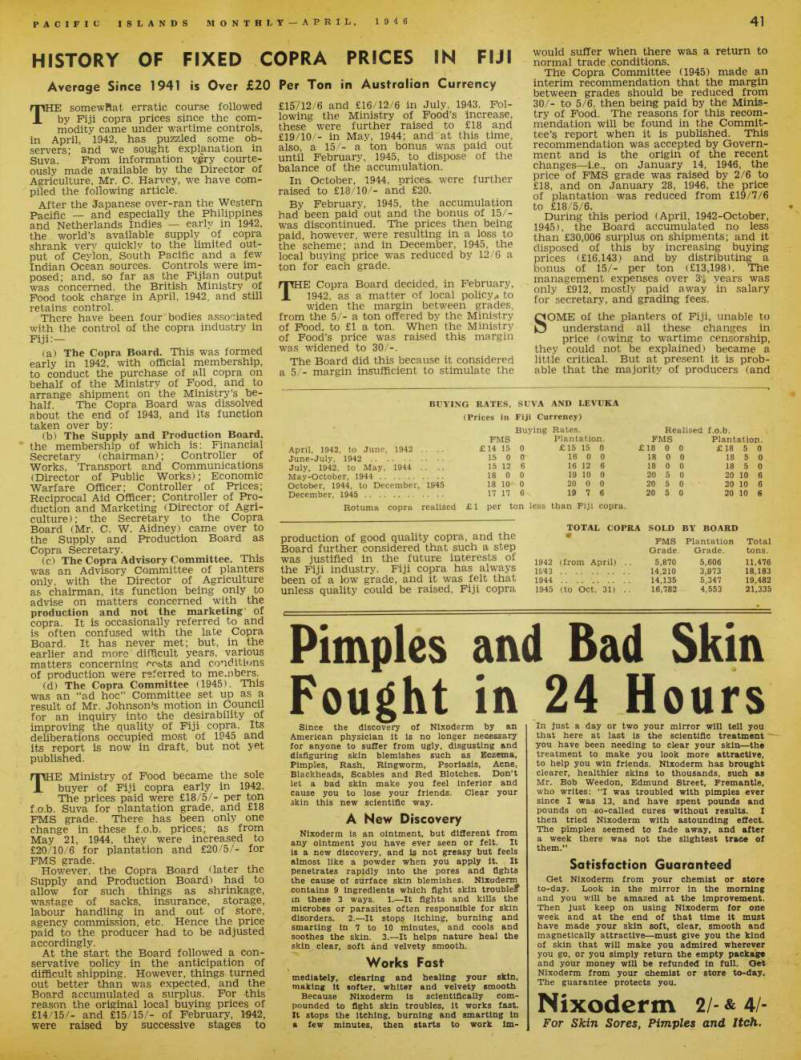
There have been four bodies associated with the control of the copra industry in Fiji;— (a) The Copra Board. This was formed early in 1942, with official membership, to conduct the purchase of all copra on behalf of the Ministry of Food, and to arrange shipment on the Ministry’s be half. The Copra Board was dissolved about the end of 1943, and its function taken over by: (b) The Supply and Production Board, the membership of which is: Financial Secretary (chairman); Controller of Works, Transport and Communications (Director of Public Works); Economic Warfare Officer; Controller of Prices; Reciprocal Aid Officer; Controller of Pro duction and Marketing (Director of Agri culture); the Secretary to the Copra Board (Mr. C. W. Aidney) came over to the Supply and Production Board as Copra Secretary. (c) The Copra Advisory Committee. This was an Advisory Committee of planters only, with the Director of Agriculture as chairman, its function being only to advise on matters concerned with the production and not the marketing of copra. It is occasionally referred to and is often confused with the late Copra Board. It has never met; but, in the earlier and more difficult years, various matters concerning costs and conditions of production were referred to members. (d) The Copra Committee (1945). This was an “ad hoc” Committee set up as a result of Mr. motion in Council for an inquiry into the desirability of improving the quality of Fiji copra. Its deliberations occupied most of 1945 and its report is now in draft, but not yet published. rE Ministry of Food became the sole buyer of Fiji copra early in 1942.
The prices paid were £lB/5/- per ton f.o.b. Suva for plantation grade, and £lB FMS grade. There has been only one change in these f.o.b. prices; as from May 21, 1944, they were increased to £2O/10/6 for plantation and £2O/5/- for FMS grade.
However, the Copra Board (later the Supply and Production Board) had to allow for such things as shrinkage, wastage of sacks, insurance, storage, labour handling in and out of store, agency commission, etc. Hence the price paid to the producer had to be adjusted accordingly.
At the start the Board followed a con servative policy in the anticipation of difficult shipping. However, things turned out better than was expected, and the Board accumulated a surplus. For this reason the original local buying prices of £l4/15/- and £l5/15/- of February, 1942, were raised by successive stages to
£15712/6 and £l6/12/6 in July, 1943. Fol lowing the Ministry of Food’s increase, these were further raised to £lB and £l9/10/- in May, 1944; and at this time, also, a 15/- a ton bonus was paid out until February, 1945, to dispose of the balance of the accumulation.
In October, 1944, prices. were further raised to £lB/10/- and £2O.
By February, 1945, the accumulation had been paid out and the bonus of 15/was discontinued. The prices then being paid, however, were resulting in a loss to the scheme; and in December, 1945, the local buying price was reduced by 12/6 a ton for each grade. rE Copra Board decided, in February, 1942, as a matter of local policy,, to widen the margin between grades, from the 5/- a ton offered by the Ministry of Food, to £1 a ton. When the Ministry of Food’s price was raised this margin was widened to 30/-.
The Board did this because it considered a 5/- margin insufficient to stimulate the
production of good quality copra, and the Board further considered that such a step was justified in the future interests of the Fiji industry. Fiji copra has always been of a low grade, and it was felt that unless quality could be raised, Fiji copra
would suffer when there was a return to normal trade conditions.
The Copra Committee (1945) made an interim recommendation that the margin between grades should be reduced from 30/- to 5/6, then being paid by the Minis try of Food. The reasons for this recom mendation will be found in the Commit tee’s report when it is published. This recommendation was accepted by Govern ment and is the origin of the recent changes—i.e., on January 14, 1946, the price of FMS grade was raised by 2/6 to £lB, and on January 28, 1946, the price of plantation was reduced from £l9/7/6 to £lB/5/6.
During this period (April, 1942-October, 1945), the Board accumulated no less than £30,006 surplus on shipments; and it disposed of this by increasing buying prices (£16,143) and by distributing a bonus of 15/- per ton (£13,198). The management expenses over 3’s. years was only £912, mostly paid away in salary for secretary, and grading fees.
SOME of the planters of Fiji, unable to understand all these changes in price (owing to wartime censorship, they could not be explained) became a little critical. But at present it is prob able that the majority of producers (and
Buying Rates,
Suva
And Levuka
(Prices in Fiji Currency) Buying Rates.
Realised f.o.b.
Fms
Plantation.
Fms
Plantation.
April, 1942, to June, , 1942 ... £14 15 0 £15 15 0 £18 0 0 £18 5 0 June-July, 1942 15 0 0 16 0 0 18 0 0 18 5 0 July, 1942. to May, 1944 ... 15 12 6 16 12 6 18 0 0 18 5 0 May-October, 1944 . . 18 0 0 19 10 0 20 5 0 20 10 6 October. 1944, to December, 1&45 18 10 0 20 0 0 20 5 0 20 10 6 December, 1945 .. .. 17 17 6 19 7 6 20 5 0 20 10 6 Rotuma copra realised £1 per ton less than Fiji copra.
Total Copra
Sold
By Board
Fms
Plantation Total Grade.
Grade. tons. 1942 (from April) .. 5,870 5,606 11,476 1&43 14,210 3,973 18,183 1944 14,135 5,347 19,482 1945 (to Oct. 31) .. 16,782 4,553 21,335
it must not be forgotten that 60 per cerit. of the copra is produced by Fijians) are m favour of the change, as they now get slightly more for FMS copra than before.
On the other hand many owners or operators of large and comparatively efficient estates, or those estates situated in areas where weather conditions make it comparatively easy to make good copra, are disappointed because they lose the wider margin.
Probably, most producers, even those who always produce FMS quality, were disappointed because the rise in price of FMS was small as compared with the fall in plantation grade. But this is explaned by the facts that: • Plantation grade has not recently been more than 20 per cent, of the total output; and, therefore, an equal rise of the one and fall in the price of the other would not have been practicable. • For the past 18 months the scheme has purchased copra at a higher price than was justified by the f.o.b. price, be cause of the accumulation of funds due to the cautious policy followed by the Board during 1942 and 1943.