“Gappy”
pp. 36-37 · Read in the full issue
How Captain Fitch Fought Looters, Bureaucrats and Disruption and Saved Steamships Trading Co., Ltd.
IN 1942, among the multitude of dis hevelled people who arrived in Syd ney, refugees from the Jap invasion of New Guinea and Papua, I found my old friend, Captain A. S. Fitch, of Port Moresby—“Gappy,” to most Territorians.
His face was grey and lined, his shoulders sagged. He and his friend and co-director, E. V. Crisp, were two very weary men. They had been driven out by bureaucrats and military autocrats, leaving behind the wreck of a great or ganisation—a large establishment in Port Moresby, many stores, a dozen planta tions, workshops, countless trading stations, a sawmill, a fleet of coastal ships. Helpless, they had seen £60,000 worth of their merchandise abandoned to military looters.
Planters, traders, miners got together in a mutual-help association. “Gappy” appeared at a few meetings. He sat in a corner and nursed his umbrella. He didn’t say much; but his twisted mouth and the gleam in his eye indicated that he had no faith in the politicians, to whom the unhappy evacuees were then so confidently appealing, I heard him become really vocal only once—on the subject of one Alderman, famous for ever in Territories history as the “adjuster” of claims against the Army for property seized—the gentleman who was paid by the Australian Govern ment thousands of pounds in fees and ex penses for chiselling down the accounts of the ruined Territorians.
Then “Gappy” disappeared. Some time later, we learned that he was back in Port Moresby. No one knew how he had eluded the endless barriers of Brass-hat and Bureaucrat—but he was back there among his smashed workshops and looted stores; and, from then on, he contrived to keep a cold and unwavering eye upon the official guardians of his propertv. He had reached a . very interesting stage in his very colourful career.
Algernon Sydney fitch was born in London a long time ago. While still young, he qualified as a mer chant navy officer, and joined the British India Line. A shrewd shipowner named James Mackay (afterwards the first Lord Inchcape) got his eye on the square jawed youngster, and put him into the Hooghli River Pilot Service. That service took ships through the dangerous waters of the Ganges Estuary, in and out of Calcutta and the costs were wringing the Scottish heart of James Mackay.
Young Fitch soon found his place. He was in that service from 1901 until 1913, and he added to his certificates those of Hooghli pilot and hydrographic and river surveyor. The pilotage costs were much reduced.
World War I ended that period of his life. Later, he went to Tasmania, and became interested in fruit, and then in timber. A demand for ships for the Northern Tasmanian timber trade set him off on a search for a suitable vessel.
During that search he heard, for the first time, of certain possibilities in Papua.
He found a ship, the “Lady Harriet,” and got her into Sydney, for overhaul.
But when he wanted to take her out again, he ran foul of High Authority and Red Tape. It is a long story—but the fiery young Londoner got sick of it all, and defied naval officials—as a result of which a warrant for his arrest was
issued, and he was “picked up” in Pitt Street. Discouraged and disgusted, he abandoned that project, and went back to Tasmania, and appealed to his old friend Henry Jones, of IXL fame. Mr.
Jones had on his hands a long, narrow steamer (109 feet long by 14 feet beam) called the “Queenscliff.” She was 54 years old, and her tonnage was 99.
The Jones interests sold her on easy terms to a company formed by Captain Pitch; he survived the innumerable perils of Sydney officialdom and the SW Pacific; and in the middle of 1919 the “Queenscliff,” Captain Fitch, part owner and master, arrived in Port Moresby.
IN Moresby, Captain Fitch had not enough money to pay a European crew, so he prepared to engage natives.
The Administration said “No” natives could not be employed on a ship not registered in Papua. The baffled Fitch then wanted to go on to Rabaul, and trade in New Guinea—but he was with out funds.
He went in desperation to Mr. Cham pion, Government Secretary. He knew that Papua greatly needed coastal ships; he said that, if he were allowed to use a native crew until he could arrange registration, he would remain on the coast. The Murray Administration, al ways ready to help private enterprise, allowed the native crew to be engaged.
“If it had not been for Champion’s kindness then,” says Fitch, to-day, “I should have gone to New Guinea, where opportunities were much greater and now I might have been a millionaire!”
Cargo was sought by advertisement for the “Queenscliff,” departing for all ports west. She left with some empty copra bags, a case of trade tobacco, and a package addressed to a plantation across a river bar so bad that no ships would go there.
The “cargo” w T as delivered, and the ship went on into the Purari River, look ing for native trade. Fitch, using axes and knives as currency, bought 20 bags of betel nut and 300 bundles of sago.
Having no money, he paid his mate and engineer with the betel nuts (which they later sold in Moresby at a loss of
£7/10/-, which the company subsequently made good).
The sago was sold for £BO, and the “Queenscliff,” now financial, made a trip east. This also returned a small profit.
Captain Fitch put the mate in charge of the ship, and opened a small store in the bath-room of the residence he had acquired in Port Moresby. It was tough trading especially along the coast. It was mostly barter—goods for copra, the copra sold wherever a price could be got, and more goods bought. A contract to carry mails was made with the Government: and another contract to carry goods and passengers to mission stations was made with the LMS. Within two years, Steamshins Proprietary, Ltd., which had been registered in Australia, was established; two years later, in 1924, Steamships Trading Co., Ltd., was formed, bought out the first company, and was registered in Papua.
In 1924, they bought the 255-ton “Papuan Chief” in Europe, and the “Queenscliff” passed into oblivion. But she served her purpose—she established, practically from nothing, an organisation which became one of the big merchandis ing, planting and shipping concerns of the Pacific. Usually referred to as “Steamships,” it still is called by the old hands “the Queenies.”
During the next 15 years, Steamships Trading Co. grew in an astonishing fashion. When war came, “Gappy”
Fitch was one of the best-known figures in Papua. He was always on the job— business, to him, was a long adventure and a perpetual joy. He knew' every detail of an organisation that expanded every week. His ugly old “Papuan Chief” was a familiar sight in every Papuan port.
IN 1939, the “Chief” went on the reef, and was disabled; and then ensued a transaction in which “Gappy” re velled.
The ship went into the underwriters’ hands, and she lay 18 months in Port Moresby while endless argument pro ceeded about repairs. Finally, com pletely fed up, “Gappy” sold her to a Jap firm in Yokohama for 150 miles of unbleached calico, 22,000 yards of white suiting, 200 cases of soda water, 1,200 cases of sardines, and 1,500 cases of salmon. He also agreed to repair the “Chief” (for cash in advance) and pro vide her, and the schooner which brought the 150 miles of calico, with a cargo of copra.
Yokohama sent a Jap crew to take over the “Chief.” The Administration would not let them land, at first—finally allowed them three days ashore—and at last the old “Chief” staggered away, while old hands on the beach laid odds against her reaching Japan. They lost.
It seemed a crazy sort of deal—but it turned up trumps. All the gamble was
taken out of It by the war. “Gappy,” shrewd trader, states with glee that after the evacuation, the Australian Govern ment bought 50 miles of his calico at 6ld. per yard—and has since been selling it, through PCB, at 6/- per “rami,” and to plantations at 3/- per fathom!
(Continued Next Page )
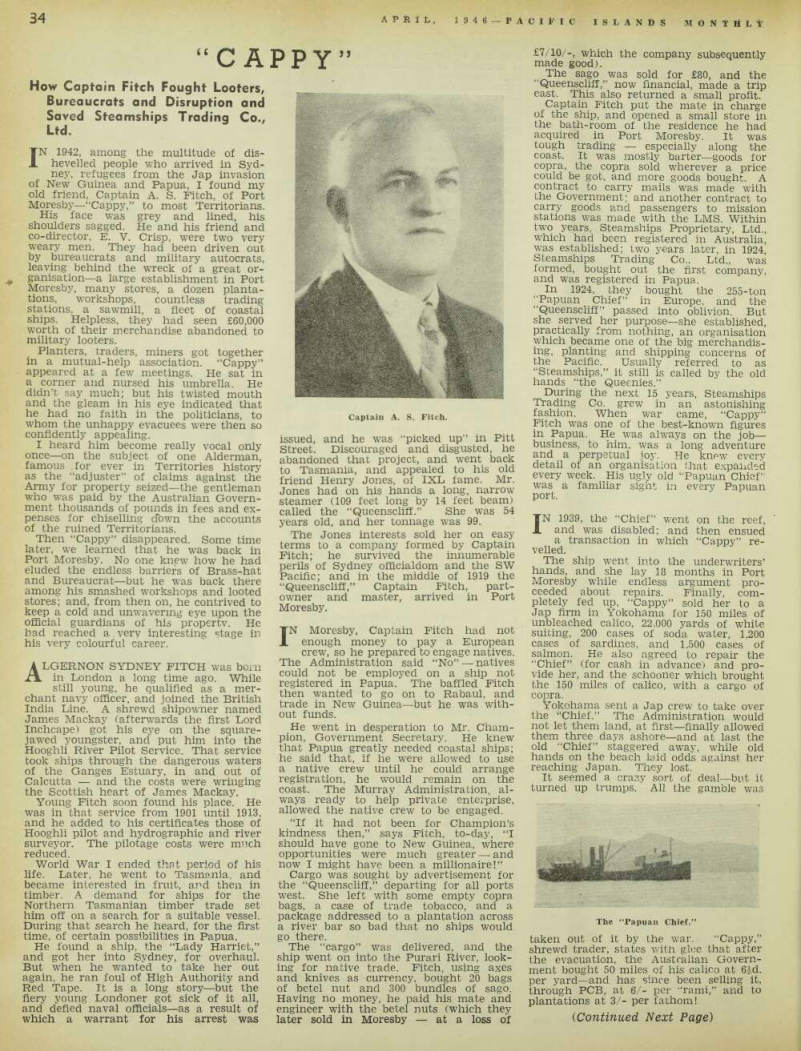
Captain A. S. Fitch.
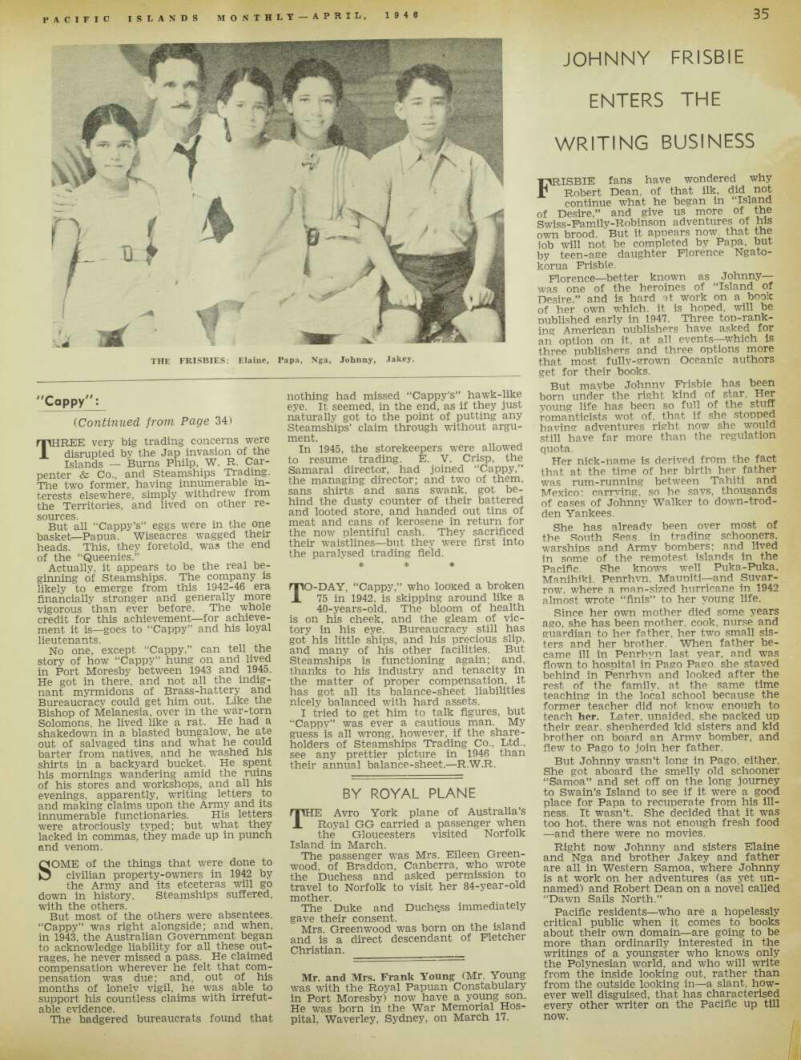
The “Papuan Chief.”
THREE very big trading concerns were disrupted by the Jap invasion of the Islands Burns Philp, W. R. Car penter & Co., and Steamships Trading.
The two former, having innumerable in terests elsewhere, simply withdrew from the Territories, and lived on other re sources.
But all “Cappy’s” eggs were in the one basket—Papua. Wiseacres wagged their heads. This, they foretold, was the end of the “Queenies.”
Actually, it appears to be the real be ginning of Steamships. The company is likely to emerge from this 1942-46 era financially stronger and generally more vigorous than ever before. The whole credit for this achievement —for achieve ment it is—goes to “Gappy” and his loyal lieutenants.
No one, except “Gappy,” can tell the story of how “Gappy” hung on and lived in Port Moresby between 1943 and 1945.
He got in there, and not all the indig nant myrmidons of Brass-hattery and Bureaucracy could get him out. Like the Bishop of Melanesia, over in the war-torn Solomons, he lived like a rat. He had a shakedown in a blasted bungalow, he ate out of salvaged tins and what he could barter from natives, and he washed his shirts in a backyard bucket. He spent his mornings wandering amid the ruins of his stores and workshops, and all his evenings, apparently, writing letters to and making claims upon the Army and its innumerable functionaries. His letters were atrociously typed; but what they lacked in commas, they made up in punch and venom.
SOME of the things that were done to civilian property-owners in 1942 by the Army and its etceteras will go down in history. Steamships suffered, with the others' But most of the others were absentees.
“Gappy” was right alongside; and when, in 1943, the Australian Government began to acknowledge liability for all these out rages, he never missed a pass. He claimed compensation wherever he felt that com pensation was due; and, out of his months of lonelv vigil, he was able to support his countless claims with irrefut able evidence.
The badgered bureaucrats found that
nothing had missed “Cappy’s” hawk-like eye. It seemed, in the end, as if they just naturally got to the point of putting any Steamships’ claim through without argu ment.
In 1945, the storekeepers were allowed to resume trading. E. V. Crisp, the Samarai director, had joined “Gappy,” the managing director; and two of them, sans shirts and sans swank, got be hind the dusty counter of their battered and looted store, and handed out tins of meat and cans of kerosene in return for the now plentiful cash. They sacrificed their waistlines—but they were first into the paralysed trading field. * * * TO-DAY, “Gappy,” who looked a broken 75 in 1942. is skipping around like a 40-years-old. The bloom of health is on his cheek, and the gleam of vic tory in his eye. Bureaucracy still has got his little ships, and his precious slip, and many of his other facilities. But Steamships is functioning again; and, thanks to his industry and tenacity in the matter of proper compensation, it has got all its balance-sheet liabilities nicely balanced with hard assets.
I tried to get him to talk figures, but “Gappy” was ever a cautious man. My guess is all wrong, however, if the share holders of Steamships Trading Co., Ltd., see any prettier picture in 1946 than their annual balance-sheet. —R.W.R.