Money-Making
p. 32 · Read in the full issue
Islets
Of Malaita
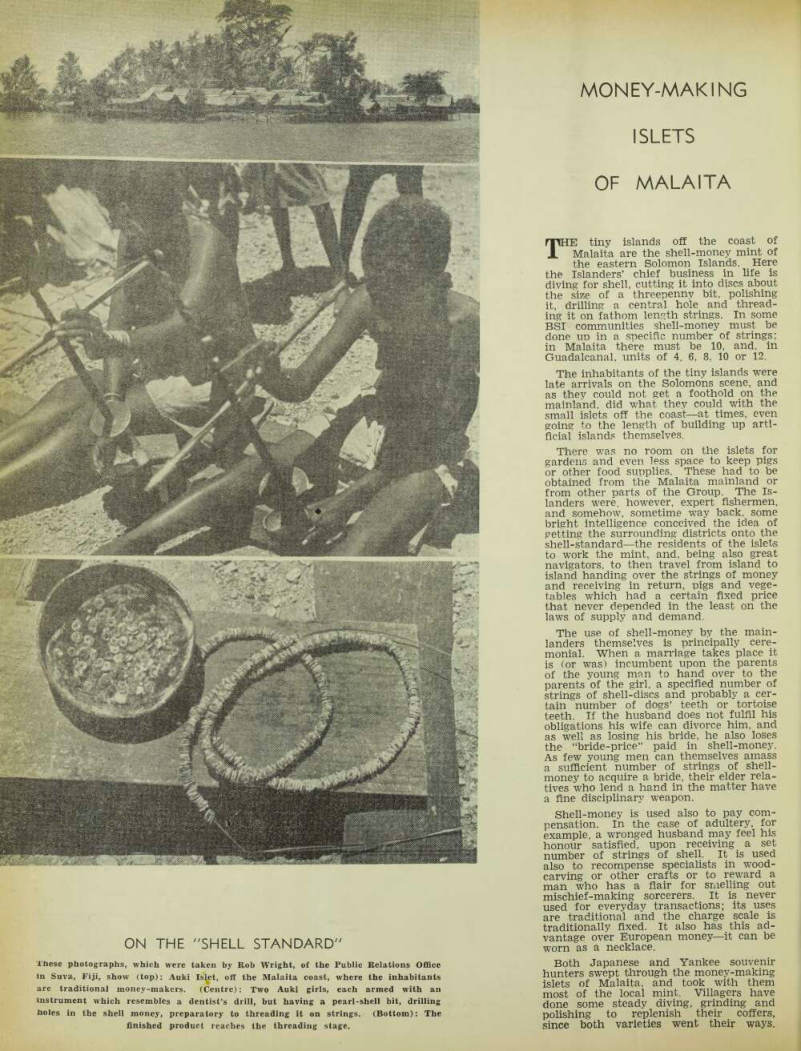
mHE tiny islands off the coast of X Malaita are the shell-money mint of the eastern Solomon Islands. Here the Islanders’ chief business in life is diving for shell, cutting it into discs about the size of a threepenny bit, polishing it, drilling a central hole and thread ing it on fathom length strings. In some ESI communities shell-money must be done un in a specific number of strings; in Malaita there must be 10, and. in Guadalcanal, units of 4. 6,8, 10 or 12.
The inhabitants of the tiny islands were late arrivals on the Solomons scene, and as they could not get a foothold on the mainland, did what they could with the small islets off the coast—at times, even going to the length of building up arti ficial islands themselves.
There was no room on the islets for gardens and even less space to keep pigs or other food supplies. These had to be obtained from the Malaita mainland or from other parts of the Group. The Is landers were, however, expert fishermen, and somehow, sometime way back, some bright intelligence conceived the idea of getting the surrounding districts onto the shell-standard—the residents of the islets to work the mint, and, being also great navigators, to then travel from island to island handing over the strings of money and receiving in return, pigs and vege tables which had a certain fixed price that never depended in the least on the laws of supply and demand.
The use of shell-money by the main landers themselves is principally cere monial. When a marriage takes place it is Cor was) incumbent upon the parents of the young man to hand over to the parents of the girl, a specified number of strings of shell-discs and probably a cer tain number of dogs’ teeth or tortoise teeth. If the husband does not fulfil his obligations his wife can divorce him, and as well as losing his bride, he also loses the “bride-price” paid in shell-money.
As few young men can themselves amass a sufficient number of strings of shell money to acquire a bride, their elder rela tives who lend a hand in the matter have a fine disciplinary weapon.
Shell-money is used also to pay com pensation. In the case of adultery, for example, a wronged husband may feel his honour satisfied, upon receiving a set number of strings of shell. It is used also to recompense specialists in wood carving or other crafts or to reward a man who has a flair for smelling out mischief-making sorcerers. It is never used for everyday transactions; its uses are traditional and the charge scale is traditionally fixed. It also has this ad vantage over European money—it can be worn as a necklace.
Both Japanese and Yankee souvenir hunters swept through the money-making islets of Malaita, and took with them most of the local mint. Villagers have done some steady diving, grinding and polishing to replenish their coffers, since both varieties went their ways.
On The "Shell Standard"
These photographs, which were taken by Rob Wright, of the Public Relations Office in Suva, Fiji, show (top): Auki Islet, off the Malaita coast, where the inhabitants are traditional money-makers, (Centre): Two Auki girls, each armed with an Instrument which resembles a dentist’s drill, but having a pearl-shell bit, drilling holes in the shell money, preparatory to threading it on strings. (Bottom): The finished product reaches the threading stage.