of Returning Europeans
pp. 12-61 · Read in the full issue
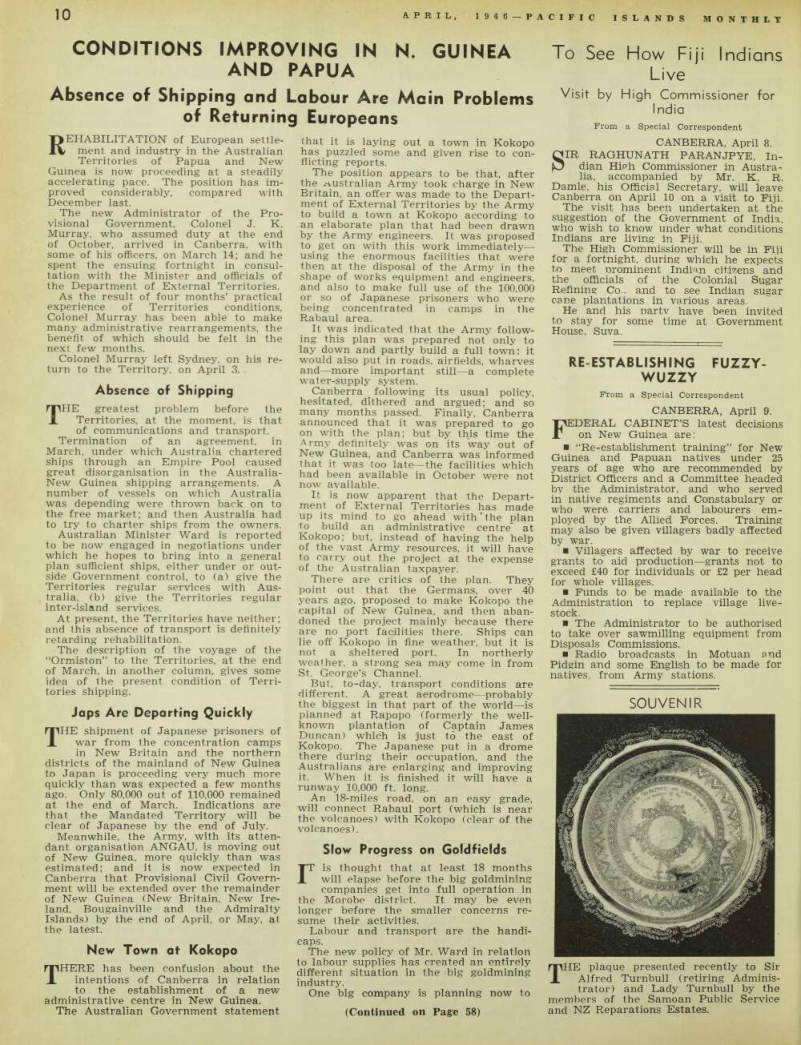
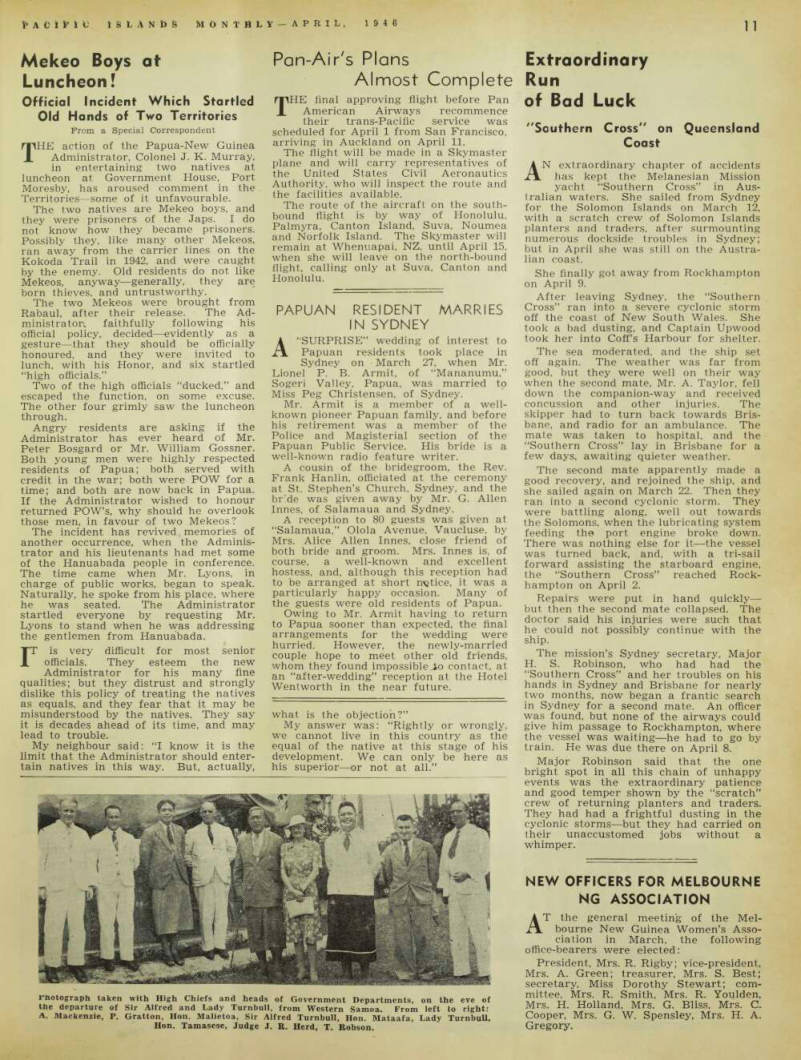
Conditions Improving In N. Guinea
And Papua
Absence of Shipping and Labour Are Main Problems of Returning Europeans
REHABILITATION of European settle ment and industry in the Australian Territories of Papua and New Guinea is now proceeding at a steadily accelerating pace. The position has im proved considerably, compared with December last.
The new Administrator of the Pro visional Government, Colonel J. K.
Murray, who assumed duty at the end of October, arrived in Canberra, with some of his officers, on March 14; and he spent the ensuing fortnight in consul tation with the Minister and officials of the Department of External Territories.
As the result of four months’ practical experience of Territories conditions, Colonel Murray has been able to make many administrative rearrangements, the benefit of which should be felt in the next few months.
Colonel Murray left Sydney, on his re turn to the Territory, on April 3.
Absence of Shipping
THE greatest problem before the Territories, at the moment, is that of communications and transport.
Termination of an agreement, in March, under which Australia chartered ships through an Empire Pool caused great disorganisation in the Australia- New Guinea shipping arrangements. A number of vessels on which Australia was depending were thrown back on to the free market; and then Australia had to try to charter ships from the owners.
Australian Minister Ward is reported to be now engaged in negotiations under which he hopes to bring into a general plan sufficient ships, either under or out side Government control, to (a) give the Territories regular services with Aus tralia. (b) give the Territories regular inter-island services.
At present, the Territories have neither; and this absence of transport is definitely retarding rehabilitation.
The description of the voyage of the “Ormiston” to the Territories, at the end of March, in another column, gives some idea of the present condition of Terri tories shipping.
Japs Are Departing Quickly
THE shipment of Japanese prisoners of war from the concentration camps in New Britain and the northern districts of the mainland of New Guinea to Japan is proceeding very much more quickly than was expected a few months ago. Only 80,000 out of 110,000 remained at the end of March. Indications are that the Mandated Territory will be clear of Japanese by the end of July.
Meanwhile, the Army, with its atten dant organisation ANGAU, is moving out of New Guinea, more quickly than was estimated; and it is now expected in Canberra that Provisional Civil Govern ment will be extended over the remainder of New Guinea (New Britain, New Ire land, Bougainville and the Admiralty Islands) by the end of April, or May, at the latest.
New Town of Kokopo
THERE has been confusion about the intentions of Canberra in relation to the establishment of a new administrative centre in New Guinea.
The Australian Government statement
that it is laying out a town in Kokopo has puzzled some and given rise to con flicting reports.
The position appears to be that, after the Australian Army took charge in New Britain, an offer was made to the Depart ment of External Territories by the Army to build a town at Kokopo according to an elaborate plan that had been drawn by the Army engineers. It was proposed to get on with this work immediately— using the enormous facilities that were then at the disposal of the Army in the shape of works equipment and engineers, and also to make full use of the 100,000 or so of Japanese prisoners who were being concentrated in camps in the Rabaul area.
It was indicated that the Army follow ing this plan was prepared not only to lay down and partly build a full town: it would also put in roads, airfields, wharves and—more important still —a complete water-supply system.
Canberra following its usual policy, hesitated, dithered and argued; and so many months passed. Finally, Canberra announced that it was prepared to go on with the plan; but by this time the Army definitely was on its 'way out of New Guinea, and Canberra was informed that it was too late—the facilities which had been available in October were not now available.
It is now apparent that the Depart ment of External Territories has made up its mind to go ahead with*the plan to build an administrative centre” at Kokopo; but, instead of having the help of the vast Army resources, it will have to carry out the project at the expense of the Australian taxpayer.
There are critics of the plan. They point out that the Germans, over 40 years ago, proposed to make Kokopo the capital of New Guinea, and then aban doned the project mainly because there are no port facilities there. Ships can lie off Kokopo in fine weather, but it is not a sheltered port. In northerly weather, a strong sea may come in from St. George’s Channel.
But, to-day, transport conditions are different. A great aerodrome —probably the biggest in that part of the world —is planned at Rapopo (formerly the well known plantation of Captain James Duncan) which is just to the east of Kokopo. The Japanese put in a drome there during their occupation, and the Australians are enlarging and improving it. When it is finished it will have a runway 10,000 ft. long.
An 18-miles road, on an easy grade, will connect Rabaul port (which is near the volcanoes) with Kokopo (clear of the volcanoes).
Slow Progress on Goldfields
IT is thought that at least 18 months will elapse before the big goldmining companies get into full operation in the Morobe district. It may be even longer before the smaller concerns re sume their activities.
Labour and transport are the handi caps.
The new policy of Mr. Ward in relation to labour supplies has created an entirely different situation in the big goldmining industry.
One big company is planning now to
(Continued on Page 58)
introduce all sorts of mechanical aids whereby, instead of employing 1,200 natives, they may be able to manage with a maximum of 200. The mechanical aids include such things as electric washing machines for the European staff, so that the need for personal wash boys will be eliminated.
This method of dealing with the labour situation may give the New Guinea Administration an economic headache.
The employment of some 30,000 natives, on various industries, prior to the war, released throughout the native popu lation a large sum of money, which trickled slowly back to the trade stores and, particularly, into the Territory’s treasury in the shape of the head tax.
That money will not now be available.
The reply of the Administration appar ently is that what the natives lose in
wages they will gain by becoming pro ducers of copra, coffee, shell, and so forth. This is probably true, so far as the sophisticated natives of New Britain and New Ireland are concerned.
But they number only a few thousands among the million or so natives of New Guinea.
The Markham-Bulolo Road
THERE is doubt in some quarters as to whether the new military road, built between the Bulolo Valley and the southern mouth of the Mark ham, via the Wampit, will supply the necessary transport service in place of the freight-carrying aeroplanes of pre war days. It is even suggested by some that maintenance cost will be so heavy that the road will have to be abandoned.
It appears, however, that the really bad part of the road is not that which has been newly constructed between Bulolo and the Markham. The part that is giving the most trouble is in the Bulolo Gorge, between Wau and Bulolo—
and those who have been over that very difficult highway can quite believe it.
The Snake Valley section, recently built by the military, is also trouble some, but some who have looked it over sa .y t s at the worst Parts can be dealt W i tl ii. by re ' location - The Army location ot the road was hurried, both in the X alle y and along the south bank i Markham. The Army engineers omit too close to the Markham bank, so there has been erosion and caving-in. this difficulty also can be got over bv re location.
The argument that it is necessary to bridge the Markham is dismissed by those who have examined the situation.
They say the bridging will be too costly —it will be a simpler proposition to con tinue the present method—namely, punt goods from Lae to Labu (the newly formed little port on the south side of the mouth of the Markham). Mr. Mick Leahy, well-known in the Territory, is now carrying Bulolo goods by trucks and barges from Lae to Labu, where they are loaded on to trucks and taken along the new road.
The critics say this will be a cheaper and better method of dealing with the Markham obstacle than building a bridge across the river.
New Settlement in Markham Area
THE Territories residents expect to see considerable developments in and around the Markham Valley, as a result of the building of the new roads.
The road up the northern bank of the Markham, towards the Ramu, already has encouraged a number of planters to investigate the possibilities of land in and around the Nadzab area. Messrs.
W. Edwards, Bertie Heath, E. Jennings, and George Whitaker already have pro mising holdings in that vicinity.
On the south side of the Markham, along the road from Labu towards the Wampit, there is said to be some very good land suitable for most New Guinea crops—and there also are some excellent stands of timber, which have been made accessible by the new road.
It is believed also that there is gold still to be found in that region. The Wampit country has never been properly prospected. Mr. Babington (who was killed in the recent war) found some good gold there in the thirties, but it is
believed that the most promising areas still have to be prospected.
This region also is likely to receive the attention of people interested in the tourist business. It is pointed out that at Zenag, on the divide between the Wampit and Snake Valley, at a height of about 4,000 ft., there is an ideal place for a tourist hotel.
Progress in Lae
LAE is developing into a busy little town, with stores and boarding houses.
Mrs. Flo Stewart has been given con siderable assistance by both Adminis tration and traders since her arrival in Lae, and has been able to establish a large boarding-house by taking over barracks recently vacated by the AMWAS. Mrs. Stewart missed out in regard to some of the war stores that were for sale, but she has been assisted in other directions and the facilities which she is providing there are much appreciated. She still holds the licence of the Lae Hotel (which was totally destroyed by bombing) and she should be able to make use of it in due course.
Wou Still a Wreck
THE town of Wau is still a complete wreck, as the result of fighting and of “scorched earth.” There are no stores or supplies or buildings for accom modation of any kind in Wau, and little has yet been done in the direction of re building.
However, as the mining companies operating in the Edie Creek, Koranga and Upper Bulolo region restore their activities, the rebuilding of Wau will go on.
Rabaul and Kavieng
THE destruction of all buildings and other European facilities in the Rabaul district of New Britain and the Kavieng district of New Ireland is 100 per cent. Nothing remains. All con struction has been destroyed and all goods removed.
Japanese in New Ireland did not even spare the natives—they stole the food and even the spears and the canoes from the native villages. In very many cases, the natives were left with nothing except their lap-laps, and it has been necessary for ANGAU to give them considerable assistance, pending the production of new supplies of food.
There are indications that the natives of the Rabaul and Kavieng areas tend— especially under the encouragement of the new Administration —to organise themselves as producers of copra, coffee, trochus shell, green snail shell, etc. They have petitioned the Government to make available to them some sort of organi sation which will receive their produce and supply them in return with the goods that they require.
Indications of Gold
IT is interesting to learn from mining engineers who recently have been to New Guinea on a survey that war operations have given good indications of gold in certain New Guinea districts.
It is said that such encouraging pros pects of gold have been found in the Torakina district of Bougainville, certain of the Sepik districts, and in the valleys between the head of the Lakekamu River and Edie Creek (while building the rough military road from Bulldog through to Edie Creek) that all those districts are due for early and intense prospecting.
It is likely that concerns interested in the future development of New Guinea will make a strong appeal to the Administration to allow persons of ex perience and proved trustworthiness to
proceed into the areas called hitherto “uncontrolled. 1 ” These “uncontrolled” areas were penetrated often during the war by men engaged on special duty, and they found very interesting indications of gold and (some say) also of oil.