Isolation is Now No
p. 24 · Read in the full issue
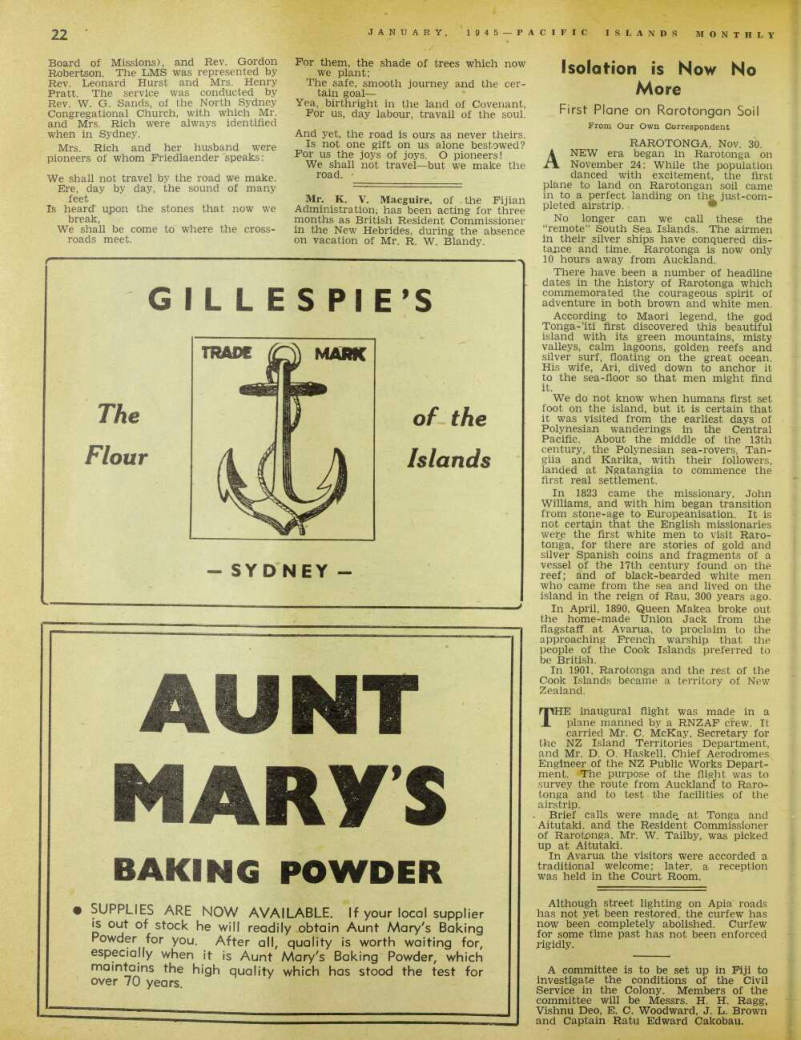
More First Plane on Rarotongan Soil
From Our Own Correspondent
Rarotonga, Nov. 30.
ANEW era began in Rarotonga on November 24: While the population danced with excitement, the first plane to land on Rarotongan soil came in to a perfect landing on the just-com pleted airstrip. • No longer can we call these the “remote” South Sea Islands. The airmen in their silver ships have conquered dis tance and time. Rarotonga is now only 10 hours away from Auckland.
There have been a number of headline dates in the history of Rarotonga which commemorated the courageous spirit of adventure in both brown and white men.
According to Maori legend, the god Tonga-’iti first discovered this beautiful island with its green mountains, misty valleys, calm lagoons, golden reefs and silver surf, floating on the great ocean.
His wife, Ari, dived down to anchor it to the sea-floor so that men might find it.
We do not know when humans first set foot on the island, but it is certain that it was visited from the earliest days of Polynesian wanderings in the Central Pacific. About the middle of the 13th century, the Polynesian sea-rovers, Tan giia and Karika, with their followers, landed at Ngatangiia to commence the first real settlement.
In 1823 came the missionary, John Williams, and with him began transition from stone-age to Europeanisation. It is not certain that the English missionaries were the first white men to visit Raro tonga, for there are stories of gold and silver Spanish coins and fragments of a vessel of the 17th century found on the reef; and of black-bearded white men who came from the sea and lived on the island in the reign of Rau, 300 years ago.
In April, 1890, Queen Makea broke out the home-made Union Jack from the flagstaff at Avarua, to proclaim to the approaching French warship that the people of the Cook Islands preferred to be British.
In 1901, Rarotonga and the rest of the Cook Islands became a territory of New Zealand.
THE inaugural flight was made in a plane manned by a RNZAF crew. It carried Mr. C. McKay, Secretary for the NZ Island Territories Department, and Mr. D. O. Haskell, Chief Aerodromes Engineer of the NZ Public Works Depart ment. The purpose of the flight was to survey the route from Auckland to Raro tonga and to test the facilities of the airstrip. . Brief calls were made, at Tonga and Aitutaki, and the Resident Commissioner of Rarotonga. Mr. W. Tailby, was picked up at Aitutaki.
In Avarua the visitors were accorded a traditional welcome; later, a reception was held in the Court Room.
Although street lighting on Apia' roads has not yet been restored, the curfew has now been completely abolished. Curfew for some time past has not been enforced rigidly.
A committee is to be set up in Fiji to investigate the conditions of the Civil Service in the Colony. Members of the committee will be Messrs. H. H. Ragg, Vishnu Deo, E. C. Woodward, J. L. Brown and Captain Ratu Edward Cakobau.