The y?“ r
p. 12 · Read in the full issue
A Fixed Calendar
Plan of US Navy Man Receives World Notice
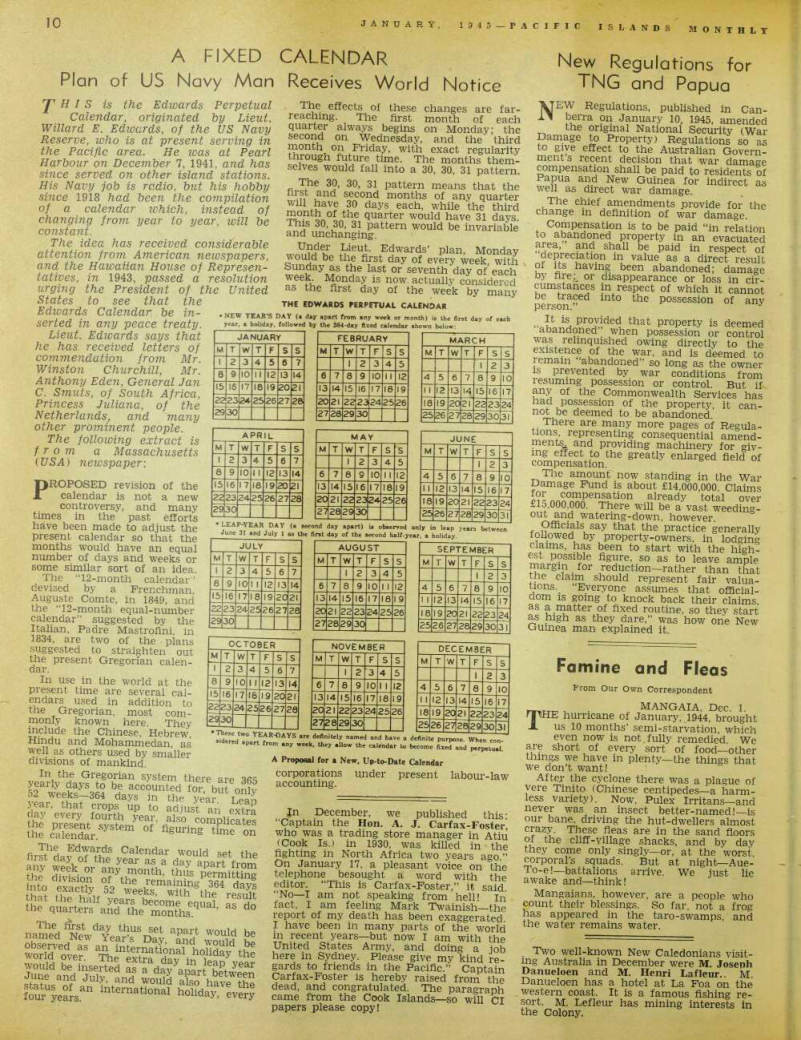
J 1 HI S is the Edwards Perpetual Calendar, originated by Lieut.
Willard E. Edwards, of the US Navy Reserve, who is at present serving in the Pacific area. He was at Pearl Harbour on December 7, 1941, and has since served on other island stations.
His Navy job is radio, but his hobby since 1918 had been the compilation of a calendar which, instead of changing from year to year, will be constant.
The idea has received considerable attention from American newspapers, and the Hawaiian House of Represen tatives, in 1943, passed a resolution urging the President of the United
States to see that the Edwards Calendar he in serted in any peace treaty.
Lieut. Edwards says that he has received letters of commendation from Mr.
Winston Churchill, Mr.
Anthony Eden, General Jan C. Smuts, of South Africa, Princess Juliana, of the Netherlands, and many other prominent people.
The following extract is from a Massachusetts {USA) newspaper : Proposed revision of the calendar is not a new controversy, and many times in the past efforts have been made to adjust the present calendar so that the months would have an equal number of days and weeks or some similar sort of an idea.
The “12-month calendar’ devised by a Frenchman, Auguste Comte, in 1849, and the “12-month equal-number calendar” suggested by the Italian, Padre Mastrofini, in 1834, are two of the plans suggested to straighten out the present Gregorian calen dar.
In use in the world at the present time are several cal endars used in addition to the Gregorian, most com monly known here. They include the Chinese, Hebrew, Hindu and Mohammedan, as well as others used by smaller divisions of mankind
In the Gregorian system there are i a w y eif S 3 £ b i/ ccoun^ weexs—364 days in the year T pan jear, that crops up to adjust an extra day every fourth year, also complicate! the calendar system of Anting time on
The y?“ r
f£ y week or any month, thus permitting the division of the remaining into exactly 52 weekl wSh Bth»4 8 th» 4 da^? that the halt years become equa! afrin the quarters and the months ’ do named wou , ld be ?our U years an lnternation »l holiday, every
The effects of these changes are far reaching. The first month of each quarter always begins on Monday; the second on Wednesday, and the third month on Friday, with exact regularity through future time. The months them selves would fall into a 30, 30, 31 pattern.
The 30, 30, 31 pattern means that the secon d months of any quarter wiH have 30 days each, while the third °* toe quarter would have 31 days.
This 30, 30, 31 pattern would be invariable
and unchanging.
u n?er Lieut. Edwards’ plan, Monday be % fi f st day of ever y week, with Sunday as the last or seventh day of each week Monday is now actually considered as the first day of the week by many
corporations under present labour-law accounting.
In December, we published this “ Captain the Hon. A. J. Carfax-Foster, who was a trading store manager in Atiu (Cook Is.) in 1930, was killed in the fighting in North Africa two years ago.”
On January 17, a pleasant voice on the telephone besought a word with the editor. “This is Carfax-Foster,” it said “No—l am not speaking from hell! in fact, I am feeling Mark Twainish—the report of my death has been exaggerated I have been in many parts of the world in recent years—but now I am with the United States Army, and doing a job here in Sydney. Please give my kind re gards to friends in the Pacific.” Captain Carfax-Foster is hereby raised from the dead, and congratulated. The paragraph came from the Cook Islands—so will Cl papers please copy!
New Year's
year, a holiday
The Edwards Perpetual Calendar
DAY (a day apart from any week or month) ia the first day of each followed by the 354-day fixed calendar shown below;
Janu
Ary
February
March
M T W T F s s M T w T F s S M T W T F s s 1 2 3 4 5 6 7 i 2 3 4 5 1 2 3 a 9 10 II 12 13 14 6 7 8 9 10 i 1 1 12 4 5 6 7 6 9 10 li 16 17 18 19 2C 21 13 14 15 16 17 18 19 1 1 12 13 i 14 15 16 17 a k 24 ■25 >26 27 26 2C >21 2c >22 24 25 26 18 19 2C )2I 2c 23 124 29(3C 21 20 29 30 25 >26 21 '28 29 30 31 A PR IL
May
June
M T W T F S S M T W T F S S M T W T F S s 1 2 3 4 5 6 7 1 2 3 4 5 1 2 3 8 9 10 1 1 12 13 14 6 7 8 9 10 1 1 12 4 5 6 7 8 9 10 15 16 1 7 16 19 20 21 13 14 15 16 17 18 19 li 12 13 14 15 16 17 22 23 24 25 26 27 28 20 21 22 23 24 25 26 18 19 20 21 22 23 24 2y 3(J 27 28 29 30 25 26 27 28 29 30 31 • LEAP-YEAR DAY (a second day apart) is observed only i June 31 and July I as the first day of the second half-year, a n le holic ap lay. yeai rs b etw. ien JL
Jly
August
September
M T W T F S S M T W T F S S M T W T F s s 1 2 3 4 5 6 7 1 2 3 4 5 I 2 3 8 9 10 1 1 12 13 14 6 7 8 9 10 1 1 12 4 5 6 7 8 9 10 15 16 17 18 19 20 21 13 14 15 16 17 18 19 1 1 12 13 14 15 16 17 22 23 24 25 26 27 28 20 21 22 23 24 25 26 18 19 20 21 22 23 24 29 30 27 28 29 30 25 26 27 28 29 30 31 0 CT OB ER
November
December
—j M T W T F S S M T W T F S S M T W T F S s 1 2 3 4 5 6 7 1 2 3 4 5 1 2 3 8 9 10 1 1 1 12 13 14 6 7 8 9 10 1 1 12 4 5 6 7 8 9 10 15 16 1 17 1 18 1 19 i 20; 21 13 14 15 16 17 18 19 1 1 12 13 14 15 16 17 22 ; ?3 i 24; 25; 26; 27; 28 20. 2i ; 22; 23; 24; 25 26 18 19 20i 2i ; 22 23 24 29: 30 27; 20; 29; 30 25; 26 27: 28; 29 30 31 YEAR ' D AYS are definitely named and have a del dered apart from any week, they allow the calendar to bee A Proposal for a New. Up-to-Datc Ca iniU omc lent ! PU i fix. lar rpos 2d a ie. V nd Vhe, F*erp 1 COl etua rill.