Marianas
p. 48 · Read in the full issue
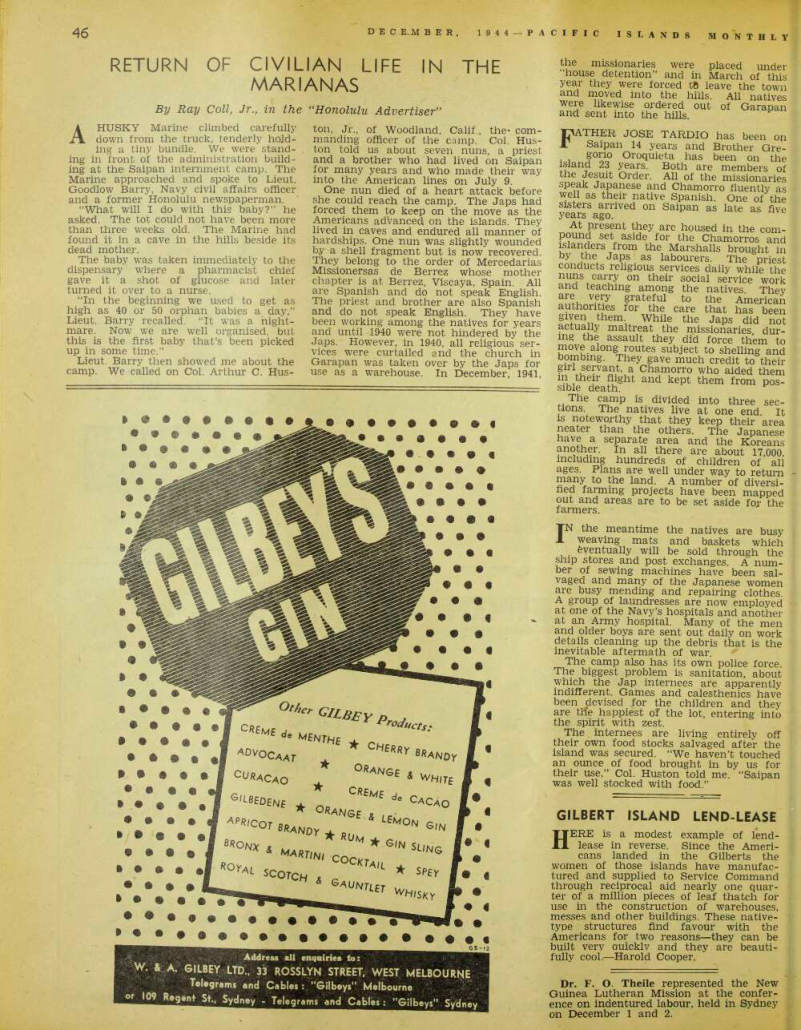
Return Of Civilian Life In The
By Ray Coll, Jr., in the “Honolulu Advertiser"
A HUSKY Marine climbed carefully down from the truck, tenderly holding a tiny bundle. We were standing in front of the administration building at the Saipan internment camp. The Marine approached and spoke to Lieut.
Goodlow Barry, Navy civil affairs officer and a former Honolulu newspaperman.
“What will I do with this baby?” he asked. The tot could not have been more than three weeks old. The Marine had found it in a cave in the hills beside its dead mother.
The baby was taken immediately to the dispensary where a pharmacist chief gave it a shot of glucose and later turned it over to a nurse.
“In the beginning we used to get as high as 40 or 50 orphan babies a day,”
Lieut. Barry recalled. “It was a nightmare. Now we are well organised, but this is the first baby that’s been picked up in some time.”
Lieut. Barry then showed me about the camp. We called on Col. Arthur C. Hus-
ton, Jr., of Woodland, Calif., the- corn manding officer of the camp. Col. Hus ton told us about seven nuns, a priest and a brother who had lived on Saipan for many years and who made their way into the American lines on July 9 One nun died of a heart attack before she could reach the camp. The Japs had forced them to keep on the move as the Americans advanced on the islands They lived in caves and endured all manner of hardships. One nun was slightly wounded by a shell fragment but is now recovered.
They belong to the order of Mercedarias Missionersas de Berrez whose mother chapter is at Berrez, Viscaya, Spain All are Spanish and do not speak English The priest and brother are also Spanish and do not speak English. They have been working among the natives for years and until 1940 were not hindered by the Japs. However, in 1940, all religious ser vices were curtailed and the church in Garapan was taken over by the Japs for use as a warehouse. In December, 1941,
the missionaries were placed under “house detention” and in March of this year they were forced to leave the town and moved into the hills. All natives were likewise ordered out of Garapan and sent into the hills.
FATHER JOSE TARDIO has been on Saipan 14 years and Brother Gre gono Oroquieta has been on the island 23 years. Both are members of the Jesuit Order. All of the missionaries speak Japanese and Chamorro fluently as well as their native Spanish. One of the sisters arrived on Saipan as late as five years ago.
At present they are housed in the com pound set aside for the Chamorros and islanders from the Marshalls brought in by the Japs as labourers. The priest conducts religious services daily while the nuns carry on their social service work and teaching among the natives. They aif r, grateful to the American authorities for the care that has been given them. While the Japs did not actually maltreat the missionaries dur ing the assault they did force them to move along routes subject to shelling and bombing. They gave much credit to their girl servant, a Chamorro who aided them m their flight and kept them from pos sible death.
The camp is divided into three sec tions. The natives live at one end It is noteworthy that they keep their area neater than the others. The Japanese have a separate area and the Koreans another. In all there are about 17,000, including hundreds of children of all ages. Plans are well under way to return many to the land. A number of diversi fied farming projects have been mapped out and areas are to be set aside for the farmers.
IN the meantime the natives are busy weaving mats and baskets which Eventually will be sold through the ship stores and post exchanges. A num ber of sewing machines have been sal vaged and many of the Japanese women are busy mending and repairing clothes.
A group of laundresses are now employed at one of the Navy’s hospitals and another at an Army hospital. Many of the men and older boys are sent out daily on work details cleaning up the debris that is the inevitable aftermath of war.
The camp also has its own police force.
The biggest problem is sanitation, about which the Jap internees are apparently indifferent. Games and calesthenics have been devised for the children and they are the happiest of the lot, entering into the spirit with zest.
The internees are living entirely off their own food stocks salvaged after the island was secured. “We haven’t touched an ounce of food brought in by us for their use,” Col. Huston told me. “Saipan was well stocked with food.”