"Terepo"
pp. 32-33 · Read in the full issue
The Story of Alain Gerbault
By H. J. Pollock
AFTER sailing thousands of miles over the oceans single-handed in his two cutters, “Firecrest” and “Alain Ger bault,” Alain Gerbault (or “Terepo”— “Navigator through the Night”—as he was called by the natives of Bora Bora) met his death in prosaic fashion by fever in Dili, Portuguese Timor, in December, 1941. He had ridden out hurricanes in the middle of the Atlantic and Pacific Oceans, had narrow escapes from being run down by steamers, and was once nearly washed from the end of the bow sprit of “Firecrest” when effecting a repair to the bob stay in the middle of the Atlantic. Yet the oceans, in the end, did not claim him as he himself pro phesied in one of his writings.
Gerbault spent the greater part of his youth at Dinard, France. It was there that he first learned to love the sea and when he was not doing long cruises on his father’s yacht he was shipping with the hardy Breton fishermen. He envied the Bretons their independent lives, and at that early age he decided that one day hb would buy a small craft of his own.
After a happy youth at Dinard he was sent to Paris to study and graduate as a civil engineer. He enlisted in the Flying Corps in 1914, and after the dull life at college found it a glorious adventure.
After the armistice his adventurous nature would not allow him to settle down to the dull routine of a city business man, so he discarded his career and looked round from port to port to find a suit able cruising cutter, and in Southhamp ton came across the 39 ft. cutter, “Fire
crest.”
In his youth, Gerbault had shown remarkable ability as a tennis player and won the Boys’ Championship of Prance, so now for a year he combined cruising and tennis, and learned to handle his little craft sijagle-handed off the south coast of France and played in many tour naments on the French Riviera. When he was in perfect physical condition and had sailed his craft through severe storms in the Bay of Biscay, he set sail from Cannes, bound for New York.
AFTER battling storms and patching his old sails, he reached New York in 142 days. But Gerbault had not shown sound judgment in one respect— he had set out with sails that were old and rotten with mildew. He was given a wonderful reception in New York and won the much-coveted prize given for the best sporting feat of the year—“ The Grand Prix of the Paris Academy of Sport.”
In New York he changed his rig from gaff-headed mainsail to Marconi rig. In preferring cutter rig to schooner or ketch he differed from the great majority of deep-sea sailors of small craft. Even when he built his new ship he retained the cutter rig. The mast of the “Fire crest” was 47 feet above deck. He then set out on a leisurely cruise through the South Sea Islands, leaving from Panama.
During this cruise he learned to love the Polynesian natives. He was a great admirer of their native arts and was continually striving to get them to revive their ancient customs and discard such
European civilisation as had been intro duced into the Islands and was gradually killing this wonderful race of people. He stated that it would be more humane to put the natives up against a wall and shoot them than to gradually kill them off by a civilisation to which they were
totally unsuited. He seemed to have more in common with the Polynesians than with the people of his OWn race, and once toyed with the idea of marrying a native girl and spending the rest of his life amongst the people he loved.
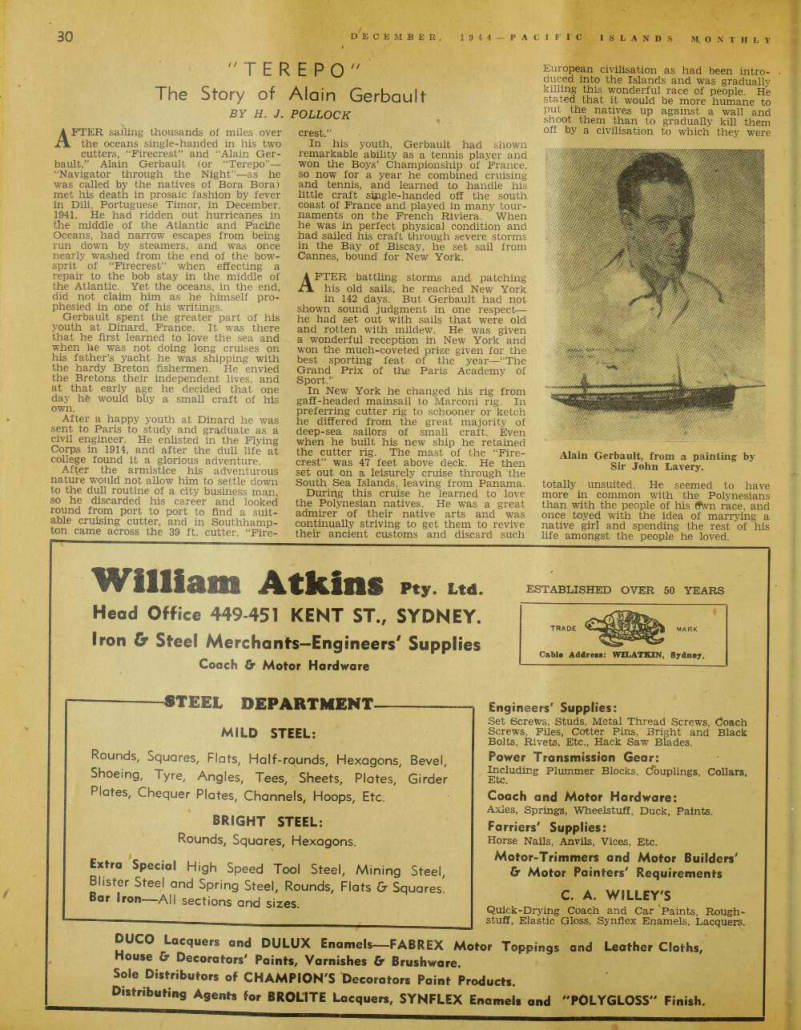
Alain Gerbault, from a painting by Sir John Lavery.
He would cruise leisurely from island to island, teaching the natives to play football and, in turn, himself trying to learn tiieir native games. He was always opposed to the natives dressing in left off European clothing, which made them look ridiculous. In order to encourage the people to return to their own healthy dress, he made a point of wearing the dress *of the particular people he was moving amongst—be it pareu, lava-lava, or sulu. This practice on occasions got him into conflict with the local authori ties, who insisted upon his wearing cor rect European dress when walking in the streets of their towns.
It is on record that he was invited to dine at Government House with the Gov ernor of Fiji, and caused a sensation by turning up to this distinguished social gathering clad only in a sulu. Needless to* say, he was never asked to come again.
He was a great admirer of the early Polynesian navigators and considered their voyages in open canoes with only primitive methods of navigation superior feats to the voyages undertaken by our own pioneer navigators. He sailed with out an engine in his ship and got great pleasure in taking his cutter into narrow and difficult passages.
IN the late 20’s, the “Firecrest” was reaching the end of her useful career as a cruising boat. He therefore decided to return to his native France and build himself a new boat. He gave “Firecrest” to the French Naval Academy, but she was wrecked whilst being towed by a tug.
He had sufficient money from the pro ceeds of his two books, “Fight of the Fire crest” and “In Quest of the Sun,” to build his new cutter. He designed her him self—learning from the weaknesses shown by the “Firecrest” in her unusual and severe tests. This time he favoured a double-ender, the most seaworthy form of small boat known. The “Firecrest” was counter-sterned. He named the new ship “Alain Gerbault” and set out once more for his favourite islands in the Society Group.
Up to the beginning of World War II he lived at Bqra Bora and in 1939 he again offered his services to his country, but as he was now nearly 50 he was rejected. In 1941 it was very difficult to determine which way Tahiti was to go politically and he wisely ' decided to leave his favourite haunts for new and less disturbed islands. He spent several months at Tonga and played his favourite game once more on the beautiful grass courts at Nukualofa. He found the boys at Nukualofa were now his equal at ten nis, for age was beginning to take toll of his physical condition.
He sailed from Tonga to Port Moresby and apparently from there to Portuguese Timor, where he met his death at the comparatively early age of 49. He had expressed a wish not to be buried in a cemetery, but to have his body placed on his yacht with sails set and let sail to sea. No doubt the whereabouts of his yacht will be released in due course. rpo strangers, Gerbault *Vas a dour fel- A low, but to his friends he was quite the reverse; in addition, he possessed a rare sense of humour. On his return to Le Havre he was accorded a civic wel come and many distinguished persons were invited to be present. Gerbault, at the banquet, was seated next an elderly countess who obviously had no knowledge of the sea. She asked Alain how he could possibly have a bath with such a limited water supply on his small craft. He solemnly replied, “Madam, I never wash.”
Gerbault was loved by the Polynesians, who composed many songs about him. He was always trying to make the French
Government recognise the fact that, largely because of their system of gov erning, the Polynesian was rapidly dying out or being absorbed by the Chinese. He deplored the system of sending Governors out for only a period of three years or so, instead of choosing officials who were willing to give their lives to the cause of their charges.
He was a great reader and always car ried about 200 books with him. One of his favourites seemed to have been Jack London; Loti, Farrere, Conrad, Stephen son and Shakespeare, too. He was a great admirer of John Masefield’s ballads. His own books he always wrote in English, although he was a Frenchman—they were later translated into many foreign languages. The last of his published works was the “Gospel of the Sun, - ’ a book much criticised in some quarters because of the author’s small regard for European civilisation. He maintained that our civilisation is already on the decline and will eventually disappear as have all its predecessors.
He had completed another book that was to be published after the war. Let us hope the manuscript has fallen into the right hands.
A simple sailor has passed on; a man who loved nature and the things of nature far better than anything produced by man. Perhaps he lived before his time; in another hundred years the Poly nesians may have revived their wonderful civilisation, and . may have increased their numbers to equal those of several centuries ago. The finest wood-carvers
in the world may have revived their art, and the old customs and dances may even be taught in open-air schools, as advo cated by Alain. Aloha, “Terepo”!