Shipping
p. 51 · Read in the full issue
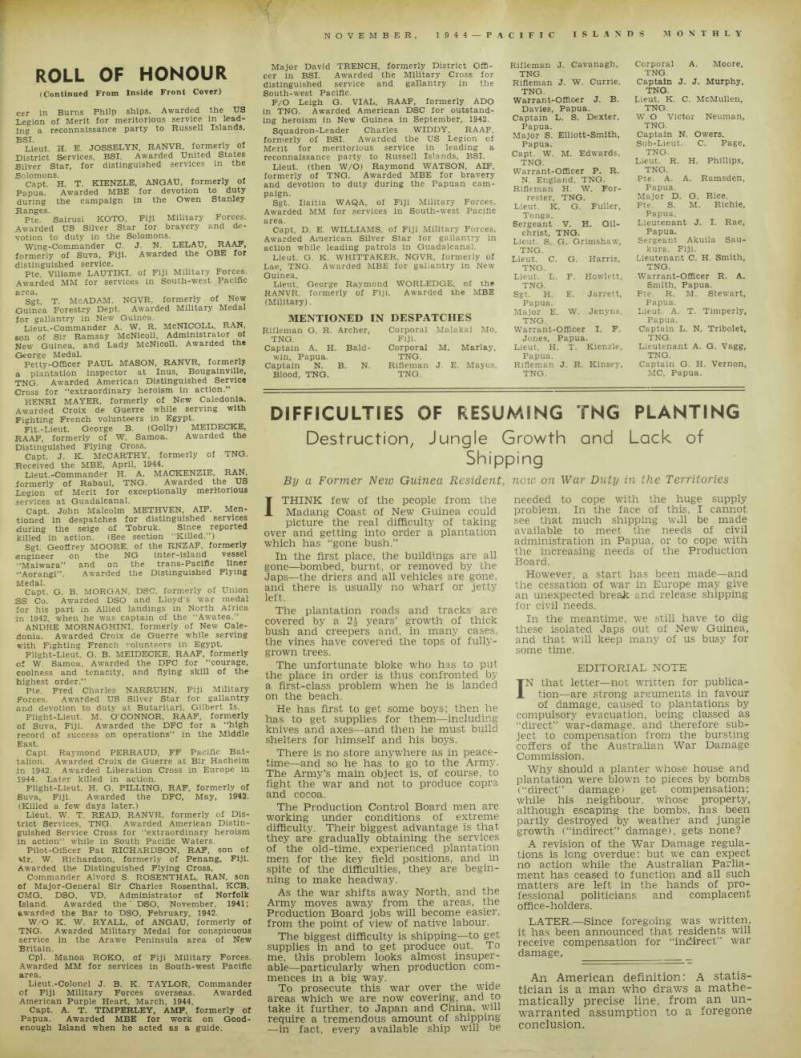
Difficulties Of Resuming Tng Planting
Destruction, Jungle Growth and Lack of Shipping
By a Former New Guinea Resident, I THINK few of the people from the Madang Coast of New Guinea could picture the real difficulty of taking over and getting into order a plantation which has “gone bush.”
In the first place, the buildings are all gone—bombed, burnt, or removed by the Japs—the driers and all vehicles are gone, and there is usually no wharf or jetty left.
The plantation roads and tracks are covered by a 2i years’ growth of thick bush and creepers and. in many cases, the vines have covered the tops of fully grown trees.
The unfortunate bloke who has to put the place in order is thus confronted by a first-class problem when he is landed on the beach.
He has first to get some boys; then he has to get supplies for them —including knives and axes —and then he must build shelters for himself and his boys.
There is no store anywhere as in peace time—and so he has to go to the Army.
The Army’s main object is, of course, to fight the war and not to produce copra and cocoa.
The Production Control Board men are working under conditions of extreme difficulty. Their biggest advantage is that they are gradually obtaining the services of the old-time, experienced plantation men for the key field positions, and in spite of the difficulties, they are begin ning to make headway.
As the war shifts away North, and the Army moves away from the areas, the Production Board jobs will become easier, from the point of view of native labour.
The biggest difficulty is shipping—to get supplies in and to get produce out. To me, this problem looks almost insuper able—particularly when production com mences in a big way.
To prosecute this war over the wide areas which we are now covering, and to take it further, to Japan and China, will require a tremendous amount of shipping —in fact, every available ship will be
now on War Duty in the Territories needed to cope with the huge supply problem. In the face of this, I cannot see that much shipping will be made available to meet the needs of civil administration in Papua, or to cope with the increasing needs of the Production Board.
However, a start has been made —and the cessation of war in Europe may give an unexpected break and release shipping for civil needs.
In the meantime, we still have to dig these isolated Japs out of New Guinea, and that will keep many of us busy for some time.
Editorial Note
IN that letter —not written for publica tion —are strong arguments in favour of damage, caused to plantations by compulsory evacuation, being classed as “direct” war-damage, and therefore sub ject to compensation from the bursting coffers of the Australian War Damage Commission.
Why should a planter whose house and plantation were blown to pieces by bombs (“direct” damage) get compensation; while his neighbour, whose property, although escaping the bombs, has been partly destroyed by weather and jungle growth (“indirect” damage), gets none?
A revision of the War Damage regula tions is long overdue; but we can expect no action while the Australian Parlia ment has ceased to function and all such matters are left in the hands of pro fessional politicians and complacent office-holders.
LATER.—Since foregoing was written, it has been announced that residents will receive compensation for “indirect” war damage, An American definition: A statis tician is a man who draws a mathe matically precise line, from an un warranted assumption to a foregone conclusion.