Busbies
p. 12 · Read in the full issue
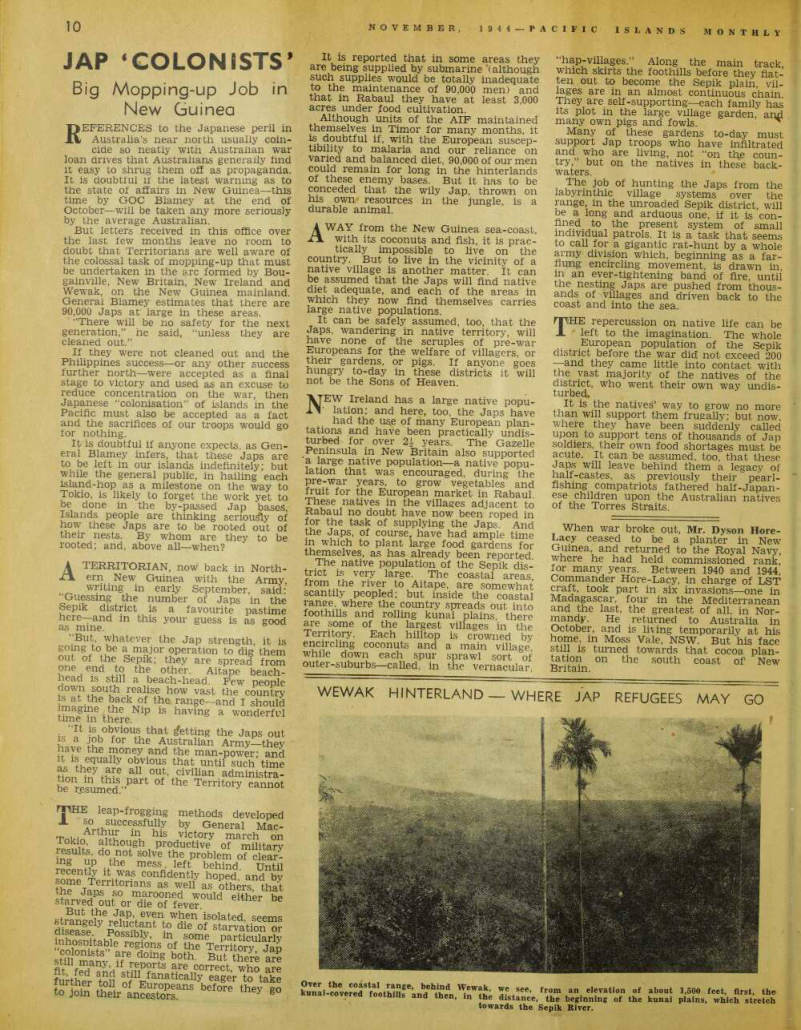
Jap ‘Colonists ’
Big Mopping-up Job in New Guinea
REFERENCES to the Japanese peril in Australia’s near north usually coin cide so neatly with Australian war loan drives that Australians generally find it easy to shrug them off as propaganda.
It is doubtful if the latest warnmg as to the state of affairs in New Guinea—this time by GOC Blarney at the end of October —will be taken any more seriously by the average Australian.
But letters received in this office over the last few months leave no room to doubt that Territorians are well aware of the colossal task of mopping-up that must be undertaken in the arc formed by Bou gainville, New Britain, New Ireland and Wewak, on the New Guinea mainland.
General Blarney estimates that there are 90,000 Japs at large in these areas.
“There will be no safety for the next generation,” he said, “unless they are cleaned out.”
If they were not cleaned out and the Philippines success—or any other success further ntprth—were accepted as a final stage to victory and used as an excuse to reduce concentration on the war, then Japanese “colonisation” of islands in the Pacific must also be accepted as a fact and the sacrifices of our troops would go for nothing.
It is doubtful if anyone expects, as Gen eral Blarney infers, that these Japs are to be left in our islands indefinitely; but while the general public, in hailing each island-hop as a milestone on the way to Tokio, is likely to forget the work yet to be done in the by-passed Jap bases, Islands people are thinking seriously of how these Japs are to be rooted out of their nests. By whom are they to be rooted; and, above all—when?
ATERRITORIAN, now back in North ern New Guinea with the Army writing in early September, said; Guessing the number of Japs in the Sepik district is a favourite pastime here—and in this your guess is as good as mine.
“But, whatever the Jap strength, it is going to be a major operation to dig them out of the Sepik; they are spread from one end to the other. Aitape beach head is still a beach-head. Few people down south realise how vast the country is at the back of the range—and I should imagine the Nip is having a wonderful time in there.
ic P getting the Japs out
a J° b for the Australian Army—they have the money and the man-power; and * equally obvious that until such time ffjhey are all out, civilian administra- ” Part ° f th 6 Territor y cannot T HE leap-frogging methods developed A S A °rtb S nr CC^ Sf v y . General Mac iri hls , VlC tory march on Tokio, although productive of militarv S ° lV6 problem of clear 15®. H p -P 16 mess le f t behind. Until recently it was confidently hoped, and bv thp lo Tam' ri^orianS as well as others, that the Japs so marooned would either be starved out or die of fever.
But the Jap, even when isolated seem* disease’ 7 Pos U sib?v ‘ die o( sta ™«on or
tahjwSta We Regions *ol Territory** Jap
‘colonists” are doing both But there are m ll fSi any U lf JS ports are correct, who are further toll nfV anatically eager to take to iSn fi? 1 - 0f Eur °Peans before they go to join their ancestors. e
!t is reported that in some areas they ?nnh be in^ili PPlled^ y u SUb . n i a n ine - ?v, SUppl - es . wou2d k® totally madequate the maintenance of 90,000 men) and that in Rabaul they have at least 3,000 acres under food cultivation.
Although units of the AIF maintained themselves in Timor for many months, it tibmtv^to 1 the n Europear * susce P" tibihty to malaria and our reliance on varied and balanced diet, 90,000 of our men could remain for long in the hinterlands of these enemy bases. But it has to be conceded that the wily Jap, thrown on durabl^an^maV 1,063 m the 2Ungle ’ 15 a durable animal.
=r.is
It can be safely assumed, too, that the Japs, wandering in native territory, will have none of the scruples of pre-war Europeans for the welfare of villagers, or Vn l 6 r!^^f a f de i is ’ ° r ¥ anyone goes hungry to-day m these districts it will not be the Sons of Heaven.
NEW Ireland has a large native popuh ? re ’ t 0 Japs have . dad °£ many European plantations and have been practically undisturbed for over 2* years. The Gazelle Peninsula in New Britain also supported fatSn e thnt lV wi? )P o nativ ? poputhat was encouraged, during the P 1 e-war years, to grow vegetables and SaKo doubt have V now Se bee a n dJ r a o C p?d £ the Japs!** c o oVrse P f P have g had ample ttme in which to plant large food eardens frtr themselves, as has already reported The native population of the Senik diQ trlct is very large The SLtaf arSf," from the river to are somewhat scantily peopled’ but inside thp pnactoi
T.;.ss e“ sk s"ssa %
MS
“hap-villages.” Along the main trank which skirts the foothills befo™they flat ten out to become the Sepik plain vil lages are in an almost continuous chain, They are self-supporting—each familv has its plot in the large vlllagf ganSn Y and many own pigs and fowls 8 8 ’ a ™ Many of these gardens tn-dnv mnct support Jap troops who have infiltrated and who are living, not “on the coun try,” but on the natives in these back waters.
The job of hunting the Jans from thp labyrinthic village g S ystemf ovei t he r ange ’ m the unroaded Sepik district, will be a long and arduous one; if it con
rswrS-JHr*S
Busbies
HTHE repercussion on native life can be X left to the imagination. The whole European population of the Sepik district before the war did not exceed 200 “ and they came little into contact with the vast majority of the natives of the district, who went their own way undis natives’ way to grow no more than will support them frugally: but now! where they have been suddenly called upon to support tens of thousands of Jan soldiers, theff own food shortSmust be acute. It can be assumed too that these Japs will leave behind them a legacy of half-castes, as previously their pearl fishing compatriots fathered half-Janan
ef cfildre^upin I “strahan nXves
° f the Torr eS Straits bfoke h ° Ut ’ T ? yson Hore ceased to be a planter in New Shpro a ’v, an S et v. ri m d to Royal Navy, where he had held commissioned rank, o or many . ye ?T s - Between 1940 and 1944, ? n ch - ar B e of BST S^ took part in six invasions — one in
SFl' EJsn s Sm
WittiSsinsi'iS