Copra Board's
p. 10 · Read in the full issue
Surplus
Fiji Position Explained
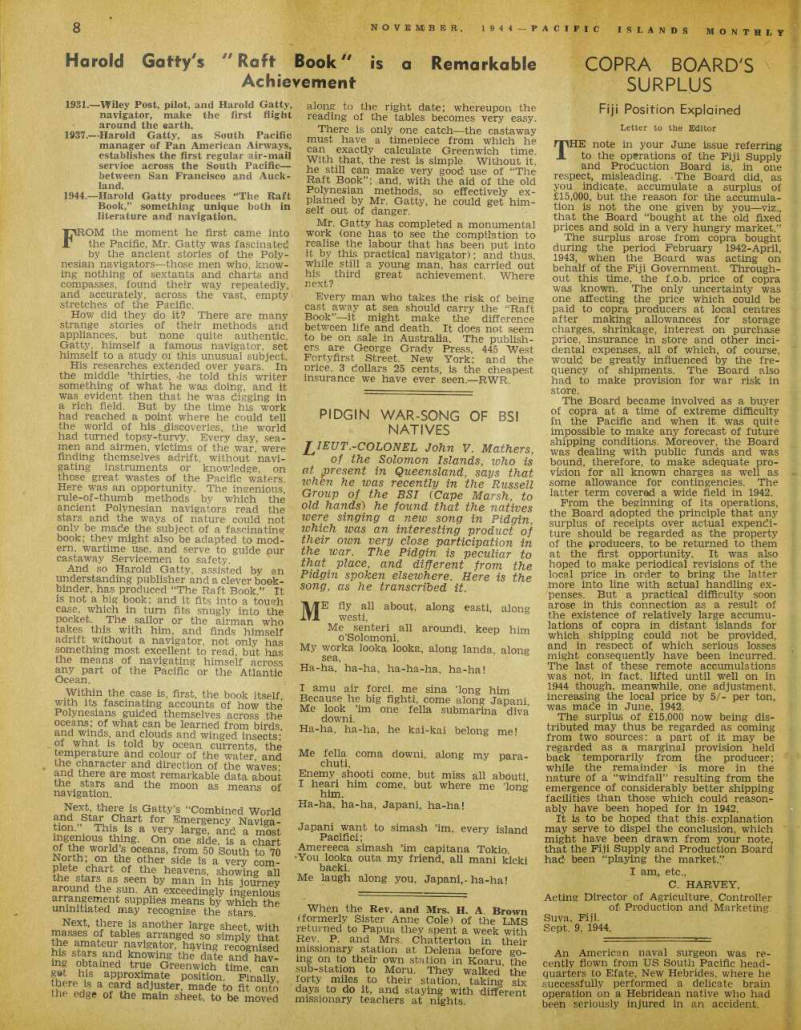
Letter to the Editor rE note in your June issue referring to the operations of the Fiji Supply and Production Board is, in one respect, misleading. The Board did, as you indicate, accumulate a surplus of £15,000, but the reason for the accumula tion is not the one given by you—viz., that the Board “bought at the old fixed prices and sold in a very hungry market.”
The surplus arose from copra bought during the period February 1942-April, 1943, when the Board was acting on behalf of the Fiji Government. Through out this time, the f.o.b. price of copra was known. The only uncertainty was one affecting the price which could be paid to copra producers at local centres after making allowances for storage charges, shrinkage, interest on purchase price, insurance in store and other inci dental expenses, all of which, of course, would be greatly influenced by the fre quency of shipments. The Board also had to make provision for war risk in store.
The Board became involved as a buyer of copra at a time of extreme difficulty in the Pacific and when it was quite impossible to make any forecast of future shipping conditions. Moreover, the Board was dealing with public funds and was bound, therefore, to make adequate pro vision for all known charges as well as some allowance for contingencies. The latter term covered a wide field in 1942.
From the beginning of its operations, the Board adopted the principle that any surplus of receipts over actual expendi ture should be regarded as the property of the producers, to be returned to them at the first opportunity. It was also hoped to make periodical revisions of the local price in order to bring the latter more into line with actual handling ex penses. But a practical difficulty soon arose in this connection as a result of the existence of relatively large accumu lations of copra in distant islands for which shipping could not be provided, and in resnect of which serious losses might consequently have been incurred.
The last of these remote accumulations was not, in fact, lifted until well on in 1944 though, meanwhile, one adjustment, increasing the local price by 5/- per ton, was made in June, 1942.
The surplus of £15,000 now being dis tributed may thus be regarded as coming from two sources: a part of it may be regarded as a marginal provision held back temporarily from the producer: while the remainder is more in the nature of a “windfall” resulting from the emergence of considerably better shipping facilities than those which could reason ably have been hoped for in 1942.
It is to be hoped that this explanation may serve to dispel the conclusion, which might have been drawn from your note, that the Fiji Supply and Production Board had been “playing the market.”
I am, etc.,
C. Harvey,
Acting Director of Agriculture, Controller of Production and Marketing.
Suva, Fiji.
Sept. 9. 1944.
An American naval surgeon was re cently flown from US South Pacific head quarters to Efate, New Hebrides, where he successfully performed a delicate brain operation on a Hebridean native who had been seriously injured in an accident.