They Whistle !
p. 38 · Read in the full issue
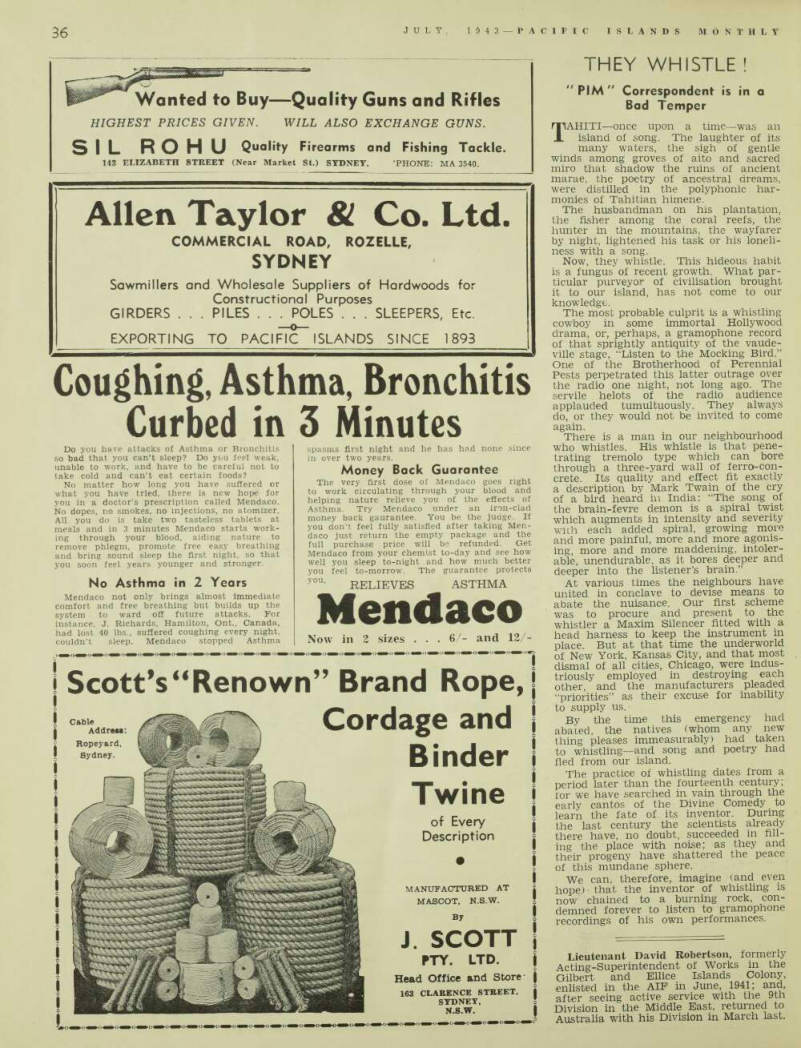
"PIM" Correspondent is in o Bad Temper
TAHITI —once upon a time —was an island of song. The laughter of its many waters, the sigh of gentle winds among groves of aito and sacred miro that shadow the ruins of ancient marae, the poetry of ancestral dreams, were distilled in the polyphonic har monies of Tahitian himene.
The husbandman on his plantation, the fisher among the coral reefs, the hunter in the mountains, the wayfarer by night, lightened his task or his loneli ness with a song.
Now, they whistle. This hideous habit is a fungus of recent growth. What par ticular purveyor of civilisation brought it to our island, has not come to our knowledge.
The most probable culprit is a whistling cowboy in some immortal Hollywood drama, or, perhaps, a gramophone record of that sprightly antiquity of the vaude ville stage, “Listen to the Mocking Bird.”
One of the Brotherhood of Perennial Pests perpetrated this latter outrage over the radio one night, not long ago. The servile helots of the radio audience applauded tumultuously. They always do, or they would not be invited to come again.
There is a man in pur neighbourhood who whistles. His whistle is that pene trating tremolo type which can bore through a three-yard wall of ferro-con crete. Its quality and effect fit exactly a description by Mark Twain of the cry of a bird heard in India; “The song of the brain-fevre demon is a spiral twist which augments in intensity and severity with each added spiral, growing more and more painful, more and more agonis ing, more and more maddening, intoler able, unendurable, as it bores deeper and deeper into the listener’s brain.”
At various times the neighbours have united in conclave to devise means to abate the nuisance. Our first scheme was to procure and present to the whistler a Maxim Silencer fitted with a head harness to keep the instrument in place. But at that time the underworld of New York, Kansas City, and that most dismal of all cities, Chicago, were indus triously employed in destroying each other, and the manufacturers pleaded “priorities” as their excuse for inability to supply us.
By the time this emergency had abated, the natives (whom any new thing pleases immeasurably) had taken to whistling—and song and poetry had fled from our island.
The practice of whistling dates from a period later than the fourteenth century: for we have searched in vain through the early cantos of the Divine Comedy to learn the fate of its inventor. During the last century the scientists already there have, no doubt, succeeded in fill ing the place with noise; as they and their progeny have shattered the peace of this mundane sphere.
We can, therefore, imagine (and even hope) that the inventor of whistling is now chained to a burning rock, con demned forever to listen to gramophone recordings of his own performances.
Lieutenant David Robertson, formerly Acting-Superintendent of Works in the Gilbert and Ellice Islands Colony, enlisted in the AIF in June, 1941; and, after seeing active service with the 9th Division in the Middle East, returned to Australia with his Division in March last.