New Caledonia
p. 17 · Read in the full issue
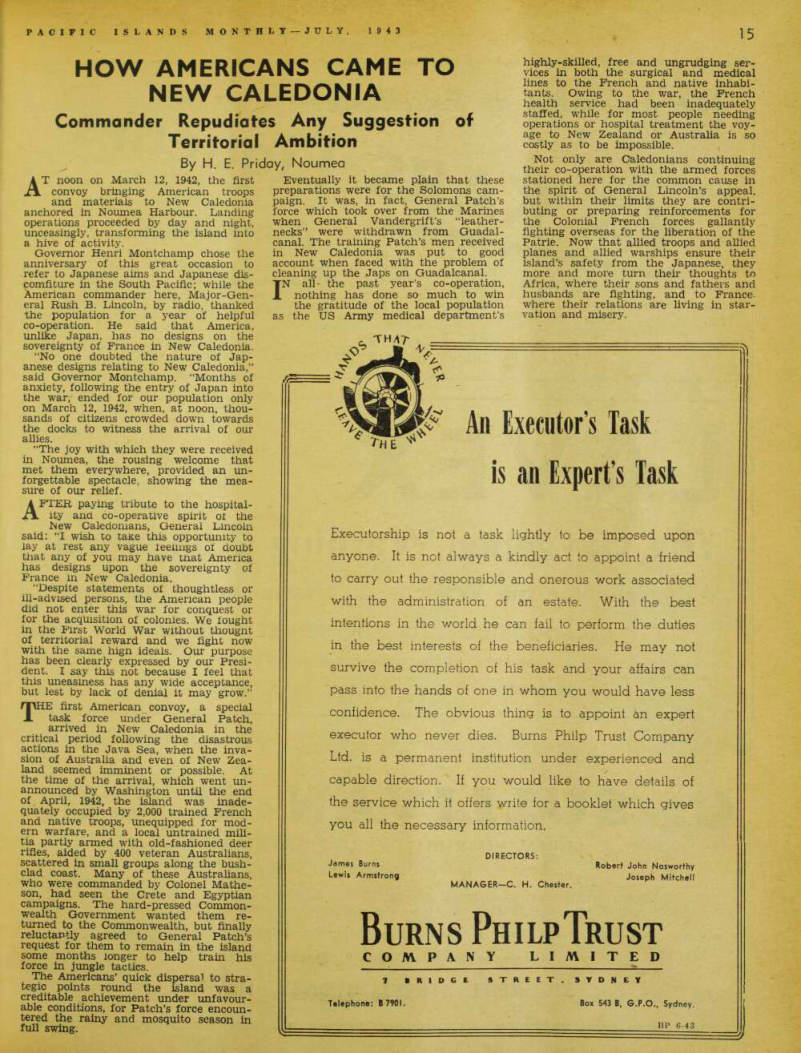
How Americans Came To
Commander Repudiates Ansy Suggestion of Territorial Ambition
By H. E. Priday, Noumea
AT noon on March 12, 1942, the first convoy bringing American troops and materials to New Caledonia anchored in Noumea Harbour. Landing operations proceeded by day and night, unceasingly, transforming the island into a hive of activity.
Governor Henri Montchamp chose the anniversary of this great occasion to refer to Japanese aims and Japanese dis comfiture in the South Pacific; while the American commander here, Major-Gen eral Rush B. Lincoln, by radio, thanked the population for a year of helpful co-operation. He said that America, unlike Japan, has no designs on the sovereignty of France in New Caledonia.
“No one doubted the nature of Jap anese designs relating to New Caledonia,” said Governor Montchamp. “Months of anxiety, following the entry of Japan into the war, ended for our population only on March 12, 1942, when, at noon, thou sands of citizens crowded down towards the docks to witness the arrival of our allies.
“The joy with which they were received in Noumea, the rousing welcome that met them everywhere, provided an un forgettable spectacle, showing the mea sure of our relief.
AFTER paying tribute to the hospital ity and co-operative spirit of the New Caledonians, General Lincoln said: “I wish to take this opportunity to lay at rest any vague feelings of doubt that any of you may have mat America has designs upon the sovereignty of France in New Caledonia.
“Despite statements of thoughtless or ill-advised persons, the American people did not enter this war for conquest or for the acquisition of colonies. We fought in the First World War without thougnt of territorial reward and we fight now with the same hign ideals. Our purpose has been clearly expressed by our Presi dent. I say this not because I feel that this uneasiness has any wide acceptance, but lest by lack of denial it may grow.” rE first American convoy, a special task force under General Patch, arrived in New Caledonia in the critical period following the disastrous actions in the Java Sea, when the inva sion of Australia and even of New Zea land seemed imminent or possible. At the time of the arrival, which went un announced by Washington until the end of April, 1942, the island was inade quately occupied by 2,000 trained French and native troops, unequipped for mod ern warfare, and a local untrained mili tia partly armed with old-fashioned deer rifles, aided by 400 veteran Australians, scattered in small groups along the bush clad coast. Many of these Australians, who were commanded by Colonel Mathe son, had seen the Crete and Egyptian campaigns. The hard-pressed Common wealth Government wanted them re turned to the Commonwealth, but finally reluctantly agreed to General Patch’s request for them to remain in the island some months longer to help train his force in jungle tactics.
The Americans’ quick dispersal to stra tegic points round the island was a creditable achievement under unfavour able conditions, for Patch’s force encoun tered the rainy and mosquito season in full swing.
Eventually it became plain that these preparations were for the Solomons cam paign. It was, in fact, General Patch’s force which took over from the Marines when General Vandergrift’s “leather necks” were withdrawn from Guadal canal. The training Patch’s men received in New Caledonia was put to good account when faced with the problem of cleaning up the Japs on Guadalcanal.
IN all the past year’s co-operation, nothing has done so much to win the gratitude of the local population as the US Army medical department’s
highly-skilled, free and ungrudging ser vices in both the surgical and medical lines to the French and native inhabi tants. Owing to the war, the French health service had been inadequately staffed, while for most people needing operations or hospital treatment the voy age to New Zealand or Australia is so costly as to be impossible.
Not only are Caledonians continuing their co-operation with the armed forces stationed here for the common cause in the spirit of General Lincoln’s appeal, but within their limits they are contri buting or preparing reinforcements for the Colonial French forces gallantly fighting overseas for the liberation of the Patrie. Now that allied troops and allied planes and allied warships ensure their island’s safety from the Japanese, they more and more turn their thoughts to Africa, where their sons and fathers and husbands are fighting, and to France where their relations are living in star vation and misery.