Regarded as Ideal Type of Jungle Fighters
p. 13 · Read in the full issue
Fijian Soldiers For Overseas
AFTER training strenuously for two or three years in anticipation of seeing overseas service, the First Battalion of the Fiji Military Defence Forces recently marched through the town of Suva to embark for an advanced Pacific base.
The battalion comprises Fijians, Euro nesians and Europeans, and its members are particularly selected for their perfect physical condition. This is the first time, except for a few commandos on Guadal canal, that Fijians have left the Colony for active combatant service in this war.
Headed by the native military band, accompanied by Brigadier J. G. C. Wales, MC, Commandant of the Fiji Military Forces, showered with confetti and streamers, and cheered unceasingly, the men were greeted with such scenes of enthusiasm as have not been witnessed since the First Fiji Contingent (Euro pean) left for World War I.
Officered by local Europeans, New Zea landers and Fijians, the battalion is commanded by Lieutenant-Colonel J. B.
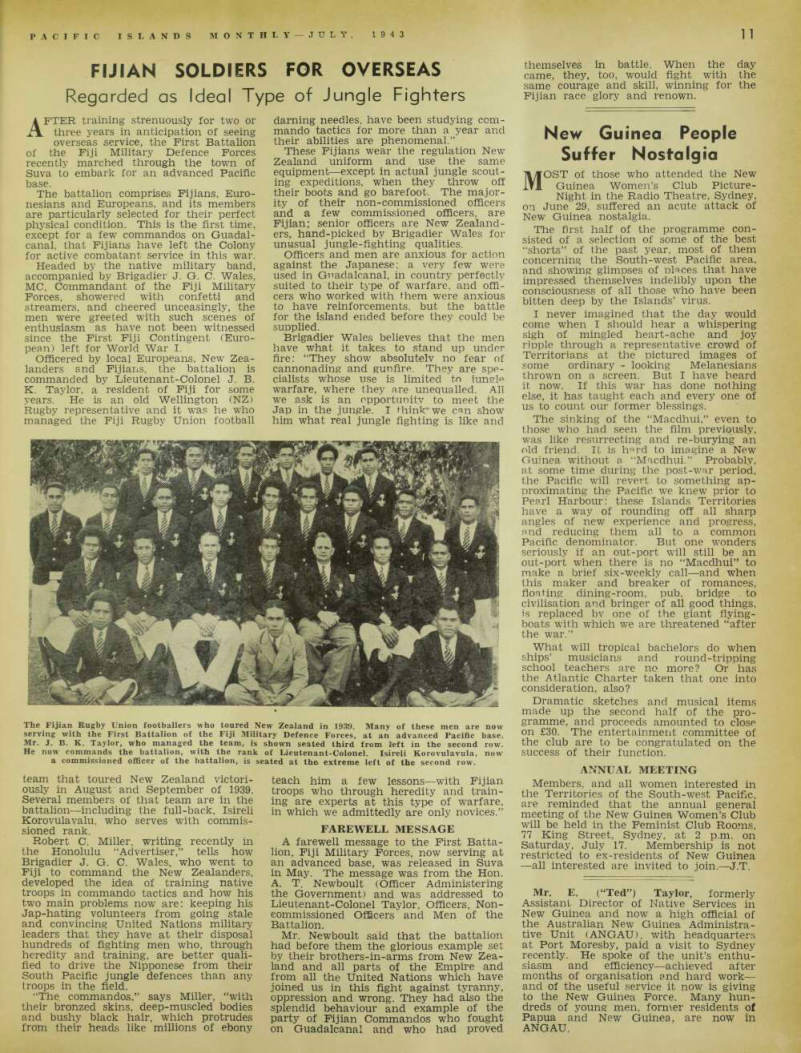
K. Taylor, a resident of Fiji for some years. He is an old Wellington (NZ) Rugby representative and it was he who managed the Fiji Rugby Union football
team that toured New Zealand victori ously in August and September of 1939.
Several members of that team are in the battalion—including the full-back, Isireli Korovulavalu, who serves with commis sioned rank.
Robert C. Miller, writing recently in the Honolulu “Advertiser,” tells how Brigadier J. G. C. Wales, who went to Fiji to command the New Zealanders, developed the idea of training native troops in commando tactics and how his two main problems now are: keeping his Jap-hating volunteers from going stale and convincing United Nations military leaders that they have at their disposal hundreds of fighting men who, through heredity and training, are better quali fied to drive the Nipponese from their South Pacific jungle defences than any troops in the field.
“The, commandos,” says Miller, “with their bronzed skins, deep-muscled bodies and bushy black hair, which protrudes from their heads like millions of ebony
darning needles, have been studying com mando tactics for more than a year and their abilities are phenomenal.”
These Fijians wear the regulation New Zealand uniform and use the same equipment—except in actual jungle scout ing expeditions, when they throw off their boots and go barefoot. The major ity of their non-commissioned officers and a few commissioned officers, are Fijian; senior officers are New Zealand ers, hand-picked by Brigadier Wales for unusual jungle-fighting qualities.
Officers and men are anxious for action against the Japanese: a very few were used in Guadalcanal, in country perfectly suited to their type of warfare, and offi cers who worked with them were anxious to have reinforcements, but the battle for the island ended before they could be supplied.
Brigadier Wales believes that the men have what it takes to stand up under fire; “They show absolutely no fear of cannonading and gunfire. They are spe cialists whose use is limited to iuns> warfare, where they are unequalled. All we ask is an opportunity to meet the Jap in the jungle. I think’we can show him what real jungle fighting is like and
teach him a few lessons —with Fijian troops who through heredity and train ing are experts at this type of warfare, in which we admittedly are only novices.”
Farewell Message
A farewell message to the First Batta lion, Fiji Military Forces, now serving at an advanced base, was released in Suva in May. The message was from the Hon.
A. T. Newboult (Officer Administering the Government) and was addressed to Lieutenant-Colonel Taylor, Officers, Non commissioned Officers and Men of the Battalion.
Mr. Newboult said that the battalion had before them the glorious example set by their brothers-in-arms from New Zea land and all parts of the Empire and from all the United Nations which have joined us in this fight against tyranny, oppression and wrong. They had also the splendid behaviour and example of the party of Fijian Commandos who fought on Guadalcanal and who had proved
themselves in battle. When the day came, they, too, would fight with the same courage and skill, winning for the Fijian race glory and renown.
The Fijian Rugby Union footballers who toured New Zealand in 1939. Many of these men are now serving with the First Battalion of the Fiji Military Defence Forces, at an advanced Pacific base.
Mr. J. B. K. Taylor, who managed the team, is shown seated third from left in the second row.
He now commands the battalion, with the rank of Lieutenant-Colonel. Isireli Korovulavula, now a commissioned officer of the battalion, is seated at the extreme left of the second row.