Solomons Aid
p. 10 · Read in the full issue
Allies
Significant Story of What Happened in May-August, 1942
'T'HE Japanese came into the Central ■*- Solomons and occupied Tulagi and the neighbourhood in strengtn at the end of April, 1942; and they remained mere until thrown out by the Americans the following August.
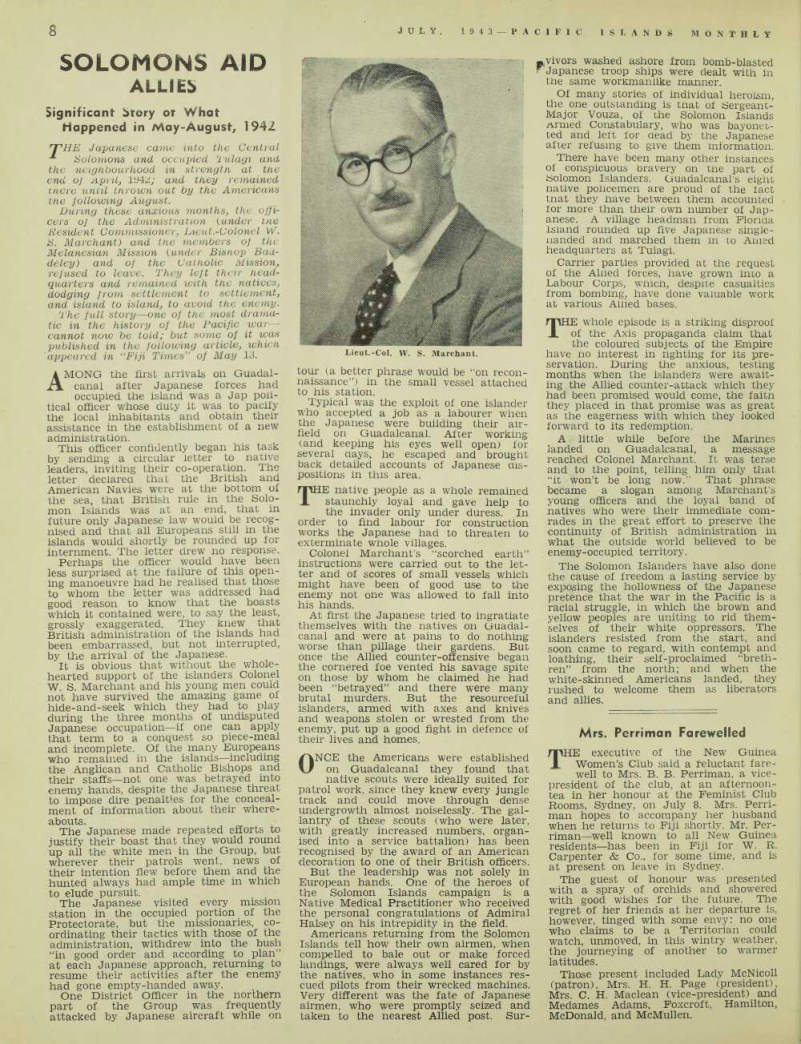
During these anxious months, the offi cers of the Administration (under me Resident Commissioner, Lieut.-Colonel W. if. Marchant) and tne members of the Melanesian Mission (under Bisnop Bad deley) and of the Catholic Mission, refused to leave. They left their head quarters and remained with the natives, dodging from settlement to settlement, and island to island, to avoid the enemy.
The full story—one of the most drama tic in the history of the Pacific war — cannot now be told; but some of it was published in the following article, which appeared in “Fiji Times” of May 13.
AMONG the first arrivals on Guadal canal after Japanese forces had occupied the island was a Jap poli tical officer whose duty it was to pacify the local inhabitants and obtain their assistance in the establishment of a new administration.
This officer confidently began his task by sending a circular letter to native leaders, inviting their co-operation. The letter declared that the British and American Navies were at the bottom of the sea, that British rule in the Solo mon Islands was at an end, that in future only Japanese law would be recog nised and that all Europeans still in the islands would shortly be rounded up for internment. The letter drew no response.
Perhaps the officer would have been less surprised at the failure of this open ing manoeuvre had he realised that those to whom the letter was addressed had good reason to know that the boasts which it contained were, to say the least, grossly exaggerated. They knew that British administration of the islands had been embarrassed, but not interrupted, by the arrival of the Japanese.
It is obvious that without the whole hearted support of the islanders Colonel W. S. Marchant and his young men could not have survived the amazing game of hide-and-seek which they had to play during the three months of undisputed Japanese occupation—if one can apply that term to a conquest so piece-meal and incomplete. Of the many Europeans who remained in the islands —including the Anglican and Catholic Bishops and their staffs—not one was betrayed into enemy hands, despite the Japanese threat to impose dire penalties for the conceal ment of information about their where abouts.
The Japanese made repeated efforts to justify their boast that they would round up all the white men in the Group, but wherever their patrols went, news of their intention flew before them and the hunted always had ample time in which to elude pursuit.
The Japanese visited every mission station in the occupied portion of the Protectorate, but the missionaries, co ordinating their tactics with those of the administration, withdrew into the bush “in good order and according to plan” at each Japanese approach, returning to resume their activities after the enemy had gone empty-handed away.
One District Officer in the northern part of the Group was frequently attacked by Japanese aircraft while on
tour (a better phrase would be “on recon naissance”) in the small vessel attached to his station.
Typical was the exploit of one islander who accepted a job as a labourer when the Japanese were building their air field on Guadalcanal. After working (and keeping his eyes well open) for several days, he escaped and brought back detailed accounts of Japanese dis positions in this area. rE native people as a whole remained staunchly loyal and gave help to the invader only under duress. In order to find labour for construction works the Japanese had to threaten to exterminate whole villages.
Colonel Marchant’s “scorched earth” instructions were carried out to the let ter and of scores of small vessels which might have been of good use to the enemy not one was allowed to fall into his hands.
At first the Japanese tried to ingratiate themselves with the natives on Guadal canal and were at pains to do nothing worse than pillage their gardens. But once the Allied counter-offensive began the cornered foe vented his savage spite on those by whom he claimed he had been “betrayed” and there were many brutal murders. But the resourceful islanders, armed with axes and knives and weapons stolen or wrested from the enemy, put up a good fight in defence of their lives and homes.
ONCE the Americans were established on Guadalcanal they found that native scouts were ideally suited for patrol work, since they knew every jungle track and could move through dense undergrowth almost noiselessly. The gal lantry of these scouts (who were later, with greatly increased numbers, organ ised Into a service battalion) has been recognised by the award of an American decoration to one of their British officers.
But the leadership was not solely in European hands. One of the heroes of the Solomon Islands campaign is a Native Medical Practitioner who received the personal congratulations of Admiral Halsey on his intrepidity in the field.
Americans returning from the Solomon Islands tell how their own airmen, when compelled to bale out or make forced landings, were always well cared for by the natives, who in some instances res cued pilots from their wrecked machines.
Very different was the fate of Japanese airmen, who were promptly seized and taken to the nearest Allied post. Sur
,vivors washed ashore from bomb-blasted Japanese troop ships were dealt with in the same wononanlike manner.
Of many stories of individual heroism, the one outstanding is that of Sergeant- Major Vouza, of the Solomon Islands Armed Constabulary, who was bayonet led and left for dead by the Japanese after refusing to give them information.
There have been many other instances of conspicuous bravery on tne part of Solomon Islanders. Guadalcanal’s eight native policemen are proud of the fact tnat they have between them accounted for more than their own number of Jap anese. A village headman from Florida Island rounded up five Japanese single nanded and marched them in to Amed headquarters at Tulagi.
Carrier parties provided at the request of the Allied forces, have grown into a Labour Corps, which, despite casualties from bombing, have done valuable work at various Allied bases. fITHE whole episode is a striking disproof X of the Axis propaganda claim that the coloured subjects of the Empire have no interest in fighting for its pre servation. During the anxious, testing months when the islanders were await ing the Allied counter-attack which they had been promised would come, the faitn they placed in that promise was as great as the eagerness with which they looked forward to its redemption.
A little while before the Marines landed on Guadalcanal, a message reached Colonel Marchant. It was terse and to the point, telling him only that “it won’t be long now.” That phrase became a slogan among Marchant’s young officers and the loyal band of natives who were their immediate com rades in the great effort to preserve the continuity of British administration in what the outside world believed to be enemy-occupied territory.
The Solomon Islanders have also done the cause of freedom a lasting service by exposing the hollowness of the Japanese pretence that the war in the Pacific is a racial struggle, in which the brown and yellow peoples are uniting to rid them selves of their white oppressors. The islanders resisted from the start, and soon came to regard, with contempt and loathing, their self-proclaimed “breth ren” from the north; and when the white-skinned Americans landed, they rushed to welcome them as liberators and allies.
Lieut.-Col. W. S. Marchant.