What "Evacuees" Can Do On August 21
pp. 5-6 · Read in the full issue
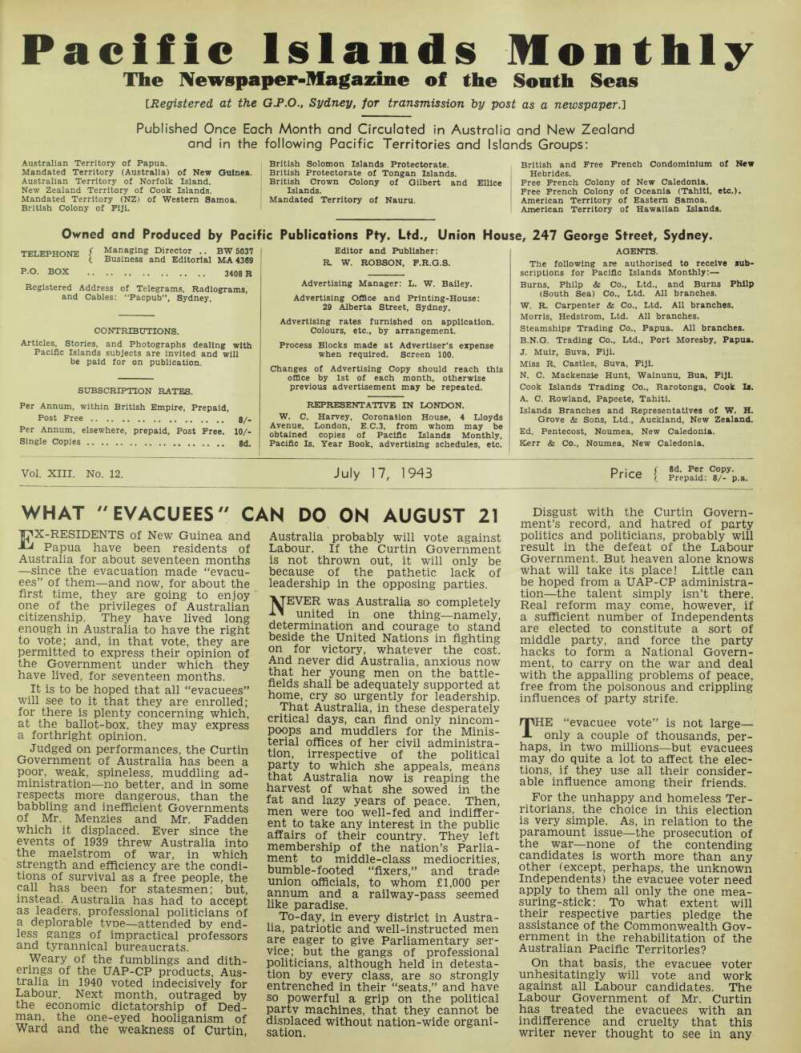
EX-RESIDENTS of New Guinea and Papua have been residents of Australia for about seventeen months —since the evacuation made “evacu ees” of them—and now, for about the first time, they are going to enjoy one of the privileges of Australian citizenship. They have lived long enough in Australia to have the right to vote; and, in that vote, they are permitted to express their opinion of the Government under which they have lived, for seventeen months.
It is to be hoped that all “evacuees” will see to it that they are enrolled; for there is plenty concerning which, at the ballot-box, they may express a forthright opinion.
Judged on performances, the Curtin Government of Australia has been a poor, weak, spineless, muddling ad ministration—no better, and in some respects more dangerous, than the babbling and inefficient Governments of Mr. Menzies and Mr. Fadden which it displaced. Ever since the events of 1939 threw Australia into the maelstrom of war, in which strength and efficiency are the condi tions of survival as a free people, the call has been for statesmen; but, instead. Australia has had to accept as leaders, professional politicians of a deplorable tvne—attended by end less gangs of impractical professors and tyrannical bureaucrats.
Weary of the fumblings and dith erings of the UAP-CP products, Aus tralia in 1940 voted indecisively for Labour. Next month, outraged by the economic dictatorship of Ded man, the one-eyed hooliganism of Ward and the weakness of Curtin,
Australia probably will vote against Labour. If the Curtin Government is not thrown out, it will only be because of the pathetic lack of leadership in the opposing parties.
NEVER was Australia so completely united in one thing—namely, determination and courage to stand beside the United Nations in fighting on for victory, whatever the cost.
And never did Australia, anxious now that her young men on the battle fields shall be adequately supported at home, cry so urgently for leadership.
That Australia, in these desperately critical days, can find only nincom poops and muddlers for the Minis terial offices of her civil administra tion, irrespective of the political party to which she appeals, means that Australia now is reaping the harvest of what she sowed in the fat and lazy years of peace. Then, men were too well-fed and indiffer ent to take any interest in the public affairs of their country. They left membership of the nation’s Parlia ment to middle-class mediocrities, bumble-footed “fixers,” and trade union officials, to whom £l,OOO per annum and a railway-pass seemed like paradise.
To-day, in every district in Austra lia, patriotic and well-instructed men are eager to give Parliamentary ser vice; but the gangs of professional politicians, although held in detesta tion by every class, are so strongly entrenched in their “seats,” and have so powerful a grip on the political party machines, that they cannot be displaced without nation-wide organi sation.
Disgust with the Curtin Govern ment’s record, and hatred of party politics and politicians, probably will result in the defeat of the Labour Government. But heaven alone knows what will take its place! Little can be hoped from a UAP-CP administra tion—the talent simply isn’t there.
Real reform may come, however, if a sufficient number of Independents are elected to constitute a sort of middle party, and force the party hacks to form a National Govern ment, to carry on the war and deal with the appalling problems of peace, free from the poisonous and crippling influences of party strife.
THE “evacuee vote” is not large— only a couple of thousands, per haps, in two millions—but evacuees may do quite a lot to affect the elec tions, if they use all their consider able influence among their friends.
For the unhappy and homeless Ter ritorians, the choice in this election is very simple. As, in relation to the paramount issue—the prosecution of the war—none of the contending candidates is worth more than any other (except, perhaps, the unknown Independents) the evacuee voter need apply to them all only the one mea suring-stick: To what extent will their respective parties pledge the assistance of the Commonwealth Gov ernment in the rehabilitation of the Australian Pacific Territories?
On that basis, the evacuee voter unhesitatingly will vote and work against all Labour candidates. The Labour Government of Mr. Curtin has treated the evacuees with an indifference and cruelty that this writer never thought to see in any
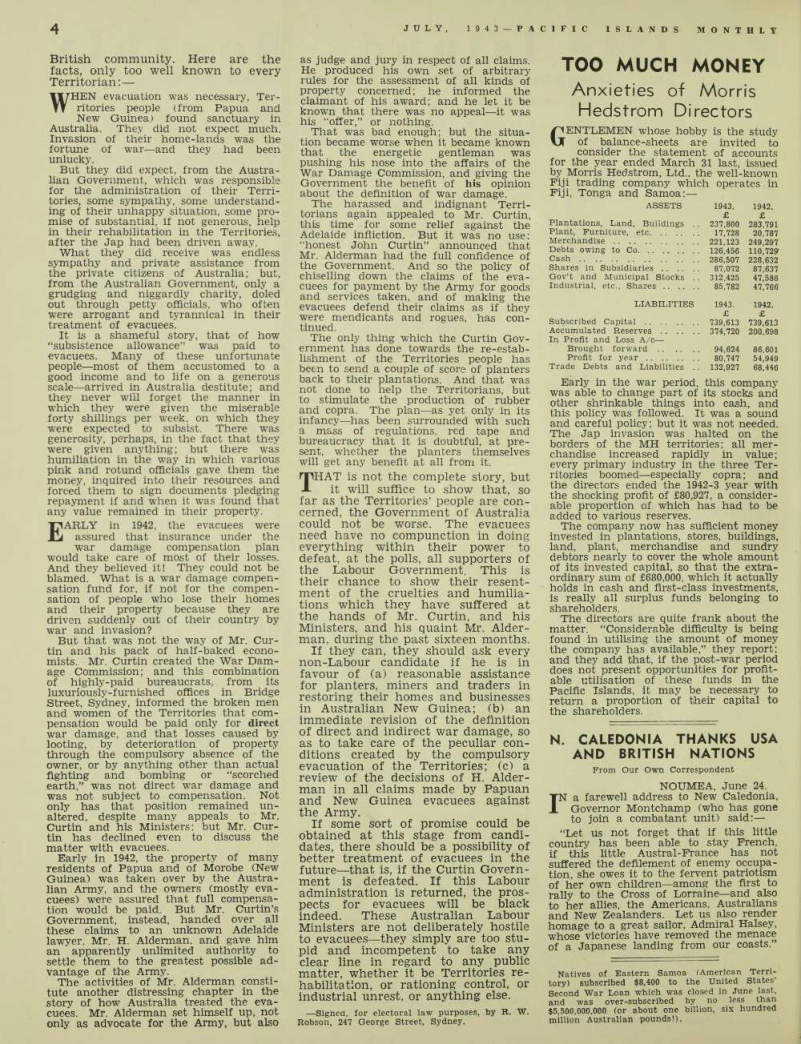
British community. Here are the facts, only too well known to every Terri torian:— WHEN evacuation was necessary, Ter ritories people (from Papua and New Guinea) found sanctuary in Australia. They did not expect much.
Invasion of their home-lands was the fortune of war—and they had been unlucky.
But they did expect, from the Austra lian Government, which was responsible for the administration of their Terri tories, some sympathy, some understand ing of their unhappy situation, some pro mise of substantial, if not generous, help in their rehabilitation in the Territories, after the Jap had been driven away.
What they did receive was endless sympathy and private assistance from the private citizens of Australia; but, from the Australian Government, only a grudging and niggardly charity, doled out through petty officials, who often were arrogant and tyrannical in their treatment of evacuees.
It is a shameful story, that of how “subsistence allowance” was paid to evacuees. Many of these unfortunate people—most of them accustomed to a good income and to life on a generous scale —arrived in Australia destitute; and they never will forget the manner in which they were given the miserable forty shillings per week, on which they were expected to subsist. There was generosity, perhaps, in the fact that they were given anything; but there was humiliation in the way in which various pink and rotund officials gave them the money, inquired into their resources and forced them to sign documents pledging repayment if and when it was found that any value remained in their property, EARLY in 1942, the evacuees were assured that insurance under the war damage compensation plan would take care of most of their losses.
And they believed it! They could not be blamed. What is a war damage compen sation fund for, if not for the compen sation of people who lose their homes and their property because they are driven suddenly out of their country by war and invasion?
But that was not the way of Mr, Cur tin and his pack of half-baked econo mists. Mr. Curtin created the War Dam age Commission; and this combination of highly-paid bureaucrats, from its luxuriously-furnished offices in Bridge Street, Sydney, informed the broken men and women of the Territories that com pensation would be paid only for direct war damage, and that losses caused by looting, by deterioration of property through the compulsory absence of the owner, or by anything other than actual fighting and bombing or “scorched earth,” was not direct war damage and was not subject to compensation. Not only has that position remained un altered, despite many appeals to Mr.
Curtin and his Ministers; but Mr. Cur tin has declined even to discuss the matter with evacuees.
Early in 1942, the property of many residents of Papua and of Morobe (New Guinea) was taken over by the Austra lian Army, and the owners (mostly eva cuees) were assured that full compensa tion would be paid. But Mr. Curtin’s Government, instead, handed over all these claims to an unknown Adelaide lawyer. Mr. H. Alderman, and gave him an apparently unlimited authority to settle them to the greatest possible ad vantage of the Army.
The activities of Mr. Alderman consti tute another distressing chapter in the story of how Australia treated the eva cuees. Mr. Alderman set himself up, not only as advocate for the Army, but also
as judge and jury in respect of all claims.
He produced his own set of arbitrary rules for the assessment of all kinds of property concerned; he informed the claimant of his award; and he let it be known that there was no appeal—it was his “offer,” or nothing.
That was bad enough; but the situa tion became worse when it became known that the energetic gentleman was pushing his nose into the affairs of the War Damage Commission, and giving the Government the benefit of his opinion about the definition of war damage.
The harassed and indignant Terri torians again appealed to Mr. Curtin, this time for some relief against the Adelaide infliction. But it was no use: “honest John Curtin” announced that Mr. Alderman had the full confidence of the Government. And so the policy of chiselling down the claims of the eva cuees for payment by the Army for goods and services taken, and of making the evacuees defend their claims as if they were mendicants and rogues, has con tinued.
The only thing which the Curtin Gov ernment has done towards the re-estab lishment of the Territories people has been to send a couple of score of planters back to their plantations. And that was not done to help the Territorians, but to stimulate the production of rubber and copra. The plan—as yet only in its infancy—has been surrounded with such a mass of regulations, red tape and bureaucracy that it is doubtful, at pre sent, whether the planters themselves will get any benefit at all from it.
THAT is not the complete story, but it will suffice to show that, so far as the Territories’ people are con cerned, the Government of Australia could not be worse. The evacuees need have no compunction in doing everything within their power to defeat, at the polls, all supporters of the Labour Government. This is their chance to show their resent ment of the cruelties and humilia tions which they have suffered at the hands of Mr. Curtin, and his Ministers, and his quaint Mr. Aider man, during the past sixteen months.
If they can, they should ask every non-Labour candidate if he is in favour of (a) reasonable assistance for planters, miners and traders in restoring their homes and businesses in Australian New Guinea; (b) an immediate revision of the definition of direct and indirect war damage, so as to take care of the peculiar con ditions created by the compulsory evacuation of the Territories; (c) a review of the decisions of H. Aider man in all claims made by Papuan and New Guinea evacuees against the Army.
If some sort of promise could be obtained at this stage from candi dates, there should be a possibility of better treatment of evacuees in the future—that is, if the Curtin Govern ment is defeated. If this Labour administration is returned, the pros pects for evacuees will be black indeed. These Australian Labour Ministers are not deliberately hostile to evacuees—they simply are too stu pid and incompetent to take any clear line in regard to any public matter, whether it be Territories re habilitation, or rationing control, or industrial unrest, or anything else. —Signed, for electoral law purposes, by R. W.
Robson, 247 George Street, Sydney.