Fiji's Labour
p. 45 · Read in the full issue
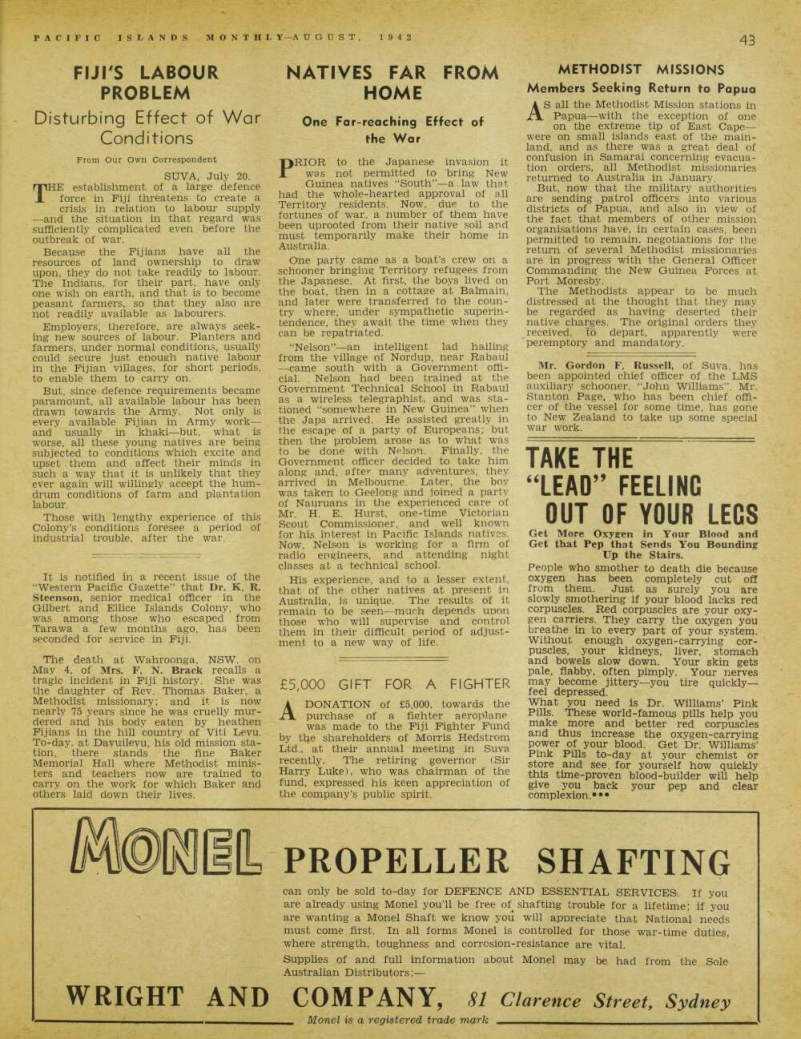
Problem
Disturbing Effect of War Conditions
From Our Own Correspondent SUVA, July 20.
THE establishment of a large defence force in Fiji threatens to create a crisis in relation to labour supply —and the situation in that regard was sufficiently complicated even before the outbreak of war.
Because the Fijians have all the resources of land ownership to draw upon, they do not take readily to labour.
The Indians, for their part, have only one wish on earth, and that is to become peasant farmers, so that they also are not readily available as labourers.
Employers, therefore, are always seek ing new sources of labour. Planters and farmers, under normal conditions, usually could secure just enough native labour in the Fijian villages, for short periods, to enable them to carry on.
But, since defence requirements became paramount, all available labour has been drawn towards the Army. Not only is every available Fijian in Army work— and usually in khaki —but. what is worse, all these young natives are being subjected to conditions which excite and upset them and affect their minds in such a way that it is unlikely that they ever again will willingly accept the hum drum conditions of farm and plantation labour.
Those with lengthy experience of this Colony’s conditions foresee a period of industrial trouble, after the war.
It is notified in a recent issue of the “Western Pacific Gazette” that Dr. K. R.
Steenson, senior medical officer in the Gilbert and Ellice Islands Colony, who was among those who escaped from Tarawa a few months ago, has been seconded for service in Fiji.
The death at Wahroonga. NSW, on May 4, of Mrs. F. N. Brack recalls a tragic incident in Fiji history. She was the daughter of Rev. Thomas Baker, a Methodist missionary; and it is now nearly 75 years since he was cruelly mur dered and his body eaten by heathen Fijians in the hill country of Viti Levu.
To-day. at Davuilevu, his old mission sta tion, there stands the fine Baker Memorial Hall where Methodist minis ters and teachers now are trained to carry on the work for which Baker and others laid down their lives.