How The Men Of Hmas "Perth" Enjoyed A "Continental
pp. 23-26 · Read in the full issue
Sunday" In Tahiti
r PHE story of how. the famous Australian cruiser “Perth” visited Papeete, in Tahiti, one day early in 1940, is told, for the first time, by Edward C. Snow. The “Perth” proved her quality in many engagements, subsequent to the incidents described below; and she was sunk, in battle with the Japanese, in East Indian waters, in 1942.
HMAS “Perth” timed it nicely . . . Even as the myriad lantern lights over hanging the outrigger canoes bobbed and winked, while the native fishermen skirted the reef after catches for the Sunday morning market, the now his toric cruiser was turning its bows toward Papeete Pass.
Very early in Sunday’s small hours, she came in line with the two red light standards which indicated the navigable passage through the reef into Papeete Lagoon, and in due course tied up at the wharf.
Six hundred officers and men greeted with enthusiasm the Continental Sunday at Tahiti—a mixture of French comic
opera and South Sea Island burlesque, which made it quite the best spot in the world where a crew could spend the day.
For Australian sailors are neither kill joys nor liver-ridden penitents, and they took to the Continental Sunday like so many ducks to water. It was, in fact, the largest Australian contingent to visit the famous port.
Tahiti had plenty to offer the men; plenty to show them.
The Fish Market
SUNDAY dawns shortly after 5.30 in this tropic port, at which hour the market was officially opened with the ringing of a bell. Chinese stores and
restaurants usually opened about 4 a.m., to give early dealers a French breakfast of coffee, rolls and fruit.
Australian sailors, bubbling with excite ment and surprise, mhled with the natives during the three fiours that fish and fruit, meat and vegetables were briskly traded. The men had been long months away from a home port; and, although they found Tahiti “very for eign”, they were nevertheless glad of the chance to stretch their legs.
Of special interest to them was the behaviour of the voluble native girls, as the latter bought up all the exotically perfumed wreaths with which to halo their heads, and leis to hang around their necks. The Australians obviously liked the extreme liveliness and vivacity of the island girls.
They marvelled frankly at the fish; and the natives, mistaking their gestures,
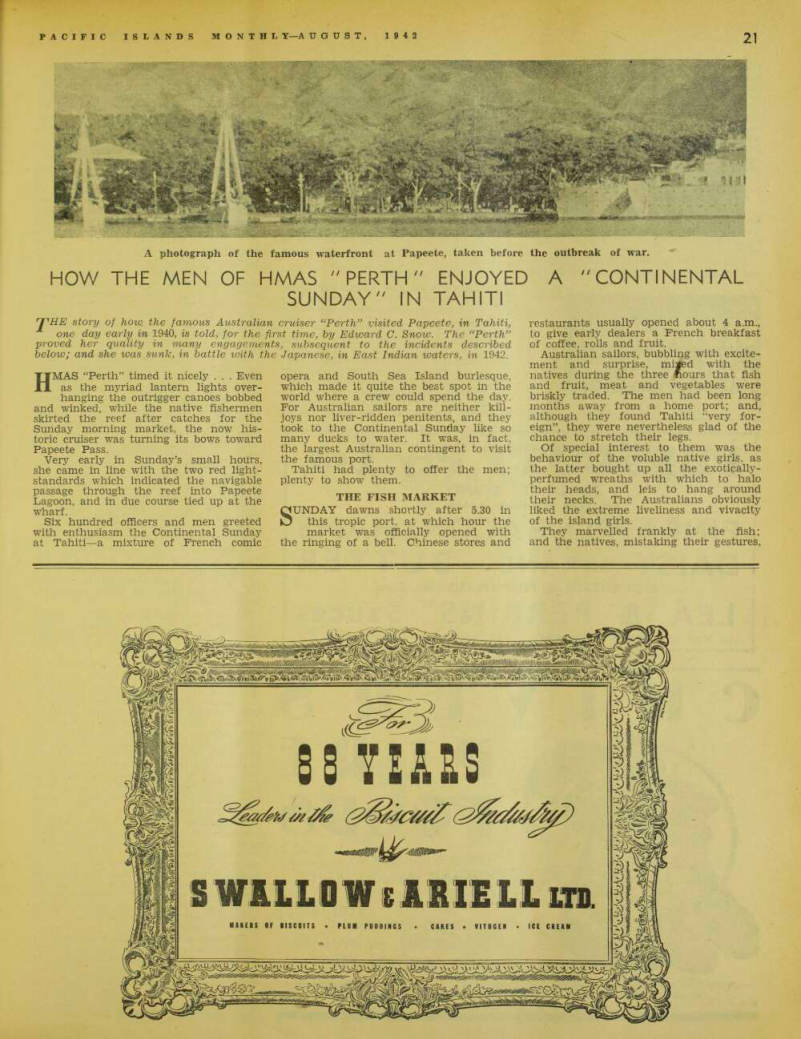
A photograph of the famous waterfront at Papeete, taken before the outbreak of war.
endeavoured to persuade them to buy.
Some tourists, appraising the general uselessness of the idea as a commercial proposition, went into fits of laughter.
The fish that attracted the sailors’ attention, at which they had pointed, looked like anything but fish! There were yellow fish with green stripes, parrot-fish with two tails, square-fish with streamer tails, cowfish with two homs, and fish that made the ratings look at each other, and question their own sobriety. (For the benefit of those who cannot make the lengthy voyage to the far South Seas, many specimens of queer Tahitian fish are now on view in the aquariums of Sydney and San Francisco.) A native girl carried a baby octopus by the head, and its tentacles trailed in the
mud. Later, it would in all probability be devoured with chop-suey, bought at Too Fat’s restaurant.
Too Fat, the best known and most photographed Chinese at Tahiti, informed a group of sailors enthusiastically that he was in reality an Australian-born Chinese from Menangle, in New South Wales.
The fate and destination of the octo pus caused a good deal of speculation.
Somebody said he had heard they were delicious, when cooked “the right way”.
Whereupon somebody else interjected that it was all poppycock; when he par ticipated, the octopus tasted like “broiled motor-bike tyres served up in crude-oil and salt-water sauce”. (Readers can be safely recommended to keep to bacon and eggs.)
Boxing
QUITE early on the momentous Sun day, the first men lucky enough to be granted shore leave found the public boxing-ring. They had not very far to 100k —it was very handy.
The Tahiti waterfront, from Captain Cook down to movie-actors such as Doug las Fairbanks and Stirling Hayden, has been termed “The World’s Greatest Stage”. The boxing-ring was situated in an open-air yard, opposite where the “Perth” lay, between the coal-dump and a cabaret known as “Col Bleu”. Bouts
between the ratings of the cruiser fol lowed in fast succession. There were no rules or refs, but there was a lot of fun.
Raised on nine oil-drums, gloves pro vided free, the boxing-ring was a more or less successful attempt by the local administration to absorb the superfluous energy of visiting sailors and tourists. (Quite the knottiest problem they have ever had to deal with.) Small boys hit the oil-drums with stone-slings, in lieu of conventional gongs, and the lads in tropic white required no second bidding to get on with it. Contests were in pro gress from the arrival of the cruiser until its departure.
Packed Churches
VISITING sailors and tourists attended the services—in marked contrast with the manner in which they neglect the places of worship back home.
At Tahiti, they couldn’t be kept oUt The churches at Papeete were not merely packed. Even the Protestant churches had a phenomenal overflow, and that was the rule, rather than the exception.
Gregorian Chants, interspersed with the striking of bells, were heard at the Catholic Cathedral, and they were so melodious in tone that the impression they made was unforgettable.
At the Protestant Temple the singing of “himenes” lasted all the morning.
That style of singing differed from any thing the visiting sailors had previously heard. Unlike most congregations, that of the Tahitian church did not sing all at once. The Protestant assembly was invisibly divided into six choirs, repre senting six nearby districts. Each sec tion sang in rotation the “himenes” arranged by the chiefs of the various dis tricts. The effects were lovely—quite beyond description in mere words.
Tahitian singing is the softest and most pleasant to the ear, in all Oceania.
It differs from the hard consonant tones of the white races inasmuch as it is a vowel tongue—two or more vowels to every consonant.
Tourists and sailors sat spell-bound at something so strange and new. They voted it the best experience of all that Tahiti had to offer them.
The Cock-Fight
THE Sunday cock-fight at Tahiti was held in the district of Punaauia, near the Punaaru River Bridge.
What it lacked as an edifying spectacle it more than made up for in humour.
The state of excitement into which the natives transported themselves, rather than the behaviour of the contesting roosters, made the entertainment.
The ring was a small circus affair of bambo and pandanus, while the specta tors leaned on an outer barrier, similar to a racecourse railing.
Tethered by a piece of string tied to one leg, and looped round a handy tree, stood a game contestant. Pouting, crouching and spurring, it awaited its chance at the lists. Tied at safe, and convenient distances, other fighters ruff led their feathers. Two Euronesian bookmakers, puffing at American cigar ettes, and with wads of rather grubby five and twenty-francs notes in their hands, accepted bets.
The cock-fight proved to be a series of contests, some of which were flops, and others rich in unexpected comedy.
One bird, after a great deal of flurry with its wings, proved chicken-hearted in a literal sense of the term. It beat a furious retreat round and round the ring, and then crowned the event by
flying up to an overhanging branch and crowing lustily.
Even funnier was the derisive yelling and gesticulations of the natives.
However, the most humorous feature of the meeting from the viewpoint of the visiting sailors was the manner in which the intervals were filled. The seconds, and owners of the birds, put the beaks of the badly-winded fighters in their own mouths and blew hard, endeavour ing to resuscitate the exhausted roosters for a further contest! An American who won five francs declared quite truthfully that he had done what was impossible in his own country in a thousand Sun days.
Sports
BY far the most popular entertain ments on the South Sea Island Sun day were the regular sporting fix tures —horse-races, football matches and basket-ball contests.
True, the horse-races were only a wild west type of burlesque. However, the visit of the “Perth”, owing to wartime radio prohibitions, was unheralded, and the local committees had not time to stage anything more spectacular than soccer matches between the crew of the “Perth” and the Papeete champions, and basket-ball contests between high school teams, Fei-pi and Ecole Centrale.
There was plenty of Tahiti beer and French wine at the Sports Ground booth, and the large attendance had a very good time.
Taxi Rides
IN that sphere of activity the British Consul interceded with some excel lent work.
It had long been the custom, upon the arrival of a tourist-ship, for the prices charged by native Jehus to increase even faster than their taxis could accelerate.
But, whereas opulent tourists on the Swedish liner “Kungsholme” and the American liner “Monterey” paid up to £l3 for an 80-miles trip round the island, “Perth” sailors had the unique experi ence of finding the price pegged, for their benefit, at 350 francs, or £2/10/-.
The British Consul, taking into con sideration the limited depths of the sail ors’ pockets, saw to it that his charges received good value for their money in the 40 odd trips that were made around the island.
The Cinema
AS the screening of new films always 'fell on Sunday, the price for admis sion was accordingly trebled on that day. The cinema did not open at all on Monday or Friday, but on Tuesday and the middle of the week, films of yester year could be seen at very moderate prices.
The main attraction with the arrival of any large ship was usually Tahiti’s own “Bounty” film. However, what with breaks and wear and tear, since the pre miere in 1936, the screening the men on the “Perth” saw of the famous “Mutiny” film boasted only two-thirds of its ori ginal length!
Cabaret Dances
EVEN as the paradoxes of the Tahitian church services had surprised the sailors, so also did the Polynesian method of dancing. There were anoma lies for which no explanation could be given. With the outbreak of war in 1939 week-day dances and dance bands had been prohibited. Dances were permitted on Saturdays and Sunday nights only!
Tahitian dances never begin in Euro pean ballroom fashion. They start with a violent bang somewhere near the middle of things. They end, just as abruptly, with the dancer falling flat on
the floor. The softer and more subdued passages, which to a certain degree corresponded with the commencement of Western dancing, come in the middle of a Tahitian dance.
The cabarets, “Quinn’s”, “Lionel’s” and “Col Bleu”, were packed to suffocation when the hula dances (and the inevitable stamping noise—like anti-aircraft gunfire—that went with them) came on.
The world-travelled sailors of the “Perth” found it no less exciting than the Tahitians themselves.
Tetua and Natai, the ace hula-girls, were adjudged the equal of anything the men had seen.
“Ain’t she something wonderful!” exclaimed an American tourist admirer of Tetua. “The speed with which she can shake her hips!”
Not everybody was so favourably impressed. The remarks of the speaker’s platinum-blonde wife were apt, pithy and pointed.
Equally spectacular with the dances of the hula-girls were those of the ace hula-boy, Charles Frogier. He performed the “Ori Tahiti”, translated as: “The Jelly-belly Dance of the Stone-age Man”. (Some while ago, when the Tahitian Contingent was stationed at Liverpool, NSW, the members of several Sydney societies had the privilege of viewing Mr.
Frogier’s unique dance at the Australia and Carlton hotels.)
Consul's "At Home"
tujM&tLt) ai Huivifc TOWARD the end of the cruiser's stay, the British Consul held an "at home” on board, and printed invita tions were sent to most of Tahiti’s lead ing British residents. As the reception wore on, there was an element of “gate crashing” by many others, who most decidedly were not British! However, in a land where hospitality was paramount, all concerned turned a benign “blind eye” to it.
The band of the “Perth” returned the kindness shown them on all sides by delighting the cosmopolitan populace of Papeete with a concert of selections in the Place du Marechal Joffre. Everybody applauded the fine open-air entertain ment ‘ maori farfwfit
Maori Farewell
AT length departure came, inexorably A and all too quickly. The visit closed, unmarred by any unpleasant inci dent, and with the men voting the Tahi tian way of life, especially that of spend ing Sunday, as the sweetest of all their experiences.
With the Royal Australian Ensign fluttering from the stern and the band
playing on the lower deck, the “Perth” sailed away. The Maori Farewell was sung. Promises had been made—they would return . . .
And the spirit of the men of the “Perth” will return —perhaps in new ships not yet built—filled with more Australian sailors, just as light-hearted and ,carefree as their predecessors, to greet another bevy of flower-laden girls.
The old ships and the old flowers are
gone, but the spirit of the men and the girls lives on.
So it always has been, to sailors and flower-like Tahitians.