How Mv “Macdhui” Was Lost
p. 11 · Read in the full issue
Bombed and Sunk by Japs in Port Moresby
(Report from Brisbane “Courier Mail” of July 28.) ALIGHT members of the crew of the Burns, Philp motorship, "Mocdhui" were killed when Japanese bombs sank the well-known vessel at Port Moresby on June 18, and later two more died from their injuries.
CAPTAIN J. Campbell, the master, who was injured, and 62 other survivors have reached an Australian port.
The ship was hit and damaged on two successive days. On the first, June 17, three men were killed and one fatally injured. On June 18 five were killed outright and one fatally injured.
The list of killed is:— Herbert Smith, about 55, steward.
William Barrett, about 42, steward.
Dr. C. Tunstall, 74, single, formerly of Chillagoe Hospital, ship’s medical officer.
J. Fiddes, about 64, able-seaman, mar ried.
Harry Rosen, about 40, steward, of Coogee, Sydney.
David Rawson, about 26, second officer, of Sydney.
James Lawson, about 28, first-grade steward, married, of Coogee, Sydney.
Arthur Richards, about 48, butcher, married, lived near Penrith, New South Wales.
William Drury, first-grade steward, was injured on the second day and died in hospital in Port Moresby the next day.
H. Saville, a member of the crew, aged about 56, was injured on the first day and died later in Port Moresby.
Captain Injured
AMONG those injured were:— Captain James Campbell, of Rand wick, Sydney, who suffered burns on the face and injuries to arms and a leg.
Gordon Howe, about 36, chief officer, North Sydney, injuries to arms and legs.
Richard Laws, 73, steward, of Woy Woy, married, injuries to arms and legs.
Other survivors include: Third Offi cer Len Wagner, North Sydney; Elec trician T. Webb, King’s Cross; Chief Steward N. Clarke, Willoughby; Wire less Officer J. Cleary, Strathfield; Second Radio Officer N. Seymour, Sculleryman A. Turner, Purser B. Allen, Sydney; Assistant Pursers W. Kilgour, Ryde, and G. Wilson, Ashfield; Chief Engineer A.
Walsh, Artarmon.
Doctors Brave Rescue
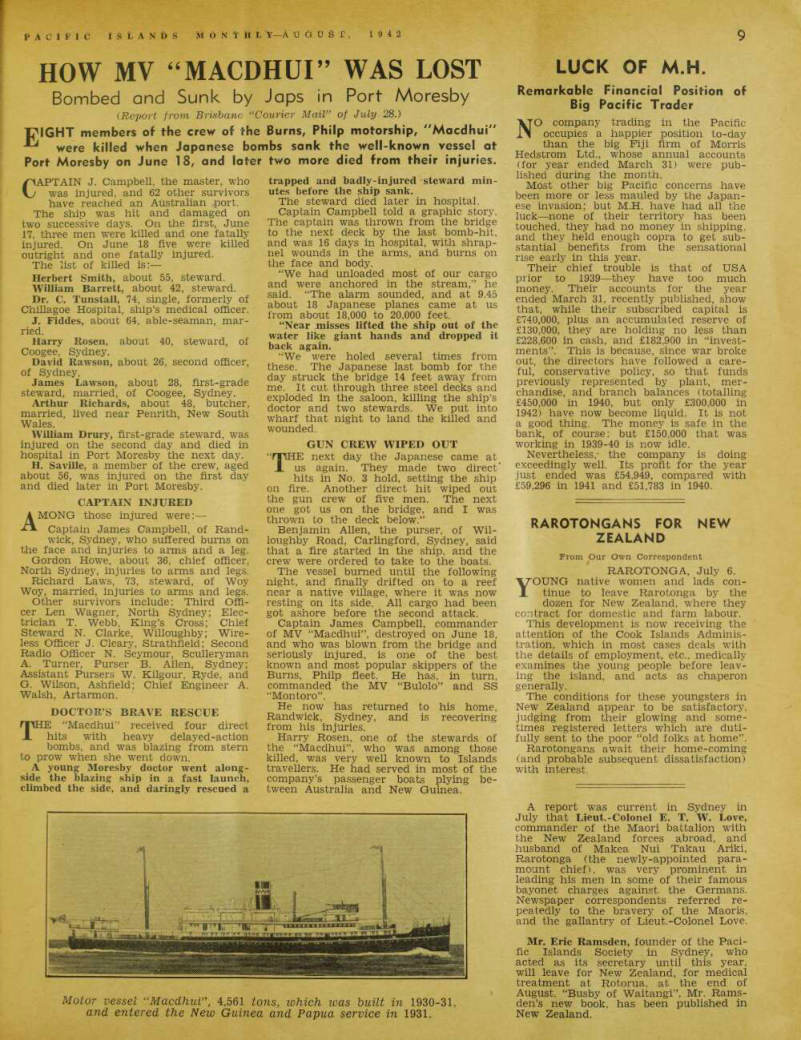
rpHE “Macdhui” received four direct A hits with heavy delayed-action bombs, and was blazing from stern to prow when she went down.
A young Moresby doctor went along side the blazing ship in a fast launch, climbed the side, and daringly rescued a
trapped and badly-injured steward min utes before the ship sank.
The steward died later in hospital.
Captain Campbell told a graphic story.
The captain was thrown from the bridge to the next deck by the last bomb-hit, and was 16 days in hospital, with shrap nel wounds in the arms, and burns on the face and body.
“We had unloaded most of our cargo and were anchored in the stream,” he said. “The alarm sounded, and at 9.45 about 18 Japanese planes came at us from about 18,000 to 20,000 feet.
“Near misses lifted the ship out of the water like giant hands and dropped it back again.
“We were holed several times from these. The Japanese last bomb for the day struck the bridge 14 feet away from me. It cut through three steel decks and exploded in the saloon, killing the ship’s doctor and two stewards. We put into wharf that night to land the killed and wounded.
Gun Crew Wiped Out
r'E next day the Japanese came at us again. They made two direct hits in No. 3 hold, setting the ship on fire. Another direct hit wiped out the gun crew of five men. The next one got us on the bridge, and I was thrown to the deck below.”
Benjamin Allen, the purser, of Wil loughby Road, Carlingford, Sydney, said that a fire started in the ship, and the crew were ordered to take to the boats.
The vessel burned until the following night, and finally drifted on to a reef near a native village, where it was now resting on its side. All cargo had been got ashore before the second attack.
Captain James Campbell, commander of MV “Macdhui”, destroyed on June 18, and who was blown from the bridge and seriously injured, is one of the best known and most popular skippers of the Burns, Philp fleet. He has, in turn, commanded the MV “Bulolo” and SS “Montoro”.
He now has returned to his home, Rand wick, Sydney, and is recovering from his injuries.
Harry Rosen, one of the stewards of the “Macdhui”, who was among those killed, was very well known to Islands travellers. He had served in most of the company’s passenger boats plying be tween Australia and New Guinea.
Motor vessel “Macdhui”, 4,561 tons, which was built in 1930-31, and entered the New Guinea and Papua service in 1931.