Battle Of The Solomons
Allies Now Engaged in Prolonged Offensive Operation
SYDNEY, Friday, August 14.
A GREAT battle for the possession of the Tulagi, or central, section of the British Solomon Islands, has been proceeding for a week between powerful American naval and air forces, supported by Australian naval and air forces, and Japanese naval, air and land forces.
rE battle began on Friday, August 7, in the form of an attack by the Allies, to regain possession of the Tulagi area, and it has gone on ever since.
In the beginning, it appears to have taken the form of attacks by the Allies upon bases established by the Japanese in and around Tulagi; but to-day (Aug ust 14) reports indicate that powerful Japanese naval forces have gone to the assistance of their Tulagi establishment, and that a naval battle of considerable importance is in progress.
A rough map of the Tulagi area is published on page 46. Reference to this will show that Tulagi is a little island that lies close to the southern shore of the bigger island of Gela (or Florida).
Gela lies between the very large islands of Guadalcanal and Malaita, The deep, sheltered, narrow waters which lie between Tulagi Island and Gela shore comprise the harbour of Tulagi, which the Japanese rapidly turned into a naval and seaplane base after they occupied Tulagi on May 4.
Furthermore, the Japanese, with frantic haste, apparently established strong points and anti-aircraft batteries all around Tulagi—on Tulagi itself, on the nearby islets of Gavutu and Tanamboga, on Makambo islet (in Tulagi harbour), and on the Gela shore. It is easy to imagine that, by August 7, they were in a position to offer a most formidable resistance.
Japanese also, during June and July, cleared an airfield on fairly flat country
on Guadalcanal —presumably, in the vicinity of Tulagi—but it is not yet dis closed to what extent they actually had constructed a base for land planes. Evi dently, they had already assembled some force, because there is a reference in the Allies’ first communique to “opposition by land-based planes and garrisons”.
Between their occupation of Rabaul, in January, and the occupation of Tulagi in May, the Japanese crept down the chain of the Solomon islands and ports (Buka, Bougainville, Faisi, Gizo, etc.) as if they were using a series of stepping-stones; and they must have made effective use of the time allowed them by our period of preparation to dig in very thoroughly, not only in the Tulagi area, but also in the northern Solomons.
The Allies will need all their armed strength, all their enterprise and cour age, and all their spiritual ability to take and stand up to hard blows, before they root out this enemy rats’ nest in the Solomons, and drive the Japs back to the New Guinea area.
The Allied offensive is on a large scale, and was carefully and secretly prepared, over many weeks. The meagre informa tion thus far received shows that Ameri can marines have landed and are hold ing positions on four islands—presum ably, Tulagi, Gela, Guadalcanal and Malaita; that the enemy resistance is bitter, stubborn and prolonged; and that the Allies up to Tuesday, August 11, had lost one cruiser sunk, and two cruisers, two destroyers and one transport dam aged.
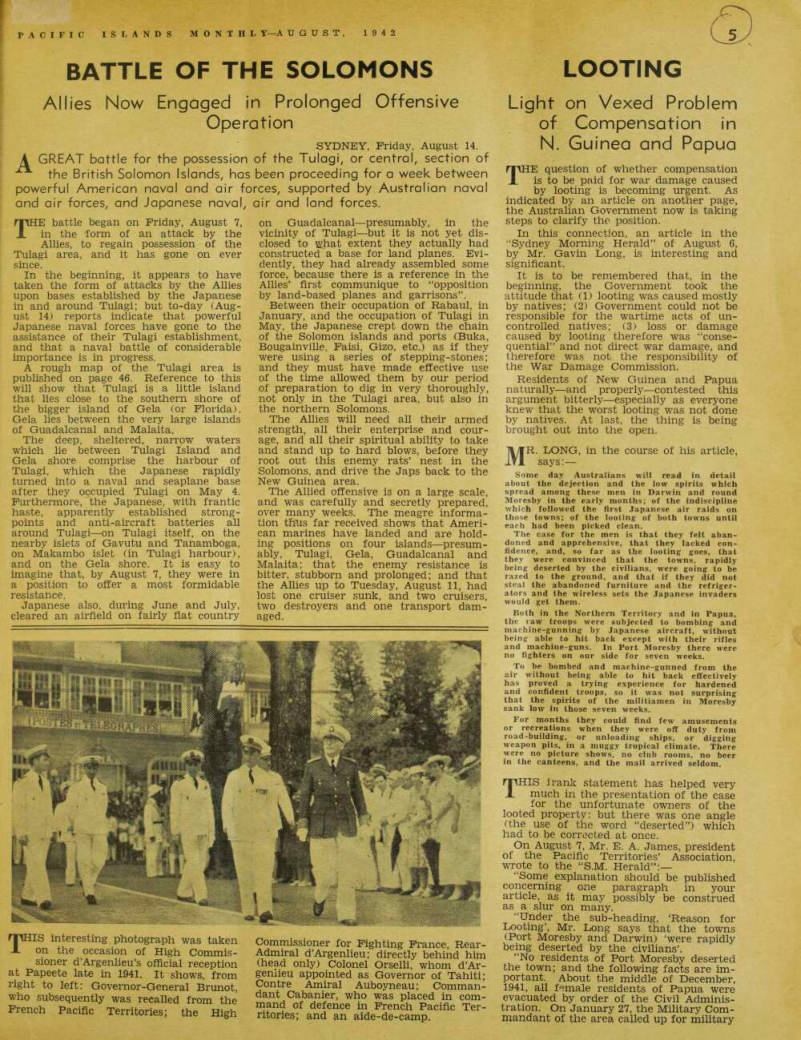
mHIS interesting photograph was taken X on the occasion of High Commissioner d’Argenlieu’s official reception at Papeete late in 1941. It shows, from right to left: Governor-General Brunot, who subsequently was recalled from the French Paciflo nrprrifn-Hoe* fvic rr - •frenen pacific Terntones, the High
Commissioner for Fighting Prance, Rear- Admiral d’Argenlieu; directly behind him (head only) Colonel Orselli, whom d’Ar genlieu appointed as Governor of Tahiti; Centre Amiral Auboyneau; Comman- S as p i a( * d S 1 com ' inand of defence in French Pacific Ter ritories; and an aide-de-camp.