Some Aspects Of The "Global War “
pp. 5-6 · Read in the full issue
THIS is a “global war”. We in the Pacific are affected just as much by what happens in the Caucasus, or the Atlantic, as by developments in the Solomons or the Aleutians. We have no separate national life: we of Fiji or New Zealand, of New Guinea or Australia, stand or fall with the United Nations.
Two events of the past month have profoundly modified the war situation and outlook. They are: The success of the Germans in driving through into the Caucasus area of Russia; and the success of the creeping Japanese in raising revolutionary elements in India against us.
These two things are part of the same Axis plan—the linking of the land-power of Germany and Japan across India and south-western Asia, An attack by Japan upon Russia’s is part of the same plan-it may come before this article is in type. If it does not , it is because the little gentlemen of Tokio are holding back to see wnat the naval and air forces of America are going to do next.
In many minds, the Axis successes in Russia and India present a dismal and depressing picture. that is understandable ; but it is nevertheless a fact that many minds cannot see beyond the ends of their own mental noses. The picture is not all gloomy.
In fact , it has some very cheering aspects.
THE Russians have been driven back and wost of all , their oil supplies have been gravely disorganised.
But they have not been broken. am mey nave not been broken,
Their enormous armies are intact; and even the mendacious Berlin radio has made no claims of great captures of men or booty. The Russians still are fighting strongly; behind them is still their vast new industrial areas in the Urals; it may be assumed that they have somewhere a precautionary store of at least one year’s oil. The Axis generals dare not carry on through the Caucasus, to their rendezvous with the Japanese, while an unbroken, belligerent Russia re mains on their flank.
The picture in India is similarly in complete. It is yet too soon to speak with certainty; but the signs indicate that the firm, strong, uncompromising attitude of the British Raj will keep India quiescent—for the present, at any rate—and allow the organisation of an adequate defence against the Japanese armies, now on the Burma frontier awaiting the end of the monsoonal season. The Japs had hoped to march into a country seeth ing with Fifth Column-ism and inter racial war. We now may hope that India will put up a resistance that at least will hold the Japanese.
We must never forget that there are in India nearly 400,000,000 people; that perhaps half of them are Hindus with an anti-British bias; that a quarter of them are Moslems, who hate the British less than they hate the Hindus; and that the other quarter are generally friendly to the British, and mostly under the control of various Indian princes. Unless some great power, such as Britain, holds this incredible, swarming mass
together, it would fall away into a dozen quarrelling, fighting, semi independent States, which would be at the mercy of any predatory people, such as the Japanese.
None can deny that, until the last couple of decades, Britain made little effort to train the Indians for complete self-government, and that the British carried on the commercial exploitation of India on the grand scale. But neither can it be denied that the British have maintained order and peace over this vast racial powder-magazine; that they have dealt out strict, even-handed justice; and that they have introduced a great measure of local self-government.
Britain is completely justified now in insisting that, for the present, India shall not open her flank to the thrusting power of Japan.
A now, the other side of the picture. Unless these Axis Powers can get a decision before the 1942 winter closes down upon them— and it is now less than 12 weeks away —they must lose this “global war”.
They cannot get a decision unless they can knock out Russia. If they knock out Russia, they will turn their enormous forces against the Anglo- American Alliance the Germans against Britain, the Japanese against the Americans, Even then, we need not be defeated; but it would be difficult to visualise, then, anything better than a nego tiated peace, with the world divided into two spheres, Anglo-American and Axis—an armed peace which would be merely the preliminary to another and more horrible Armageddon.
That is why many important people, representing the United Nations, now are gathered secretly in Moscow, talking with Joseph Stalin. Russia must be kept fighting. Whether there is to be a Second Front, or not, depends entirely upon world-wide factors of which we know little. In the wide sweep of “global war” strategy, we here in the South Pacific count little, We can only wait, and hope.
THE Battle of the Coral Sea, in the first week of May, marked the turn of the Japanese invasion tide.
They had come leap-frogging down through the countless islands of Indonesia and the Western Pacific; and then, poised in Timor, New Guinea and the Solomons, they prepared their final smashing blow at the British and Fighting French communities in the South Pacific—Australia, New Hebrides, New Caledonia, Fiji and New Zealand. But the Americans got here in time.
We do not yet know the full story; but it is now clear that two, and perhaps three, Japanese invasion forces began to move southwards from the New Guinea area, through the Louisiade archipelago (east of Papua) and through the Solomons; and the Americans trapped them very cleverly in the Solomons, and in the waters west of the Solomons, and inflicted upon them a stinging defeat.
We still have not been given full details, but we know that the
Japanese lost two or three aircraft carriers, a couple of warships, and four or five transports, while the Allies’ losses, apart from the aircraft carrier “Lexington”, were small, The Japanese thereupon withdrew their naval forces to the New Guinea area, and planned a more cautious campaign—the construction of ad vanced airfields, in north-eastern Papua, as near as possible to Port Moresby and North Queensland, and in Guadalcanal, in the Solomons, as near as possible to Fiji, Auckland, New Caledonia and Eastern Australia.
The idea, no doubt, was that they should creep southwards under cover of an “air umbrella” from these advanced airfields.
But they have encountered Ameri can and Australian resistance of a kind they never experienced in Indonesia (where we were unprepared and ill-equipped); and, even as this is being written, our land forces are attacking in the Kokoda district of Papua, and a great concentration of American naval and air forces, with some useful Australian units, is clean ing out the rats’ nest which the in vaders had established at Tulagi.
ALL our communiques speak of the strong, bitter resistance of the Japanese, especially in the Solomons area. This is to be expected. It is part of the enemy’s policy to inflict upon us, at this stage of our attack, heavy, discouraging losses.
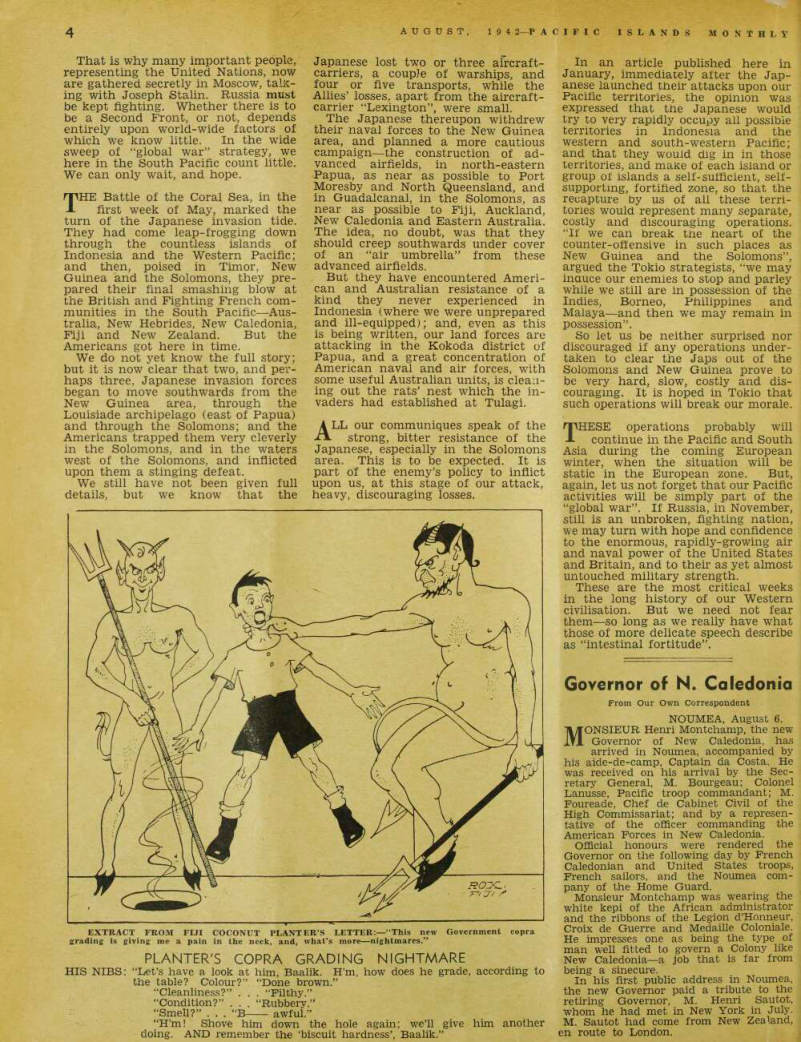
Planter's Copra Grading Nightmare
HIS NIBS: “Let’s have a look at him, Baalik. H’m, how does he grade, according to the table? Colour?” “Done brown.”
“Cleanliness?” . . . “Filthy.”
“Condition?” . . . “Rubbery.”
“Smell?” . . . “B awful.”
“H’m! Shove him down the hole again; we’ll give him another doing. AND remember the ‘biscuit hardness’, Baalik.”
In an article published here in January, immediately alter the Jap anese launched their attacks upon our Pacific territories, the opinion was expressed that the Japanese would try to very rapidly occupy all possible territories in Indonesia and the western and south-western Pacific; and that they would dig in in those territories, and make of each island or group of islands a self-sufficient, self supporting, fortified zone, so that the recapture by us of all these terri tories would represent many separate, costly and discouraging operations.
“If we can break the neart of the counter-offensive in such places as New Guinea and the Solomons”, argued the Tokio strategists, “we may induce our enemies to stop and parley while we still are in possession of the Indies, Borneo, Philippines and Malaya—and then we may remain in possession”.
So let us be neither surprised nor discouraged if any operations under taken to clear the Japs out of the Solomons and New Guinea prove to be very hard, slow, costly and dis couraging. It is hoped in Tokio that such operations will break our morale.
THESE operations probably will continue in the Pacific and South Asia during the coming European winter, when the situation will be static in the European zone. But, again, let us not forget that our Pacific activities will be simply part of the “global war”. If Russia, in November, still is an unbroken, fighting nation, we may turn with hope and confidence to the enormous, rapidly-growing air and naval power of the United States and Britain, and to their as yet almost untouched military strength.
These are the most critical weeks in the long history of our Western civilisation. But we need not fear them—so long as we really have what those of more delicate speech describe as “intestinal fortitude”.
EXTRACT FROM FIJI COCONUT PLANTER’S LETTER: —“This new Government copra grading is giving me a pain in the neck, and, what’s more—nightmares.” 4