Dance!
pp. 26-28 · Read in the full issue
On With The
Novel Features of Village Life in Melanesia
A South Seas missionary, writing in happier days before 1939, describes some novel features of Melanesian dancing.
IN most countries, dancing is a' very serious matter. Here in the South Seas its type varies according to outlook and culture; but sexes are not given the opportunity of looking into each other’s eyes to the plaintive rhymes of “blue” and “yeoo”, or “skies” and “eyes”—for, in most cases, sexes dance apart and in some places the songs they sing are simply words in some dialect or other strung together to a tune that suits a simple scale.
Probably it is for this reason—the fad that they use poems passed by word of
mouth from remote villages, where lan guages are completely different—that makes the local Papuan dances seem lacking in fire and vigour. One is coun selled to see Papuan dancing first, and, later, other Melanesian dancing, to really appreciate both.
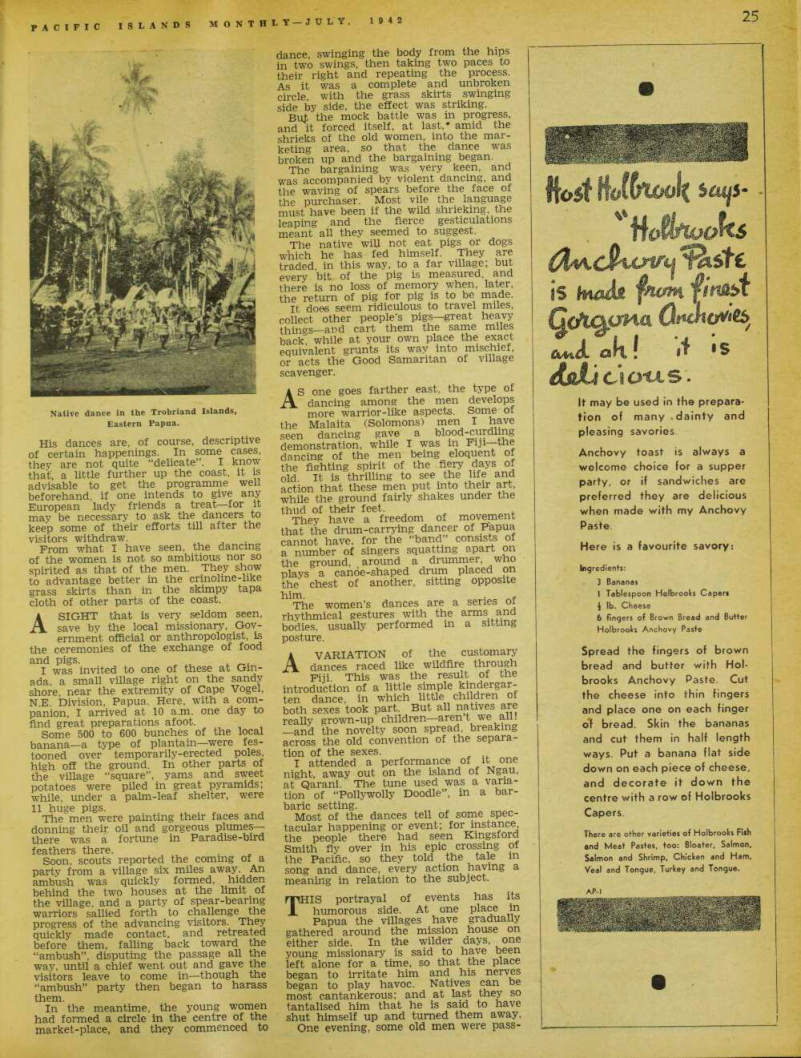
Here in Papua all the dancers sing, and each carries a tubular drum. He hasn’t heard of Tennyson’s “Brook”, but when he starts dancing there’s a feeling that he may go on for ever. But it ends when he is footsore, and muscle-bound from clearing a patch of grass as long as his “stamping ground” extends; when his feathers, at first splendid tossing plumes, seem to droop with him; when the oil from his body, mixed with per spiration, mingles with the red paint that once decorated (in wonderfully symmetrical lines) his charcoal-blackened face. He is fit, then, for “consolation”.
A Papuan decked for the dance.
His dances are, of course, descriptive of certain happenings. In some cases, they are not quite “delicate”. I know that, a little further up the coast, it is advisable to get the programme well beforehand, if one intends to give any European lady friends a treat —for it may be necessary to ask the dancers to keep some of their efforts till after the visitors withdraw.
From what I have seen, the dancing of the women is not so ambitious nor so spirited as that of the men. They show to advantage better in the crinoline-like grass skirts than in the skimpy tapa cloth of other parts of the coast.
A SIGHT that is very seldom seen, save by the local missionary, Gov ernment official or anthropologist, is the ceremonies of the exchange of food and pigs.
I was invited to one of these at Gm ada. a small village right on the sandy shore, near the extremity of Cape Vogel, N.E. Division, Papua. Here, with a com panion, I arrived at 10 a.m. one day to find great preparations afoot.
Some 500 to 600 bunches of the local banana—a type of plantain—were fes tooned over temporarily-erected poles, high off the ground. In other parts of the village “square”, yams and sweet potatoes were piled in great pyramids; while, under a palm-leaf shelter, were 11 huge pigs.
The men were painting their faces and donning their oil and gorgeous plumes there was a fortune in Paradise-bird feathers there.
Soon, scouts reported the coming of a party from a village six miles away. An ambush was quickly formed, hidden behind the two houses at the limit of the village, and a party of spear-bearmg warriors sallied forth to challenge the progress of the advancing visitors. They quickly made contact, and retreated before them, falling back toward the “ambush”, disputing the passage all the way, until a chief went out and gave the visitors leave to come in—though the “ambush” party then began to harass them.
In the meantime, the young women had formed a circle in the centre of the market-place, and they commenced to
dance, swinging the body from the hips in two swings, then taking two paces to their right and repeating the process.
As it was a complete and unbroken circle, with the grass skirts swinging side by side, the effect was striking.
But the mock battle was in progress, and it forced itself, at last,* amid the shrieks of the old women, into the mar keting area, so that the dance was broken up and the bargaining began.
The bargaining was very keen, and was accompanied by violent dancing, and the waving of spears before the face of the purchaser. Most vile the language must have been if the wild shrieking, the leaping and the fierce gesticulations meant all they seemed to suggest.
The native wiU not eat pigs or dogs which he has fed himself. They are traded, in this way, to a far village; but every bit of the pig is measured, and there is no loss of memory when, later, the return of pig for pig is to be made.
It does seem ridiculous to travel miles, collect other people’s pigs—great heavy things—and cart them the same miles back while at your own place the exact equivalent grunts its way into mischief, or acts the Good Samaritan of village scavenger.
AS one goes farther east, the type of dancing among the men develops more warrior-like aspects. Some of the Malaita (Solomons) men I have seen dancing gave a blood-curdling demonstration, while I was in Fiji—the dancing of the men being eloquent of the fighting spirit of the fiery days of old It is thrilling to see the life and action that these men put into their art, while the ground fairly shakes under the thud of their feet.
They have a freedom of movement that the drum-carrying dancer of Papua cannot have, for the “band” consists of a number of singers squatting apart on the ground, around a drummer, who plays a canoe-shaped drum placed on the chest of another, sitting opposite The women’s dances are a series of rhythmical gestures with the arms and bodies, usually performed in a sitting posture.
A VARIATION of the customary dances raced like wildfire through Fiji. This was the result of the introduction of a little simple kindergar ten dance, in which little children of both sexes took part. But all natives are really grown-up children —aren t we all. —and the novelty soon spread, breaking across the old convention of the separa tion of the sexes.
I attended a performance of it one night, away out on the island of Ngau, at Qarani. The tune used was a varia tion of “Pollywolly Doodle”, in a bar baric setting.
Most of the dances tell of some spec tacular happening or event; for instance the people there had seen Kmgsford Smith fly over in his epic crossing of the Pacific, so they told the tale in song and dance, every action haying a meaning in relation to the subject. rIS portrayal of events has its humorous side. At one place in Papua the villages have gradually gathered around the mission house on either side. In the wilder days, one young missionary is said to have been left alone for a time, so that the place began to irritate him and his nerves began to play havoc. Natives can be most cantankerous; and at last they so tantalised him that he is said to have shut himself up and turned them away.
One evening, some old men were pass
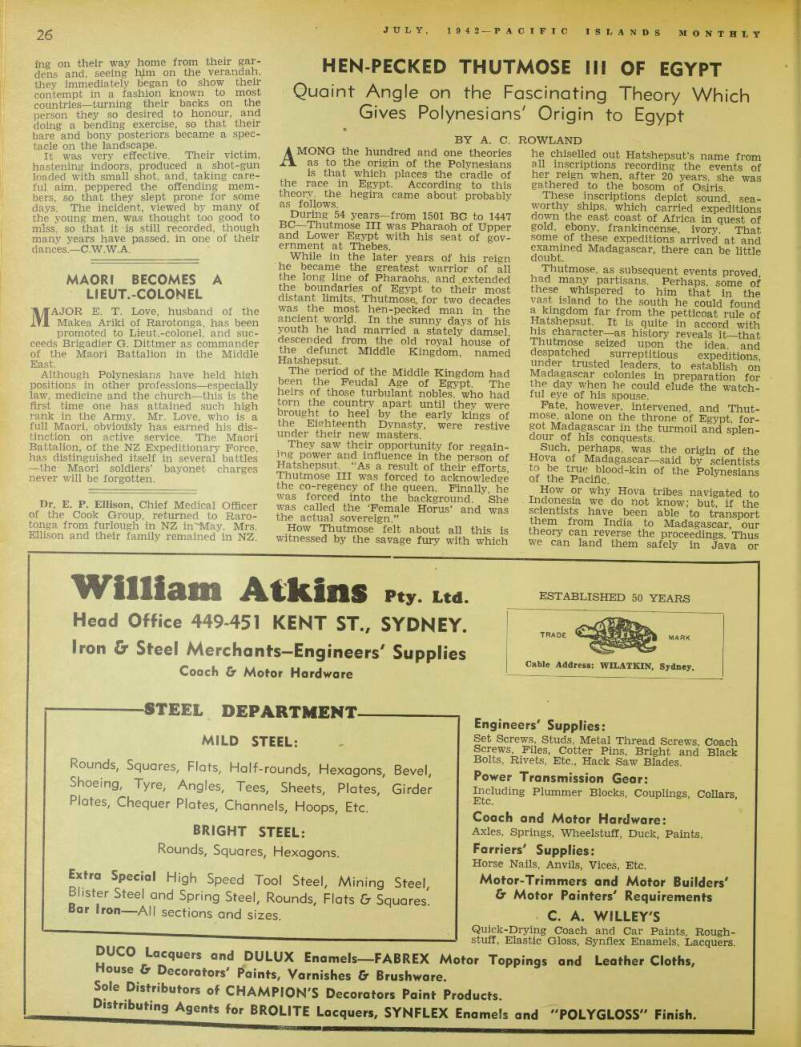
Native dance in the Trobriand Islands, Eastern Papua.
ing on their way home from their gar dens and, seeing him on the verandah, they immediately began to show their contempt in a fashion known to most countries —turning their backs on the person they so desired to honour, and doing a bending exercise, so that their bare and bony posteriors became a spec tacle on the landscape.
It was very effective. Their victim, hastening indoors, produced a shot-gun loaded with small shot, and, taking care ful aim, peppered the offending mem bers, so that they slept prone for some days. The incident, viewed by many of the young men, was thought too good to miss, so that it is still recorded, though many years have passed, in one of their
dances.-