One Gay Week
p. 24 · Read in the full issue
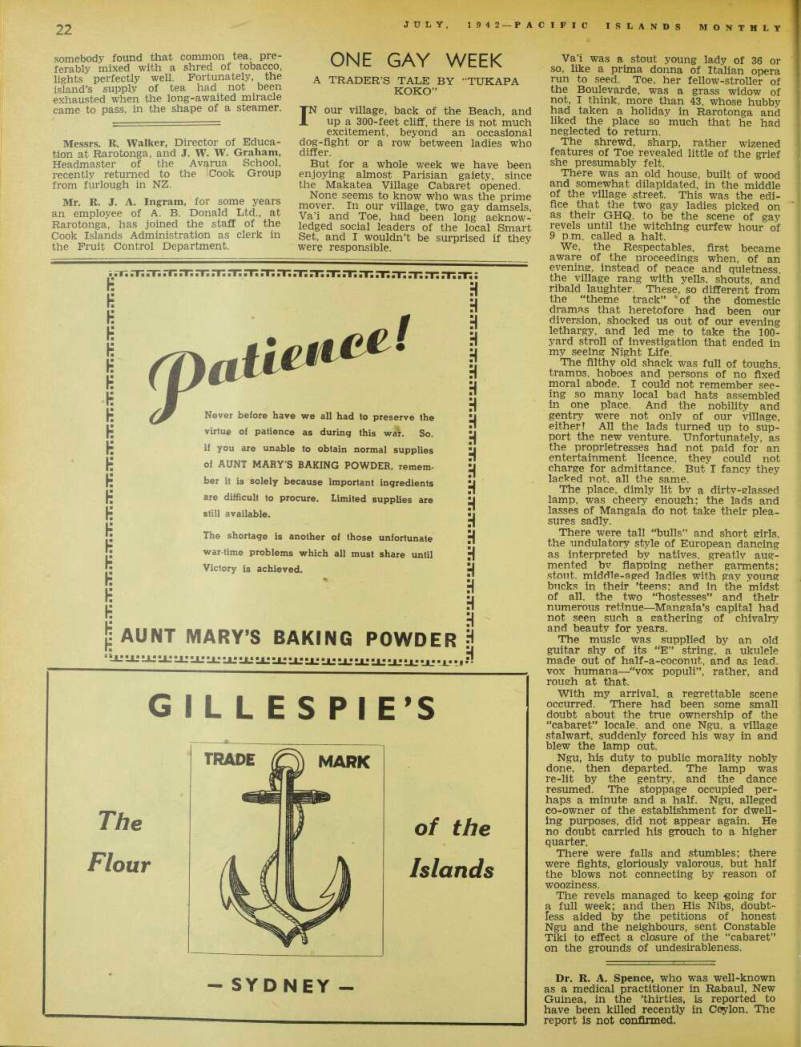
A Trader’S Tale By “Tukapa
Koko”
tn our village, back of the Beach, and A up a 300-feet cliff, there is not much excitement, beyond an occasional dog-fight or a row between ladies who diifer.
But for a whole week we have been enjoying almost Parisian gaiety, since the Makatea Village Cabaret opened.
None seems to kn °w who was the prime moV er. In our village, two gay damsels, V a’i and T oe, had been 1( f J acknow ledged social leaders of the local Smart Set, and I wouldn’t be surprised if they were responsible.
Va’i was a stout young lady of 36 or so, like a prima donna of Italian opera run to seed. Toe, her fellow-stroller of the Boulevarde, was a grass widow of not, I think, more than 43, whose hubby had taken a holiday in Rarotonga and liked the place so much that he had neglected to return.
The shrewd, sharp, rather wizened features of Toe revealed little of the grief she presumably felt.
There was an old house, built of wood and somewhat dilapidated, in the middle of the village street. This was the edi fice that the two gay ladies picked on as their GHQ. to be the scene of gay revels until the witching curfew hour of 9 p.m. called a halt.
We, the Respectables, first became aware of the proceedings when, of an evening, instead of peace and quietness, the village rang with yells, shouts, and ribald laughter. These, so different from the “theme track” of the domestic dramas that heretofore had been our diversion, shocked us out of our evening lethargy, and led me to take the 100yard stroll of investigation that ended in my seeing Night Life.
The filthy old shack was full of toughs, tramps, hoboes and persons of no fixed moral abode. I could not remember see ing so many local bad hats assembled in one place. And the nobility and gentry were not only of our village, either! All the lads turned up to sup port the new venture. Unfortunately, as the proprietresses had not paid for an entertainment licence, they could not charge for admittance. But I fancy they lacked not, all the same.
The place, dimly lit by a dirty-glassed lamp, was cheery enough; the lads and lasses of Mangaia do not take their plea sures sadly.
There were tall “bulls” and short girls, the undulatory style of European dancing as interpreted by natives, greatly aug mented bv flapping nether garments; stout, middle-aged ladies with gay young bucks in their ’teens; and in the midst of all. the two “hostesses” and their numerous retinue—Mangaia’s capital had not seen such a gathering of chivalry and beauty for years.
The music was supplied by an old guitar shy of its “E” string, a ukulele made out of half-a-coconut, and as lead, vox humana—“vox populi”, rather, and rough at that.
With my arrival, a regrettable scene occurred. There had been some small doubt about the true ownership of the “cabaret” locale, and one Ngu, a village stalwart, suddenly forced his way in and blew the lamp out.
Ngu, his duty to public morality nobly done, then departed. The lamp was re-lit by the gentry, and the dance resumed. The stoppage occupied per haps a minute and a half. Ngu, alleged co-owner of the establishment for dwell ing purposes, did not appear again. He no doubt carried his grouch to a higher quarter.
There were falls and stumbles; there were fights, gloriously valorous, but half the blows not connecting by reason of wooziness.
The revels managed to keep -going for a full week; and then His Nibs, doubt less aided by the petitions of honest Ngu and the neighbours, sent Constable Tiki to effect a closure of the “cabaret” on the grounds of undesirableness.
Dr. R. A. Spence, who was well-known as a medical practitioner in Rabaul, New Guinea, in the ’thirties, is reported to have been killed recently in Ceylon. The report is not confirmed.