Territories Plantations
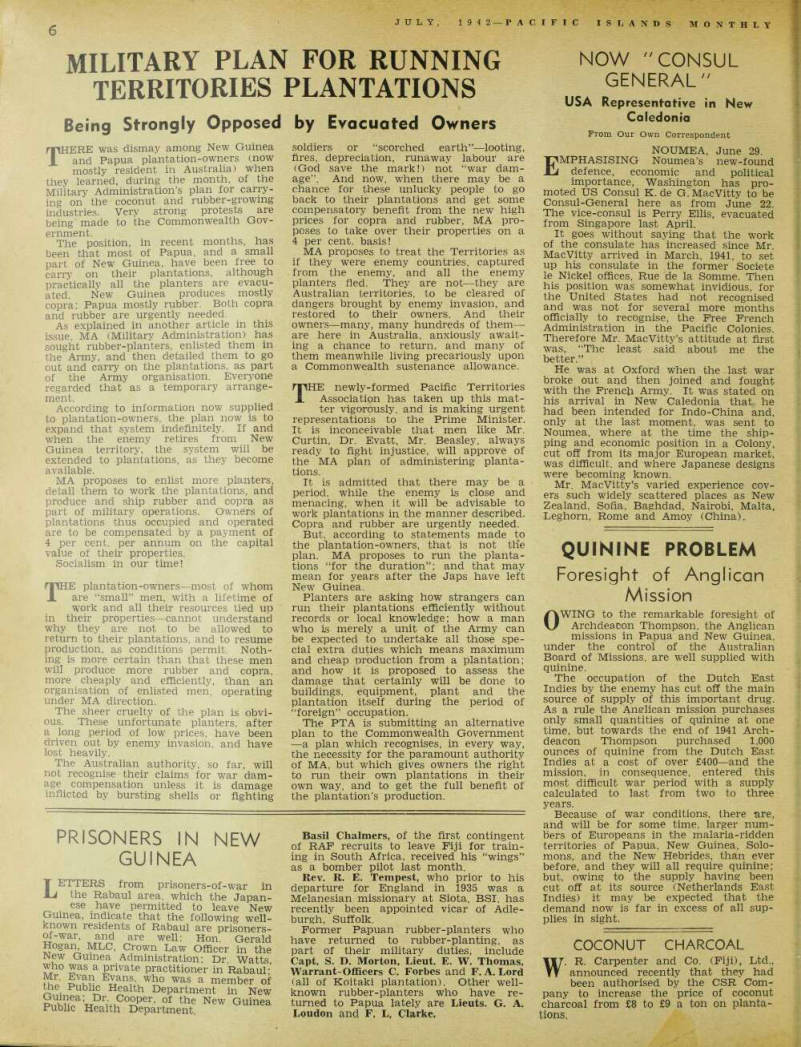
Military Plan For Running
Being Strongly Opposed by Evacuated Owners
rERE was dismay among New Guinea and Papua plantation-owners (now mostly resident in Australia) when they learned, during the month, of the Military Administration’s plan for carry ing on the coconut and rubber-growing industries. Very strong protests are being made to the Commonwealth Gov ernment.
The position, in recent months, has been that most of Papua, and a small part of New Guinea, have been free to carry on their plantations, although practically all the planters are evacu ated. New Guinea produces mostly copra; Papua mostly rubber. Both copra and rubber are urgently needed.
As explained in another article in this issue, MA (Military Administration) has sought rubber-planters, enlisted them in the Army, and then detailed them to go out and carry on the plantations, as part of the Army organisation. Everyone regarded that as a temporary arrange ment.
According to information now supplied to plantation-owners, the plan now is to expand that system indefinitely. If and when the enemy retires from New Guinea territory, the system will be extended to plantations, as they become available.
MA proposes to enlist more planters, detail them to work the plantations, and produce and ship rubber and copra as part of military operations. Owners of plantations thus occupied and operated are to be compensated by a payment of 4 per cent, per annum on the capital value of their properties.
Socialism in our time! rpHE plantation-owners—most of whom JL are “small” men, with a lifetime of work and all their resources tied up in their properties—cannot understand why they are not to be allowed to return to their plantations, and to resume production, as conditions permit. Noth ing is more certain than that these men will produce more rubber and copra, more cheaply and efficiently, than an organisation of enlisted men, operating under MA direction.
The sheer cruelty of the plan is obvi ous. These unfortunate planters, after a long period of low prices, have been driven out by enemy invasion, and have lost heavily.
The Australian authority, so far, will not recognise their claims for war dam age compensation unless it is damage inflicted by bursting shells or fighting
soldiers or “scorched earth”—looting, fires, depreciation, runaway labour are (God save the mark!) not “war dam age”. And now, when there may be a chance for these unlucky people to go back to their plantations and get some compensatory benefit from the new high prices for copra and rubber, MA pro poses to take over their properties on a 4 per cent, basis!
MA proposes to treat the Territories as if they were enemy countries, captured from the enemy, and all the enemy planters fled. They are not—they are Australian territories, to be cleared of dangers brought by enemy invasion, and restored to their owners. And their owners—many, many hundreds of them — are here in Australia, anxiously await ing a chance to return, and many of them meanwhile living precariously upon a Commonwealth sustenance allowance.
THE newly-formed Pacific Territories Association has taken up this mat ter vigorously, and is making urgent representations to the Prime Minister.
It is inconceivable that men like Mr.
Curtin, Dr. Evatt, Mr. Beasley, always ready to fight injustice, will approve of the MA plan of administering planta tions.
It is admitted that there may be a period, while the enemy is close and menacing, when it will be advisable to work plantations in the manner described.
Copra and rubber are urgently needed.
But, according to statements made to the plantation-owners, that is not tlie plan. MA proposes to run the planta tions “for the duration”; and that may mean for years after the Japs have left New Guinea.
Planters are asking how strangers can run their plantations efficiently without records or local knowledge: how a man who is merely a unit of the Army can be expected to undertake all those spe cial extra duties which means maximum and cheap production from a plantation; and how it is proposed to assess the damage that certainly will be done to buildings, equipment, plant and the plantation itself during the period of “foreign” occupation.
The PTA is submitting an alternative plan to the Commonwealth Government —a plan which recognises, in every way, the necessity for the paramount authority of MA, but which gives owners the right to run their own plantations in their own way, and to get the full benefit of the plantation’s production.