Easter Island Mysteries
pp. 33-34 · Read in the full issue
Attacks on an Indecipherable Script
RIGHT up until the outbreak of war, scientists were squabbling amiably about the mysteries of Easter Island; and, as scientists do not cease to inter change opinions, although their countries may be fighting, it is to be supposed that the arguments still are going on.
In the collection of material which we have before us, we note the following:— An article by Senor Imbelloni, of the Argentine Museum of Natural History, published in the 1939 Journal of the Polynesian Society (New Zealand), where-
in he, referring to an argument between certain French savants (MM. Metraux and de Hevesy), directed attention to certain remarkable resemblances between the script of the wooden tablets found on Easter Island, and the inscriptions on seals dug up in the Indus region of India in the late twenties.
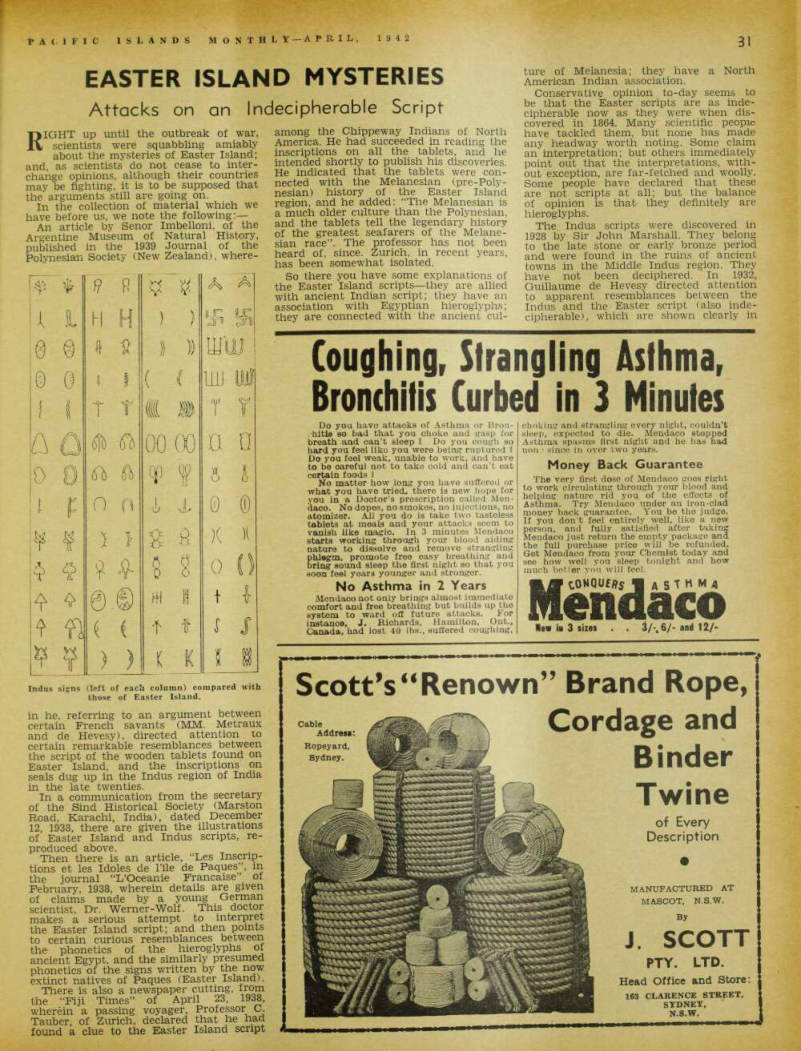
In a communication from the secretary of the Sind Historical Society (Marston Road, Karachi, India), dated December 12, 1938, there are given the illustrations of Easter Island and Indus scripts, re produced above.
Then there is an article, “Les Inscrip tions et les Idoles de Tile de Paques”, m the journal “L’Oceanie Francaise” of February, 1938, wherein details are given of claims made by a young German scientist, Dr. Werner-Wolf. This doctor makes a serious attempt to interpret the Easter Island script; and then points to certain curious resemblances between the phonetics of the hieroglyphs of ancient Egypt, and the similarly presumed phonetics of the signs written by the now extinct natives of Paques (Easter Island).
There is also a newspaper cutting, from the “Fiji Times” of April 23, 1938, wherein a passing voyager, Professor C.
Tauber, of Zurich, declared that he had found a clue to the Easter Island script
among the Chippeway Indians of North America. He had succeeded in reading the inscriptions on all the tablets, and he intended shortly to publish his discoveries.
He indicated that the tablets were con nected with the Melanesian (pre-Poly nesian) history of the Easter Island region, and he added: “The Melanesian is a much older culture than the Polynesian, and the tablets tell the legendary history of the greatest seafarers of the Melane sian race”. The professor has not been heard of, since. Zurich, in recent years, has been somewhat isolated.
So there you have some explanations of the Easter Island scripts—they are allied with ancient Indian script; they have an association with Egyptian hieroglyphs; they are connected with the ancient cul
ture of Melanesia; they have a North American Indian association.
Conservative opinion to-day seems to be that the Easter scripts are as inde cipherable now as they were when dis covered in 1864. Many scientific people have tackled them, but none has made any headway worth noting. Some claim an interpretation; but others immediately point out that the interpretations, with out exception, are far-fetched and woolly.
Some people have declared that these are not scripts at all; but the balance of opinion is that they definitely are hieroglyphs.
The Indus scripts were discovered in 1928 by Sir John Marshall. They belong to the late stone or early bronze period and were found in the ruins of ancient towns in the Middle Indus region. They have not been deciphered. In 1932, Guillaume de Hevesy directed attention to apparent resemblances between the Indus and the Easter script (also inde cipherable), which are shown clearly in
Indus signs (left of each column) compared with those of Easter Island.
the accompanying illustration. In fact, the resemblance seemed too marked to be true, and another French savant, Dr.
Alfred Metraux, suggested that de Hevesy, moved by his enthusiasm, “sligntly modi fied the original symbols and accentuated similitudes”.
The controversy extended over years, and the subsequent evidence included a statement by Professor G. R. Hunter that he had carefully examined the two lists of symbols, and that de Hevesy had re produced them “with scrupulous and indeed remarkable exactitude”.
It is worth noting, here, that Senor Imbelloni apparently subscribes to the theory of ancient Melanesian populations in the regions which now comprise Polynesia.
Dr. Werner-Wolf rejects the autoch thone hypothesis (that the mysterious culture of Easter Island originated there), and proceeds to search for its affinities — a search that has been going on ever
!^ C 0 j' he masses of statues were dis seripq6dnfln n\ 122, and the scri P t (on a u f • 2 -° wo oden tablets) by the french missionary-priest Cyraud in 1864. dl( ? n °t a ttempt to decipher the tablets; but in 1868, M. Jaussen, of Tahiti, found an old Easter Islander who declared TQnc C c oUld gl Y e ? general interpretation.
Jaussen made long lists of the hiero glyphs, and put opposite each, in the Easter, the interpretation given by the old native. Jaussen decided, eventually, that the interpretations were not sound, and ceased his investigation.
Fortunately his lists were not destroyed: and now Dr. Werner-Wolf. in the light blwi e i at S r £ n o wle dge, finds these lists helpfu! He believes that the initial sylla bles of the words represented by the glyphs form the names of the dead chiefs whom the ancient writers set out to commemorate. From that point, he finds certain affiliations with Egyptian hiero glyphs. It is a fascinating theory—even if far-fetched.